
The Bus Ticket My Father Never Used
Sometimes, the things we don’t say leave the loudest echoes

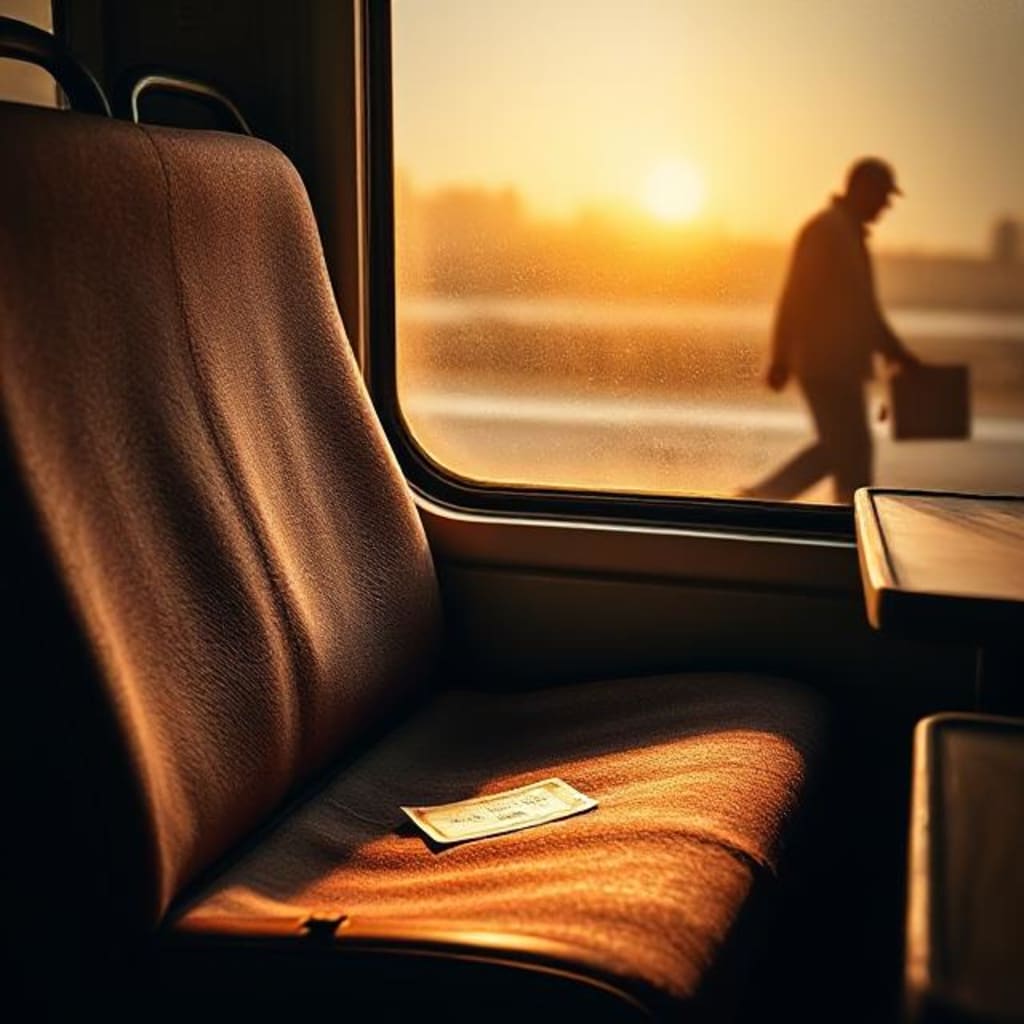
I was seventeen 17 the day my father bought a one-way bus ticket.
He never used it.
He left it sitting silently on the kitchen counter, right next to a cup of chai that had already gone cold. I remember staring at that ticket—creased slightly at the edges, but still crisp. The destination printed on it was his hometown, hundreds of miles away. A place he hadn’t visited in nearly a decade. A place he talked about only when his voice softened, and his eyes drifted off like he was somewhere else.

He used to say, “Someday I’ll go back. Just for a little while. Just to breathe.”
But he never went.
My father wasn’t the kind of man you noticed first when he entered a room. He wasn’t loud. He didn’t command attention. He was quiet in a way that made you forget he was tired, hurting, or human.

He worked at a local auto shop from early morning till late night, coming home with grease-stained hands and shoulders slumped from the weight of a life he never complained about. He didn’t talk much about his feelings. Not because he didn’t have them—but because somewhere along the way, he learned that men like him weren’t allowed to feel.
He was a provider. A fixer. A man made of patience and calloused skin.

We weren’t poor, but money was always tight. I remember sometimes watching him skip dinner, saying he wasn’t hungry, just so we could eat a little more. And yet, I never saw him treat himself. No vacations. No hobbies. No real breaks.
Just work, sacrifice, and silence.
The night he bought the ticket, we had argued.
Over something so small I can’t even remember what it was now—probably me being ungrateful about a phone or wanting to go out late. I told him he didn’t understand me. That I wanted to leave “this boring, broken life” the second I turned eighteen.

He just looked at me.
Not with anger—but with something worse: understanding.
He nodded once, then quietly walked to his room.
That was the last full conversation we had for weeks.
The next morning, he was gone. Not missing, not running away—he went to work like always. But something in him was… different.
He moved slower. Talked even less. He seemed distracted, far away, like part of him had already left.
Then I found the ticket. Still unused. Hidden in a drawer under old receipts and broken pens.
It was valid for the week prior.
He had planned to go.
But he stayed.
At first, I didn’t understand why that crushed me.
But then I realized: That ticket was his cry for help. A final whisper that said, “I can’t carry this much longer.” But he didn’t board the bus. He didn’t escape. He stayed in the very life that was slowly breaking him.
For us.
Because that’s what some people do. They stay. Even when it costs them everything.
Years passed. I grew up. Got a job. Paid bills. Felt the weight of adulthood wrap around my own shoulders. Some nights, I’d come home and stare at my own reflection—too tired to talk, too numb to cry.
And I started to understand him in ways I never could as a child.
There’s a kind of exhaustion that doesn’t come from work—it comes from feeling responsible for everyone else’s happiness while denying yourself your own.

That’s the life my father lived.
Now I carry that ticket in my wallet. Not as a keepsake, but as a reminder.
A reminder that people you love can be right next to you and drowning silently.
That strength isn’t always loud. Sometimes it looks like dirty fingernails, unopened dreams, and a man sitting quietly on the rooftop with too much on his mind and no one to share it with.
Sometimes I wonder what would’ve happened if he had taken that trip. Would he have come back refreshed? Would he have stayed away? Would he have finally been free?

But then I think maybe, just maybe—he found peace knowing he was needed.
Even if we never told him how much.
I never got the chance to thank him. To say, “I’m sorry I didn’t understand.” But I hope he knows now.
If there’s one thing life has taught me, it’s this:
The strongest people in our lives are often the ones who need the most love — but ask for it the least.
So if you still have your father… or your mother… or anyone silently giving up pieces of themselves for you — look them in the eyes today and say, “I see you.”
Because sometimes the greatest tragedies aren’t the things that happen — but the things we never say in time.
Not all heroes wear capes. Some just keep living for everyone else — and never use the ticket that could’ve saved them.
About the Creator
Keep reading
More stories from Junaid Khan and writers in Motivation and other communities.
The Habit That Gave Me Back My Confidence
For a long time, I felt invisible. Not the kind of invisible where people literally can’t see you, but the kind where you slowly begin to believe that your voice doesn’t matter. In conversations, I spoke less. In meetings, I stayed quiet. Even when I had ideas, I kept them to myself because I thought someone else probably had a better one.
By Dadullah Danish5 days ago in Motivation
Entrepreneur Terry Croteau -Begins New Chapter in Landscaping and Outdoor Living
Ontario, Canada — Entrepreneur Terry Croteau is beginning a new phase in his professional life, focusing on landscaping, outdoor living spaces, and a lifestyle that values both nature and personal well-being. The shift reflects a practical step forward for Croteau, combining hands-on outdoor work with a growing interest in wellness and community connection.
By Variety Press2 days ago in Motivation



Comments
There are no comments for this story
Be the first to respond and start the conversation.