
The Bench by the Road
Sometimes the smallest conversations leave the deepest marks.

It was a Sunday afternoon when I saw him again—sitting on the same old bench near the bus stop, beneath the shade of a neem tree. He looked older, thinner, but that gentle curve in his smile hadn’t changed.
I hadn’t seen Baba Yaqoob in nearly seven years. Back then, I was a teenager who used to walk that road every day to college. He was always there—on that same bench—with his walking stick, worn-out slippers, and a pocket radio playing faint ghazals.
He never asked for money. Never stopped anyone. But everyone knew him. Some called him "Pagal Baba," others "Radio Baba." For me, he was just Yaqoob Baba—the man who used to nod at me every day and sometimes say, "Padh likh ke kuch ban ja, beta."
The first time we actually spoke, I was in a terrible mood. I had failed a math test. Angry and tired, I sat on the bench next to him. I didn’t expect him to speak, but he did.
"Sab kuch theek ho jaata hai, jab dil saaf ho aur niyat sachi," he said without even looking at me.
I looked at him, surprised. I hadn’t told anyone anything. But somehow, he knew.
That became a habit. Every few days, I’d sit beside him. He would tell me little things. Not long stories, just small pieces of his life—how he once worked in a post office, how he lost his wife early, and how his only son left one day and never came back.
"Zindagi rukti nahi kisi ke liye," he’d say, smiling.
Then, suddenly, he disappeared.
I asked around. The fruit vendor said he hadn’t seen him. The tea seller said he might have gone to live with relatives. But nobody really knew. And slowly, life moved on.
I graduated. Got a job. Moved to a bigger city. But every time I visited my hometown, I glanced at that bench—always empty.
Until today.
I walked slowly toward him, heart pounding strangely, like I was meeting a forgotten part of myself.
“Baba…?”
He turned his head. His eyes were weaker, but he recognized me.
“You came back,” he smiled.
I sat beside him, just like old times. He didn’t ask where I had been. Didn’t ask what I did. Just sat there, smiling, as if nothing had changed.
I offered him tea from the nearby stall. He took a sip and said, “You look tired.”
I nodded. I was tired. Tired of deadlines, fake friendships, and the noise of city life. Tired of pretending everything was fine.
We didn’t talk much. Just sat.
Then he said, “You know, this bench… it listens. It remembers more than people do. All the tears, laughter, silence… it keeps it all.”
That sentence hit me harder than I expected.
He then reached into his kurta pocket and took out a folded piece of paper. “I wrote this when I thought I was dying,” he chuckled. “But I’m still here. I want you to keep it.”
I hesitated, then accepted it.
When I got home, I opened the paper.
It said:
> If you ever feel lost, come sit by the road. Not to escape the world, but to remember who you are without it.
— Baba Yaqoob
Tears filled my eyes. Not from sadness, but from the deep truth in his words.
The next time I visited the city, the bench was empty again. And it has remained that way since.
But now, I don’t walk past it. I sit there. Even if for five minutes. I let the world slow down. I breathe. I remember a man who had lost everything, yet gave wisdom for free. A man whose presence was small but whose impact was endless.
About the Creator
Keep reading
More stories from Asad zaman and writers in Motivation and other communities.
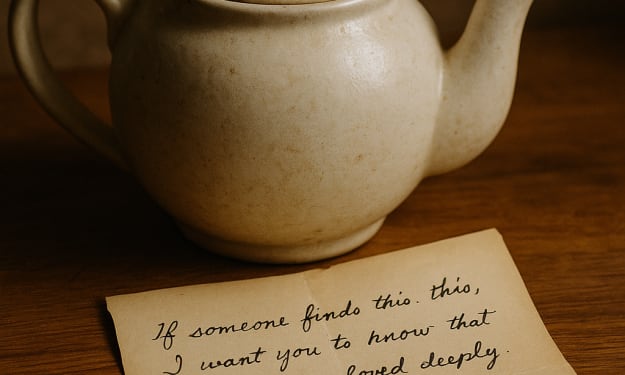
The Letter in the Teapot
I wasn’t expecting to find anything meaningful that afternoon. I was only helping my aunt clean out the old house after my grandmother passed away. The walls still smelled faintly of her jasmine perfume, and every corner felt like it had frozen in time. Nothing had moved since she left us.
By Asad zaman 6 months ago in Families
Looking back: 2025 was a beast
It's difficult to know how to start this. I've suggested that it's been a tough one from my title and in many ways, it has; however, there is an argument that it's not been that extraordinary at all, merely this wonderful thing we call "life" with all its climaxes and pitfalls.
By Rachel Deeming29 days ago in Motivation
I Didn’t Burn Out From Working Too Hard — I Burned Out From Caring Too Much
I didn't burn out from working too hard. Nah, the real reason I got burned out was caring too much. "I always thought burnout was about working too much, but it's actually way more nuanced." "Working for extended periods." Deadlines, ugh. Always on the go. Nah. That wasn't me, for real. I actually didn’t burn out from work itself. I just ran out of steam trying to care anymore. I just cared too much, you know? It all comes down to doing things right. It's tough when you really don't want to let folks down. Being the strong one means you're always there for everyone else, never really showing your own struggles. You just deal with stuff without making a big deal out of it. It felt pretty cool at first. Folks counted on me. They really put their trust in me. They needed me. I liked that. I just really enjoyed feeling important. Needed. Useful. But over time, caring slowly started to feel more like carrying a burden. I really felt the weight of everyone else's stress on my shoulders. Other people's expectations feel a bit like carrying baggage that isn't yours. Other people's problems. And I never stopped to check myself. I was really tired when I agreed to that. I showed up empty-handed. I really just ignored all the signs because I didn't want to upset anyone. I figured that made me tough. It didn't. The burnout didn't hit like a bomb. It just kind of snuck in. Quiet. It's really slow. You know that feeling when you wake up, and you're just... wiped? Like you haven't slept at all, even though you just spent hours in bed. It's a bummer, really, to start the day already feeling completely drained. Ugh, it's those tiny annoying things that just get under your skin, right? Things I really liked: It just didn't hit the same way, you know? Some days, even brushing my teeth felt like a huge effort. My least favorite part was probably the constant feeling of needing to be ready for anything. It’s hard to just relax when you’re always anticipating the next challenge. No one could see it. My life looked good. That's the main idea. Normal. "Inside?" Empty. I'm not sad. Not angry. Just done. That's the sort of emptiness you feel when you pour all your energy into everyone else and leave nothing for yourself. Being there for everyone else, always, but never really for yourself. Then someone hit me with a question I couldn’t dodge: When was the last time you did something just for you? And in that moment, when the unexpected happened, I just froze. I just couldn't recall. That really caught me off guard. I realized I only made room for others, never for me. I used to think that being selfless meant I was strong. "Rest = lazy" is definitely not true. "Boundaries = failure." I just kept going. Never paused. Didn't check in. Burnout doesn't really announce itself, does it? It whispered. "I just don't care about the stuff I used to anymore." Not 'cause I didn't wanna. I just didn't have anything left to give, you know? That really startled me. So I started doing something weird. It was uncomfortable. That really freaked me out. I just started saying no. Quiet. Not rude, just straightforward. Just being honest. No. I'm not able at this moment. No. I really need a break. No. I don't have it today. It just felt bad from the start. It felt like I was blowing some test I didn't even know I was taking. "Everyone would just think I was weak." But the world didn’t fall apart that day. Folks got used to it. A few of them understood. Some just didn't get it. And you know what? That was fine. I figured out that being caring doesn't mean you have to destroy yourself in the process. It's about knowing your limits. It's really about valuing yourself. You can be kind without getting drained. It’s possible to support others without sacrificing your own well-being. It's totally possible to care deeply about things without letting it drain all your energy. Burnout really showed me something important: You know, rest isn't something you have to earn. It's not a prize for working hard. It's okay to slow down; nobody needs your permission. It's totally okay to not give everyone all of yourself. When that heavy feeling creeps in, it can make everything feel a bit much. I paused. I'm here. I asked: “I wonder if I have enough energy for this.” It's like, when you give too much of yourself, and totally forget your own needs, that's not healthy. That's not strength. You know, that really sounds like self-neglect. I'm not going to mix those up anymore. It's true, we often put others first and forget about ourselves. Remember, you deserve care and attention too.
By Beshoy Zayer2 days ago in Motivation


Comments
There are no comments for this story
Be the first to respond and start the conversation.