
Sculpture of Bones
A haunting discovery reveals how memory, loss, and love can be carved into the most unexpected forms

I used to think bones were just silent things, hidden under the surface, holding us up without asking for recognition. But when I stood in front of my grandfather’s old workshop, staring at what he left behind, I realized bones could tell stories.
My grandfather was a carpenter, a man whose hands knew wood better than they knew softness. He built tables, chairs, cabinets—things meant to last a lifetime. But tucked away in the corner of his dusty shed was something different, something no one in the family knew about until he was gone.
It was a sculpture.
Not of wood, but of bones.
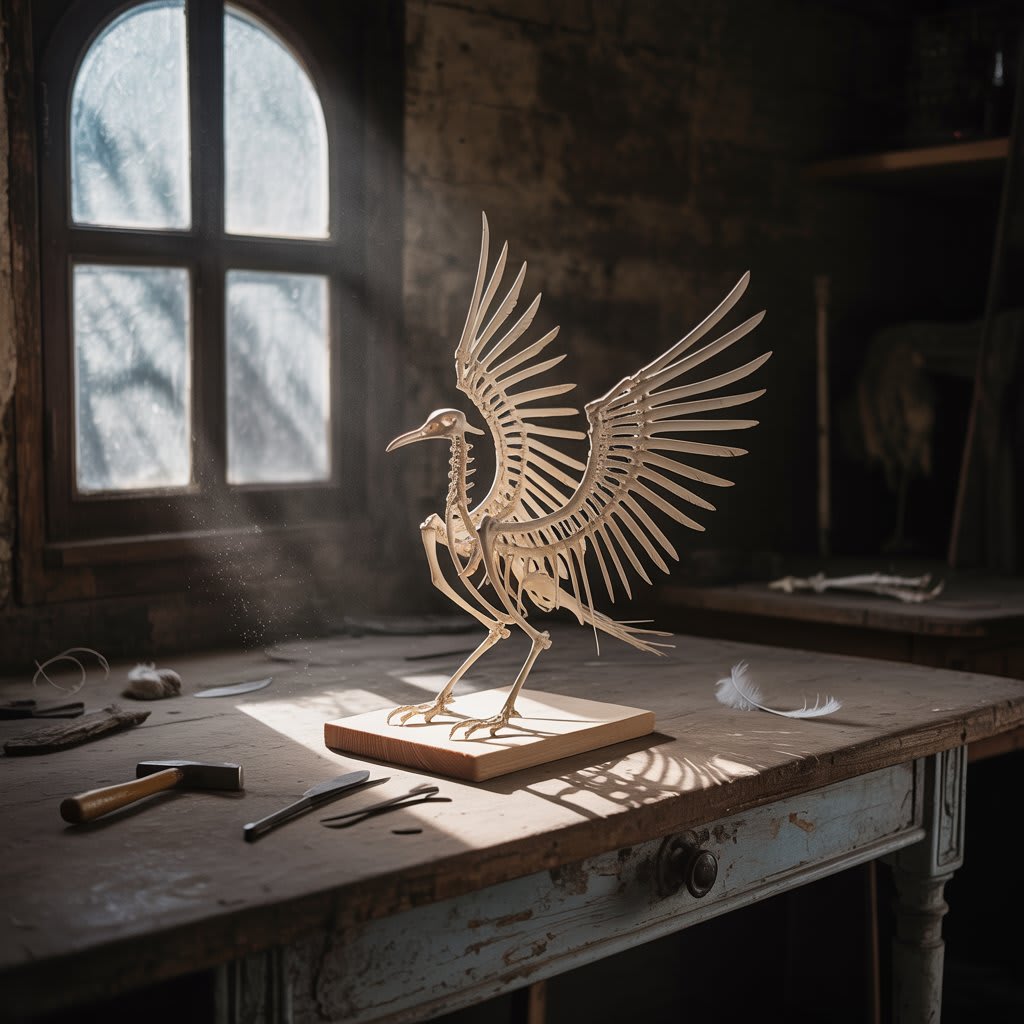
At first, I thought it was some kind of dark art project. The bones were arranged carefully, almost delicately, shaped into the figure of a bird mid-flight. Its wings stretched wide, ribs overlapping like feathers. Skulls formed the base, holding it steady, while vertebrae curved like an arched back. It was haunting, but beautiful.
I couldn’t stop staring. The detail was impossible to ignore. Whoever built it—whoever he became in his private hours—wasn’t trying to scare anyone. He was trying to say something.
For weeks, I avoided the workshop. The sculpture sat there, silent and still, but it filled the air with questions. Where did the bones come from? Why did he make it? Why did a man who built cribs for babies and tables for Sunday dinners spend his quiet hours piecing together something so strange, so fragile?
One evening, I finally found the courage to pull out his old notebooks. They were covered in sawdust, the pages yellowed and fragile. In his careful handwriting, I discovered the answer.
The bones weren’t human. They were collected from the fields around his childhood home—cows, goats, chickens, even a fox. He wrote about walking the land as a boy, finding bones bleached under the sun, carrying them home in his pockets. He wasn’t afraid of death; he was fascinated by what it left behind.
The sculpture, I realized, wasn’t about death at all. It was about memory. He called it "The Bird That Carries Us." In his notes, he wrote: "Bones are what remain when the flesh is gone. They are proof that we were here. And if I can shape them into something that looks like flight, maybe it means nothing ever truly stays buried."
Suddenly, the sculpture didn’t look eerie anymore. It looked like a story—a reminder that even the most fragile remnants could be shaped into something strong, something that carried meaning.
I brought my mother to the workshop a few days later. At first, she couldn’t look at it. "It’s morbid," she whispered. But when I showed her his words, when she read the line about memory and flight, her eyes softened. She reached out, brushing her hand over the delicate curve of the wing, and for the first time in months, she smiled.
The sculpture of bones became part of our family, not hidden in the shed but displayed in the living room. Visitors didn’t always understand it. Some found it unsettling, others were moved. But for us, it was a bridge—between what we lost and what we still carried forward.
I think about my grandfather often when I see it. The way he lived, the way he built things to last. And I realize now that bones, like wood, tell stories. They are the frame of a life, the quiet evidence that we walked this earth.
And in the end, that sculpture of bones wasn’t about death at all. It was about love. It was about the human need to leave something behind, to turn silence into a story, to shape what is broken into something that looks like flight.
About the Creator
LUNA EDITH
Writer, storyteller, and lifelong learner. I share thoughts on life, creativity, and everything in between. Here to connect, inspire, and grow — one story at a time.
Keep reading
More stories from LUNA EDITH and writers in Motivation and other communities.
Responsibility
Responsibility has a strange way of finding us. Sometimes we chase it, hoping it will prove we are capable. Other times, it lands on our shoulders without warning, heavier than we ever imagined. For me, it was never a choice. It was a calling that arrived too soon.
By LUNA EDITH5 months ago in Motivation
The Future of Technology
In the year 2145, the world had transformed in many amazing ways. Technology was no longer just a tool; it had become a part of every person's life. Cities sparkled with floating cars, and buildings reached high into the clouds, made of strong, transparent materials that shimmered under the sun. The air was filled with the gentle hum of drones delivering packages and the soft voices of friendly robots assisting people everywhere.
By Hamad Afridi about 15 hours ago in Motivation
📢 Raise Your Voice Thread: 03/05/2026
Our “Raise Your Voice Threads” are hosted most alternating Thursdays at 12PM ET to offer creators more avenues to uncover exceptional stories on Vocal. As we are continuously searching for fresh creators and inspiring stories, this thread provides an opportunity to exchange and discuss the stories that have moved and motivated us on Vocal.
By Raise Your Voice by Vocalabout 16 hours ago in Resources
Comments
There are no comments for this story
Be the first to respond and start the conversation.