
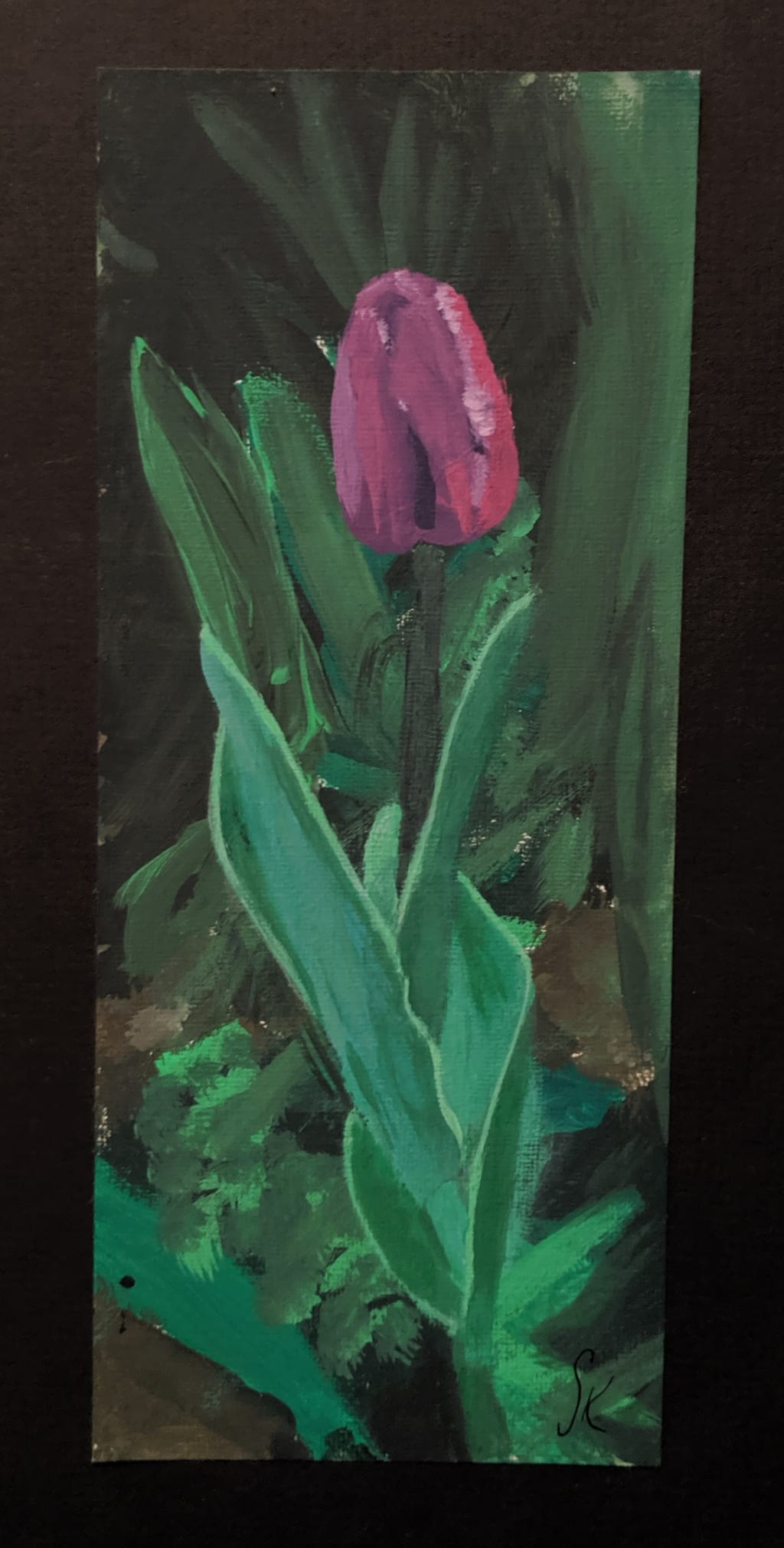
Purple Painted Tulip
A reflection and a happy reminder of my journey through paint

I was drunk with power.
In the summer before I started college, for the first time in my life, I attempted a realistic pencil sketch, and a distinct picture of my foot in a braided sandal appeared on the page. I spent several days going back to it and gaping at it in surprise and awe. That really looks like my foot! It was an epiphany. I had unlocked a secret level up skill in the game of life, with no idea how I had done it, and now everything would be easy. Well, not easy, per say, but possible. Achievable. I was in disbelief; an untrained, unpracticed artist uncovering her potential.
A few months later, with this newly minted power thick in my blood, I decided to try acrylic painting. Naturally, I had no idea what I was doing. That seemed to only solidify my determination. I had done something like this before, hadn’t I? I had miraculously figured out how to sketch on my own. Couldn’t I do this as well?
The answer to this question should not have been yes. To this day I am baffled that the answer was yes. But there it was, sitting on my college dorm room desk: a small purple tulip amongst a rich green and brown background. A real, completed painting. Was it groundbreaking? Hardly. Was it good enough for a first attempt to fill me with pride? Absolutely.
Success is rather like a drug, especially when a majority of the journey to that success consists of bumbling around, not knowing what is going on and somehow arriving at the end of the trail with bruised feet and an elated ego. How did it happen? I’m not sure. It has the thrill and allure of a well executed magic trick. Don’t get me wrong, it wasn’t easy; the novelty of success would have worn off quickly if it had been “easy.” It took time, it took focus, and it took an abundance of trial and error mixing colors. The latter I found fascinating, as I’d never done it before. There was a new flavor of problem solving to it, a new frontier for my scientific mind to trailblaze through. I was hooked.
After my first foray into painting, life in college seemed to be getting harder. My classes were rigorous, my romantic relationship was toxic, and I was losing my sense of identity. Who was I without high school sports, without my old friends, without my family? It was a few months before I painted again. When I did, it was a silhouette of myself in the light of a streetlamp, wearing a dress and a feather boa. Do I remember who I am? I thought I might. The piece was a link to the mental image I had of myself, a representation of the person I felt I was losing sight of, and more than that, it was a painting I liked. It was something to cling to while so much seemed to be crumbling around me. I didn’t know at the time that by stepping into that creativity, I was actually stepping further into myself.
Summer came, and all those things that seemed to be crumbling around me stitched themselves back together. I passed my classes, I ended my toxic relationship, and I came back home. I was whole again. I had the freedom and time to further pursue painting, something I was excited about. I got right to it and churned out several works in the month of June alone.
They were all terrible.
Part of me wanted to give up. The angry mule living behind my navel had something to say about that. Are you really going to let a couple small failures beat you? After everything you’ve gone through in the last six months? My family members were on the side of the mule.
“Do you think Van Gogh or Picasso started out painting masterpieces?” my sister asked. “Of course not! Their works are the result of hours and hours of painting, years and years of practice.”
She never gloated about being right. Though she didn’t know it, she opened up the world for me with that phrase: I was freed from the idea that any of my paintings needed to be “good.” They just needed to be practice.
Years later, after plenty of that practice and many experiments, successes and, well, we’ll call them “less pretty successes,” it’s easier to understand the moments that make me passionate about acrylic painting. Those moments are closely tied to emotion and connection.
The joy involved for me is two-fold. First, there is the simple contentment of feeling the smooth acrylic sliding onto the canvas, the calm of watching a wide swath of green appear in stark contrast to the white all around it. That joy is in the first few strokes of the painting. Second, there is the thrill of looking at the finished product: the pride of having created something out of nothing, the reward of knowing all of the work I put in was worth it, and the sheer relief that I can finally stop working on it and move on to something else.
The hard work, the toil, and the problem solving in the middle are all important too. Self doubt often sneaks in, leading to endless mutterings of, “It’s not done yet, this part isn’t right, I need to fix this shading, oh no, did I just mess that up? I’m going to have to redo it.” Overcoming that doubt is an exercise in mental strength, and painting gives me constant practice. I have so much gratitude for that mental strength, which has helped give me perspective in other aspects of my life. There’s also the problem solving and constant curiosity of, “What makes this gray background look different from this gray sweatshirt?” and “What color is that? How do I make that color? Should I make it that color?” So many lines of emotion and thought intertwine to connect me to a single painting, but those lines also probe outward. Those lines connect me not only to myself, but to the world around me and the people around me.
Like my best friend.
She and I made a pact to make something for each other over the summer one year, and we both knew I was going to paint something. As inspiration often does, an idea popped into my head when I wasn't thinking about the project, waiting for my food inside a Cafe Yumm, so I began a quick sketch in my notebook before I could forget it. The project had four parts. The more I stewed on it, the more I thought I was perhaps the most genius creative on the planet.
That was until it came to part three of my plan, when I started questioning my sanity.
Part one of the plan was simple; paint. It was a scene of two hands stretching toward each other over a delicately arranged pile of rocks, rife with blues and grays. One hand was mine, the other was hers. The inspiration was a picture the two of us had taken one year as we tried to make a mini-movie about a witch and her bodyguard that ended up becoming more enjoyable as a 5 minute blooper reel. It was one of our more carefree, happy days, when we weren’t separated by distance or the strain of work and school.
Part two was simple as well. Once it was dry, I flipped the painting over and carefully measured and sketched the outlines of several shapes, turning the painting this way and that to piece them all together and use up the entire area of the painting.
Then it was time for part three. If this had been a movie, this is the part where one of my eyelids would have been twitching. I pulled out a pair of scissors and painstakingly cut along the lines I had drawn in part two. My dad walked by the table as I was doing this. It took him a moment to reconcile what I was doing with reasonable logic.
“Why are you ruining your painting?”
“I’m not,” I replied calmly, with confidence, “I’m making it better.” All the while my internal organs were in a riotous battle to the death in rebellion and my brain was screaming, Suffer for your art! Suffer for your art! Trust the process! SUFFER FOR YOUR ART!
My dad shook his head and continued on his way, clearly lacking the creative vision necessary to comprehend this undertaking. (Read: unwilling to pry further into what must have appeared to be utter chaos.)
With part three complete, I put down the scissors and refused to mourn the loss of my sanity. That would be giving power to the doubt, and I would not do it. Everything would come together in part four.
And it did: here was the final reveal of the magic trick. I cut a black mat board down to size and arranged all the pieces of my painting into the shape of a wooden figurine. The figurine as a symbol held particular meaning for my best friend. It was a motif that dug into the idea of life and philosophy. Some photo mount adhesive, a stack of books to weigh it down and make it flat, and 24 hours later, it was finished.
There was something sweeter than the magic trick for this project, though. It was sweeter, even, than that first taste of success. It was the moment my best friend took the piece in her hands, gasped, and tears welled up in her eyes.
“This is the most meaningful thing anyone has ever given me. I am so grateful to have you in my life.”
It isn’t something I’m likely to ever forget.
That artwork didn’t magically create the deep bonds of our friendship. It didn’t change us. But it was a striking symbol of pure human connection, of something powerful and true.
Painting led me to all of that, and has done much more for me than I could have ever imagined in my tiny college dorm room, sitting at a desk and starting a love affair with a small, purple tulip.
About the Creator
Sydney King
I have bad feet but my hobbies won't let me rest.
Keep reading
More stories from Sydney King and writers in Motivation and other communities.
One Hard Thing
Stop me if you’ve heard this one before: You have the number, you know your schedule- you’ve even picked out the perfect day and time to make this appointment. Shoot, you’ve even picked out alternative days and times just in case their schedules can’t accommodate you!
By Taylor Rigsby5 days ago in Motivation
Together in Action: How Teamwork Turns Charity Efforts Into Lasting Change
Charity work becomes far more powerful when people unite behind a shared mission, and collaboration helps transform individual intentions into meaningful results that touch entire communities. Many volunteers bring unique skills and passions to their roles. Yet, coordinated teamwork multiplies these strengths and creates opportunities for more profound impact, and collective charity impact illustrates how unified efforts make a measurable difference through social responsibility. Additionally, working as a team helps organizations stay organized, resilient, and able to respond effectively to challenges. As a result, charity work thrives when volunteers support one another and move toward a common purpose.
By Tom Walter Wake Forest2 days ago in Motivation


Comments
There are no comments for this story
Be the first to respond and start the conversation.