
I Traveled 6,000 Miles to Forget Him—It Didn’t Work
I thought new places would erase old love. But the farther I ran, the closer he followed—in memory, in music, in everything I tried to leave behind.
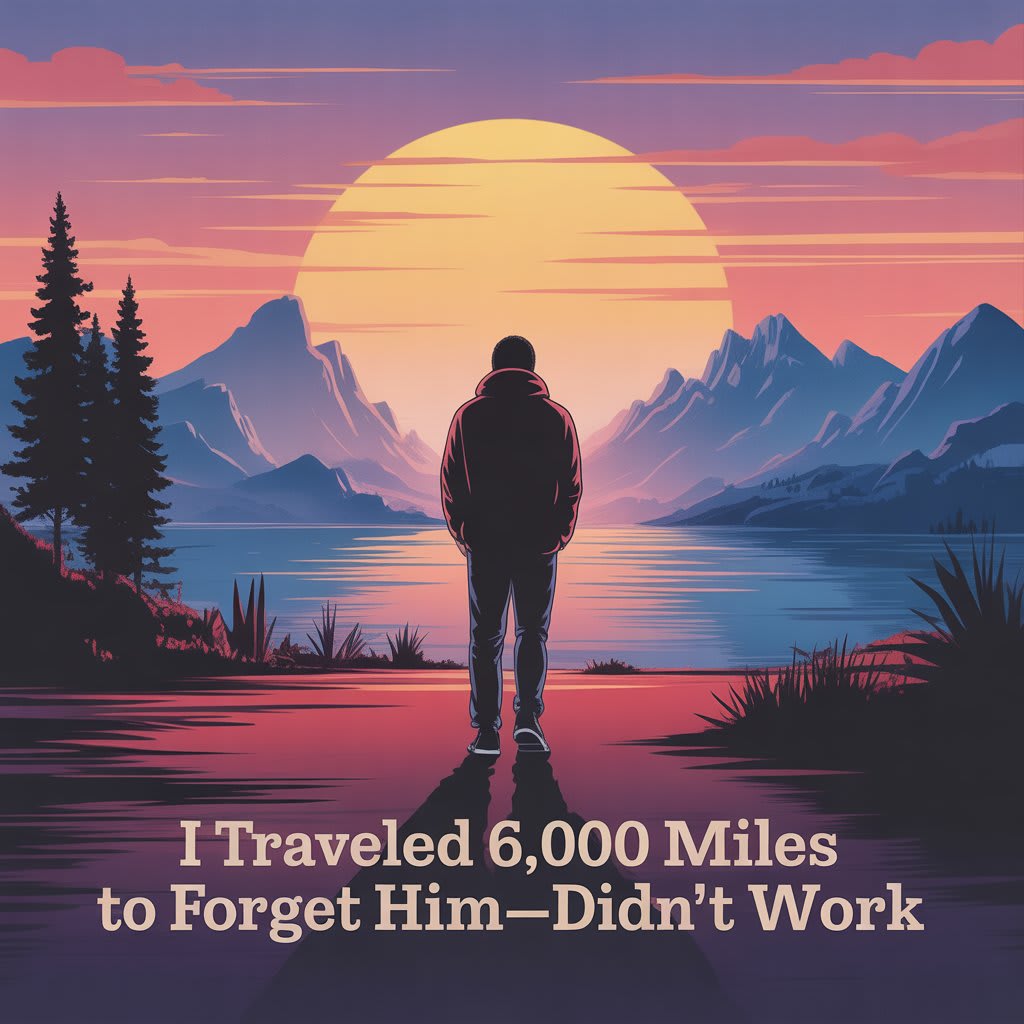
I Traveled 6,000 Miles to Forget Him—It Didn’t Work
I thought new places would erase old love. But the farther I ran, the closer he followed—in memory, in music, in everything I tried to leave behind.
Chapter 1: The Departure
It wasn’t sudden. It never is.
I booked the flight to Lisbon two weeks after Max stopped replying, five days after I deleted our photos, and about three hours after I cried on the bathroom floor while my spaghetti overboiled. Healing, they say, is not linear. But I was tired of circles.
So I did what any heartbroken, half-dramatic, self-aware woman in her late twenties would do: I packed my bags, grabbed my passport, and decided Europe could do what therapy hadn’t yet managed.
Forget him.
Portugal wasn’t on my original list. Too warm, too romantic, too coastal. But that was the point—I wanted to shock my system, to step so far outside my usual that my past couldn’t catch up.
Spoiler: it did.
Chapter 2: Jet Lag and Fado
Lisbon greeted me with sunlight and saudade.
I didn’t know the word until my third day—sitting at a street-side café in Alfama, sipping bitter coffee too late in the afternoon. My Airbnb host, an older woman named Inez, pointed at a man singing in a tiny, dim bar.
“Fado,” she said. “Sad music for hearts too full.”
I nodded, smiling, not yet understanding.
That night, I lay awake in the little tiled room with blue curtains and no air conditioning, scrolling through old texts I swore I’d deleted.
Max: “Don’t overthink it. I love you.”
Me: “You say that, but you disappear.”
He did disappear. That was the worst part—no closure, no dramatic ending. Just silence, growing heavier with each unread message. I tried to hate him for it. Some nights, I succeeded. Others, I just stared at the cracked ceiling and let the fado bleed through the window.
Chapter 3: The Woman on the Train
On the fifth day, I took a train to Sintra—a fairy tale of a town with misty forests, crumbling palaces, and tourists taking too many selfies.
I sat across from a woman who looked like my future. Mid-forties, stylish in a quiet way, book in hand. She caught me staring and smiled.
“American?” she asked, her accent British.
“Yeah. Solo traveler cliché.”
She laughed. “Aren’t we all?”
We spoke the whole ride. Her name was Ruth. Divorced. Two kids. She was visiting her ex-honeymoon spot. “Sometimes memory is a place,” she said, “and sometimes it’s a person.”
I didn’t ask her which was harder to forget.
Chapter 4: A List I Never Finished
In my journal, I made a list:
Climb the hills of Alfama without thinking of Max’s breathless laugh.
Eat pastries without remembering how he stole the last bite.
Dance in a club and not wish it were his hands at my waist.
Kiss someone else.
I got halfway through. The fourth stayed blank.
Chapter 5: A Table for One, Please
There’s a strange intimacy in eating alone.
Not the rushed, phone-in-hand type of alone we do at lunch breaks, but the intentional kind—ordering wine you can’t pronounce, sitting across from an empty chair, and pretending not to notice the couples at the tables nearby.
On my seventh night in Lisbon, I dined alone at a tiny restaurant tucked in a back alley of Bairro Alto. No menus—just a waiter with a voice like gravel and eyes that noticed everything.
He brought bread and wine before I asked, like he’d done this before.
“Table for one?” he said with a slight tilt of the head.
I nodded, suddenly self-conscious.
He smiled. “The best company.”
Halfway through my meal—a grilled fish I could barely eat—I started writing again. Not texts, not journal entries. Real writing. The kind I hadn’t done since Max told me he didn’t “get poetry” and laughed when I read mine out loud.
I don’t know why that night was different. Maybe it was the wine. Maybe it was the waiter’s quiet acceptance. Maybe I just needed to prove to myself that my voice still mattered, even if the one I wanted to hear it was gone.
That night, I wrote three pages and didn’t cry once.
Chapter 6: When the Music Played Again
The city changes at night.
During the day, Lisbon is postcards and sunlight. At night, it hums. Music leaks from windows. Glasses clink. The cobblestones echo with slow footsteps and late decisions.
I wandered without a plan, letting the streets choose for me. My feet carried me to a different part of Alfama, quieter, older. A small sign caught my eye: "Fado Tonight. No Cameras. No Applause Until the End."
Inside, the air was thick with wine and something else—grief, maybe. Or reverence.
There was no stage, just a corner of the room where an old man began to strum his guitar. A woman, probably in her fifties, took a deep breath and sang.
I didn’t understand the words, but I understood the pain. Her voice cracked in places where mine had cracked too—in texts I never sent, in arguments I replayed, in dreams I woke up from too suddenly.
Next to me, a man was crying silently. Across the room, a couple held hands like they were afraid to let go. And me? I sat perfectly still, letting the music press into the hollow places inside me.
That was the night I stopped trying to forget him.
Not because I didn’t want to—but because I realized forgetting wasn’t the point.
Healing wasn’t erasure.
It was remembering without bleeding.
About the Creator
Keep reading
More stories from Javed khan and writers in Motivation and other communities.
The Conquest of Makkah and the Prophet’s (PBUH) Forgiveness
In the 8th year of Hijra (629 CE), a monumental event occurred in the history of Islam—the conquest of Makkah. This city, once the birthplace of the Prophet Muhammad (PBUH), had been a place of great hostility towards him and his followers. The Quraysh, the tribe that controlled Makkah, had relentlessly persecuted the early Muslims, subjecting them to severe torture, forced exile, and even killing some of them. Yet, despite the endless trials and tribulations, the Prophet Muhammad (PBUH) remained firm in his commitment to the message of Islam.
By Javed khan7 months ago in Motivation
One Hard Thing
Stop me if you’ve heard this one before: You have the number, you know your schedule- you’ve even picked out the perfect day and time to make this appointment. Shoot, you’ve even picked out alternative days and times just in case their schedules can’t accommodate you!
By Taylor Rigsby11 days ago in Motivation
A Love Forboding
The chipped stone slope caused unbearable footing. I slid, skirting on my heels. I cast my shield, relinquishing my guard to stay upright. Left with my double-edge and a prayer to the maker, I skated toward my objective. The earthly stubble gave way to solid ground. I found myself restored, a trail of dust in my wake.
By James U. Rizzi6 days ago in Fiction




Comments
There are no comments for this story
Be the first to respond and start the conversation.