
I Don’t Fear AI. I Fear Forgetting My Own Voice
When machines learn to write like us, will we forget how to feel like ourselves?

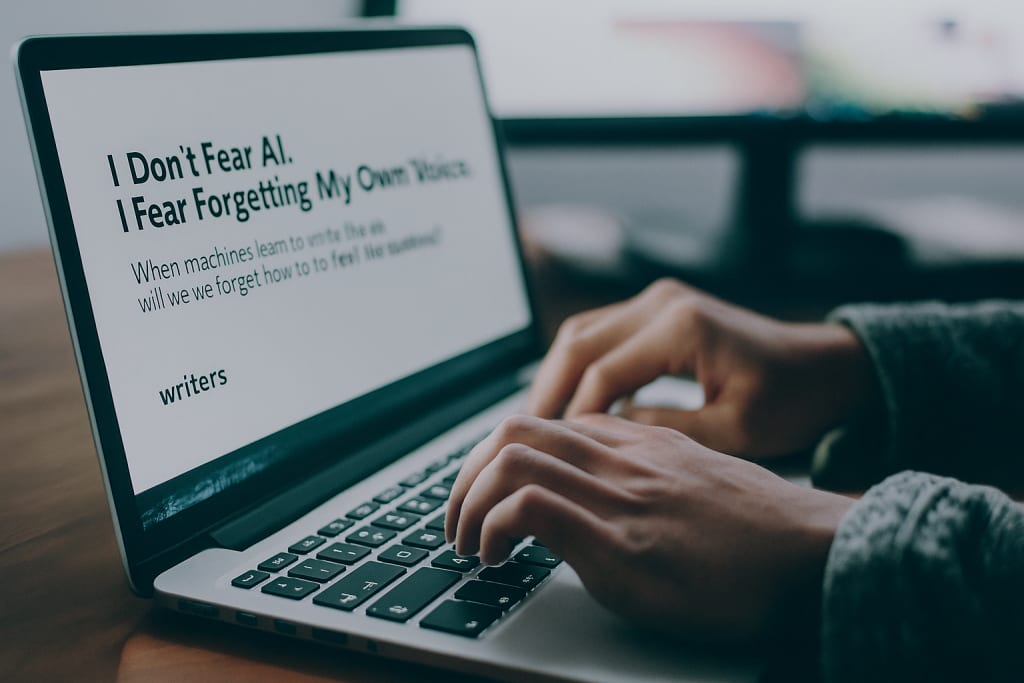
I Don’t Fear AI. I Fear Forgetting My Own Voice
Written by: Said Adrees Sadat
There was a time when writing was an act of solitude and rebellion. Like whispering secrets into the void and hoping they’d echo back as understanding. I used to sit alone in my room, long after midnight, with the world around me asleep. The silence wasn’t empty—it was full of tension, like the calm before a storm. A cup of bitter coffee kept me company, growing cold as my thoughts grew louder.
Back then, the blank page terrified me. Not because I didn’t know what to write—but because I did, and I wasn’t sure I could say it the right way. But that struggle—that intimacy between thought and word—was sacred. Personal. A space where I could be raw and unfiltered. I didn’t write for perfection. I wrote to understand. To heal. To breathe.
I made mistakes. A lot of them. My metaphors were clumsy. My sentences stumbled over themselves. But every line I wrote brought me closer to something true. And slowly, with each messy draft, I started to hear something familiar. My voice. Uneven. Vulnerable. Real.
Then came the tools.
At first, they felt like magic. Spellcheck fixed my typos. Grammarly suggested smoother phrasing. It was helpful—like having a silent editor polishing the rough edges. I still felt like the writer. I still had control.
But then, things changed.
Writing tools evolved. Autocomplete became paragraph completion. Generators didn’t just help—they wrote. I could enter a topic and watch an entire article unfold. It was fast. Slick. Efficient.
And deeply unsettling.
Because the more I relied on these tools, the more I began to drift from myself. I started questioning my instincts. I doubted the words I once trusted. I'd write a sentence, pause, and wonder: Could the AI say this better? And most of the time, it could.
But better isn’t always truer.
Its words were cleaner, more polished, more confident. But they didn’t ache the way mine did. They didn’t carry the same confusion, the same fear, the same longing. They weren’t born from a sleepless night or a memory that still stings.
They were words—but they weren’t mine.
And that’s what scares me. Not that AI will replace writers. But that writers will start replacing themselves. That we’ll stop listening to our inner voices and instead chase algorithms of approval. That we’ll value “flawless” over honest. That we’ll forget what our own truth sounds like.
Because writing was never just about the end result. It was about the journey. The doubt. The discovery. The battle between what we feel and what we’re brave enough to say out loud. It was in those moments of frustration and breakthrough that I found something worth keeping: my voice.
And AI—no matter how advanced—can’t give you that. It can simulate tone. It can replicate style. But it can’t feel. It doesn’t tremble before a painful truth. It doesn’t hesitate before a confession. It doesn’t know what it means to be human.
I do.
That’s the difference.
So now, I try to be mindful. I still use AI—spellcheck, brainstorms, maybe a few gentle nudges when I’m stuck. I’m not afraid of technology. I’m not anti-progress. But I’ve drawn a line.
AI can help me.
But it cannot speak for me.
Because the moment I let it replace my voice, I don’t just lose my writing.
I lose myself.
And I refuse to hand that over.
So here I am again, staring at the blinking cursor, the screen glowing like a quiet invitation. I know the AI could write this faster. It could clean it up, make it smarter, more optimized for clicks. But that’s not what I want.
I want honest.
I want the crooked sentences, the awkward phrasing, the trembling truth. I want to wrestle with my thoughts, to chase the feeling that hides behind the words. I want the kind of writing that isn’t always right—but is always real.
Because that voice—that messy, fragile, irreplaceable voice—is mine.
And no machine gets to take that away.
About the Creator
king pokhtoon
love is good.
Keep reading
More stories from king pokhtoon and writers in Motivation and other communities.
United in Spirit: How Fellowship Moments Strengthen Faith and Community Bonds
Faith grows stronger when people gather with open hearts and shared purpose. In churches, small groups, and community centers, simple moments often become lasting memories. A shared meal, a group prayer, or a kind word can remind people that they are not alone. These experiences reveal the beauty of Christian community connection, where belief is not just personal but shared in real and meaningful ways.
By World Olivet Assembly3 days ago in Motivation
The Architecture of a Ghost: How Michael Oher Weaponized His Trauma
The raw, unfiltered true story of Michael Oher. Beyond the Hollywood movie, discover how a homeless teenager surviving the brutal streets of Memphis turned his deepest traumas into an NFL legacy.
By Frank Massey 6 days ago in Motivation


Comments
There are no comments for this story
Be the first to respond and start the conversation.