
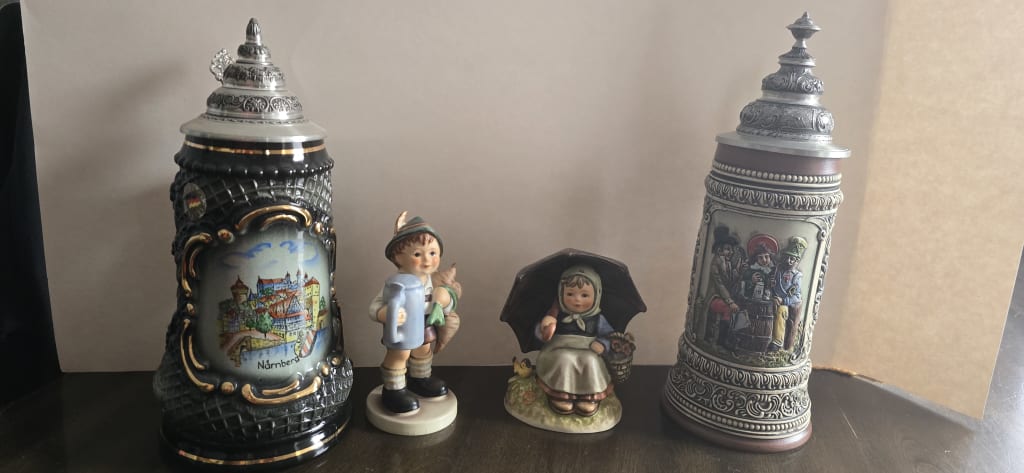
The recently opened museum, Hum-Hum, was tucked away in the center of a charming Bavarian village, encircled by undulating hills and the distant murmur of accordion tunes. Just the name aroused interest. Was it a reference to creation's mellow hum? Or a reference to the well-known Hummel figurines and their elaborate German beer stein companions? In any event, Hum-Hum had emerged as a symbol of culture, history, and the arts.
The grand opening of the museum wasn't your typical event. The aroma of clean pinewood floors and a mosaic ceiling featuring cherubic youngsters clutching steins and miniatures welcomed the torrent of tourists as they entered through the arched oak doors.
No feature was too minor to elude the curators' painstaking attention to detail, and every display conveyed a narrative.
Two childhood friends, Klaus and Margarete, who had grown up in the area, had come up with the concept for Hum-Hum. His grandfather's collection of beer steins, which included centuries' worth of hand-painted beauties, was passed down to Klaus. Margarete, however, had visited her grandmother's house and had fallen in love with the delicate beauty of Hummel figurines. Because they believed that these items were gateways to Germany's soul and not just collectibles, both friends were passionate about keeping them intact.
Although Klaus and Margarete had always had lofty goals, Hum-Hum began as a simple concept. Klaus started by dusting up his grandfather's steins and admiring the artistry of the hand-painted scenery and pewter lids. Some showed peaceful Bavarian villages encircled by pine forests, while others showed knights charging into war. An especially uncommon stein, from 1857, showed a pastoral scene of hop farmers gathering the materials that gave Bavarian beer its distinctive character.
At home, Margarete's collection of Hummel figurines was meticulously arranged in a glass case. The statues' childlike poses, rosy cheeks, and cherubic expressions took her back to a more carefree era. From kids playing instruments to shepherds caring for animals to a female holding a bunch of flowers, each figurine seems to tell a narrative of its own. The figurines were more than just ornaments; they were charming and nostalgic little pictures of rural German life.
The two friends were reflecting on their collections one fall evening by the fireplace when they had an epiphany.
"What if we established a location where others could enjoy these treasures?" Margarete asked, her eyes glistening. A museum honoring the workmanship of Germany?
The golden liquid of Klaus's beer glowed in the firelight as he took a long gulp. "A location to save our culture's heritage for upcoming generations... I enjoy it. What would we call it, though?
Margarete tapped the rim of her wineglass and laughed. "Hum-Hum."
"Hum-Hum?" Klaus's eyebrows went up.
Margarete leaned forward and added, "Consider it." Like the kids in my figurines and the clinking of beer steins at festivals, the name hums with happiness. It's whimsical, memorable, and catchy.
Thus, Hum-Hum came into being.
The museum's construction was no easy task. Klaus and Margarete combined their funds, submitted grant applications, and approached nearby companies for assistance. As soon as word got out, donations started coming in. For King Ludwig II's bicentennial celebration, a retired craftsman presented a stein he had made. A Hummel figurine of a little child reading a prayer book that had been handed down through the centuries was donated by a local priest.
The building itself was a love project. They decided to keep the stone walls and arched windows of a historic building that was formerly a brewery. As befitted a museum dedicated to beer steins, the aroma of malt was still somewhat present in the air.
Every exhibit was thoughtfully chosen. The ground floor was devoted to the beer stein collection, which was arranged chronologically to chronicle the history of brewing. Simple stoneware, early 16th-century steins were made to keep beer cool and fly-free. By the 18th century, steins had developed into ornate sculptures with vibrant enamel and detailed carvings. Oktoberfest steins, with their joyous themes of dancing couples and busy beer tents, were featured in a separate area.
Margarete's Hummel figurines were the main attraction on the second floor. Themed collections such as "Seasons of Childhood," "Village Life," and "Spiritual Reflections" were on show as visitors strolled through them. Each figurine's delicate details, such as the folds of a child's frock or the strands of hair that peeked out from behind a bonnet, were highlighted by the soft, pleasant lighting. A calm and captivating ambiance was created by the soft hum of classical music playing in the background.
A life-size model of Sister Maria Innocentia Hummel's studio was the focal point of the Hummel show. The original drawings that served as the inspiration for the figurines were made by Sister Maria, a well-known German artist and nun. Her easel, brushes, and a partially finished drawing of a young boy holding a lantern were all included in the replica. On a neighboring board, visitors were invited to write thank-you notes about how the figurines had impacted their lives.
Hum-Hum's grand opening was an unforgettable event. A brass band played upbeat polkas as both locals and visitors gathered in the town square. The mayor used enormous scissors to cut a crimson ribbon, and Klaus and Margarete spoke passionately about their adventure.
The mob rushed in as the doors opened. Youngsters pointed eagerly at the minute details as they stared at the Hummel figures. Beer connoisseurs hovered around the stein collection, discussing the provenance of individual designs. With a nostalgic gaze, elderly couples reminisced about the steins and figurines they had formerly had.
One guest, Emily, an American traveler, was especially enthralled. During her backpacking trip across Europe, she had discovered Hum-Hum and was immediately captivated by its allure. Emily took careful notes and took pictures as she spent hours looking over the displays. She later admitted to Klaus and Margarete that she was motivated to begin her own collection of German items by the museum.
Hum-Hum evolved into more than just a museum. It held seminars where craftspeople showed guests how to carve steins and paint figures. Craft fairs, folk dances, and beer tastings were all part of the seasonal celebrations of Bavarian culture. On-site, a café offered classic fare like apple strudel, bratwurst, and pretzels, all paired with beer made nearby.
Additionally, the museum developed into a storytelling center. In order to create an audio tour, Klaus and Margarete asked residents to tell personal stories about their steins and figurines. These stories were then recorded. An elderly woman named Helga shared one such tale, recalling how her father had brought home a stein from the front lines of World War II, a unique item that had lifted their spirits during difficult times.
Years went by, and Hum-Hum prospered. It attracted tourists from all over the world and received praise for its original idea and sincere implementation. The bond between Klaus and Margarete was stronger than ever, and they continued to be actively involved.
Klaus raised his stein in a toast one bright afternoon while they were sitting in the museum café with a view of the cobblestone street. "To Hum-Hum, to us, to our culture."
Margarete smiled brightly as she clinked her coffee cup on his stein. "To the connections these treasures create and the stories they tell."
And the hum of life and legacy reverberated within the walls of Hum-Hum as the sun sank below the horizon, bathing the settlement in a golden glow.
About the Creator
Keep reading
More stories from Dagmar Goeschick and writers in Motivation and other communities.
Winter Ritual
Winter arrives without asking. It comes quietly, often overnight, when the world has decided to slow down. Winter is cold. Winter is white. Winter lasts three long months—sometimes more—and sometimes it comes with snow, and sometimes only with the promise of it. Either way, it changes everything.
By Dagmar GoeschickExclusive • 3 months ago
Boost Your Productivity with These 7 AI Tools
Seven AI Tools That Help You Work Smarter By 2026, getting things done isn’t about pushing longer hours - it’s shifting toward sharper methods. Because of artificial intelligence, how founders, learners, independent workers, and digital makers handle daily efforts has changed completely. Since tools powered by AI stepped in, drafting words, shaping visuals, sorting duties, or streamlining routines now take far less energy. Though speed matters, the real difference shows in how little strain comes with finishing tasks.
By Abdul Lateef5 days ago in Motivation
The Day Failure Taught Me to Fly
The Day Failure Taught Me to Fly I had always been afraid of failing. Even the word “failure” felt like a heavy chain around my chest. In school, I avoided competitions I thought I could lose. In college, I never took risks in projects or presentations. My comfort zone was my fortress, and I guarded it fiercely.
By Samaan Ahmad2 days ago in Motivation



Comments (1)
A beautiful story and interesting mix of museum objects. I adore museums and would visit if I could.