
How We Use AI To Publish 50+ Human-Like Articles Per Month
Our Step-by-Step Strategy to Scale Quality Content Using AI Without Sacrificing Authenticity

Are you struggling to publish long-form blog posts consistently?
These days, businesses and websites thrive on content, and blog posts are very important for SEO. But it takes time to publish long-form content, and that too consistently.
Over the last couple of years, AI writing tools have captured the market, and basically, they are trying to kick out writers from this equation. At least it seems like it, though.
At our agency, PullingOffStrategies, we believe AI can’t replace human writers. However, when human writers get assistance from AI, they can use it as a weapon to fast-track their content writing process. That’s how we predominantly use AI to publish 50+ articles per month.
Remember that using the combination of AI and human writers, we have ranked over 250+ articles on Google’s Page 1.
In fact, most of the content that we publish for our SaaS clients using AI turns out to be engaging, informative, and rank-worthy.
Is Using AI Good or Bad for SEO?
Let’s clear the air: Google doesn’t hate AI. In fact, they’ve been pretty vocal about it in their recent algorithm updates. They’re not out to punish AI content in particular.
Here is the caveat! You can’t expect to publish raw, unedited AI-generated content and expect it to rank. Why? Because most of the content is regurgitated and sounds too robotic.
Here’s what you need to know about using AI content from an SEO standpoint:
- Google is focused on quality content, not the tool used to create content. In their March 2024 core update, they targeted low-quality, unhelpful content — whether it’s AI-generated or not.
- Remember, Google’s E-E-A-T guidelines still apply to this date. Here, AI struggles with providing first-hand experience and expertise that Google values, so AI fails to cater to EEAT guidelines.
That being said, we have seen AI tools that can publish content and rank without much editing. However, the unsaid truth is that AI content seems to work when you’re in a niche that is not established and isn’t competitive.
For example, you can probably use raw AI content (with less editing) to rank for Jewellery businesses, but it doesn’t apply the same for other competitive online businesses.
We at PullingOffStrategies deal with SaaS clients, and most of their target audiences are well-informed. These businesses also operate in highly competitive niches.
So, using raw AI content isn’t going to work, and even if we choose to use it, the readers can sense it from a mile away.
So, is AI good or bad for SEO? It’s not either — it’s how you use it. The winning combo is to blend AI’s efficiency with human interpretation.
Our 5-Step Content Writing System That Uses AI To Rank Articles on Google Page 1
1) Researching The Topic
Research is the very first step of every content-writing process. At our agency, we have a dedicated SOP designed for research that our team follows to come up with useful and unexplored insights about the topic.

Our Research SOP goes beyond researching a couple of articles:
- For every keyword and topic, we dive into forums like Reddit and Quora to get new insights.
- We surf through long-form content pieces like YouTube and Podcasts to discover deeper knowledge.
- We use AI tools to extract the content from hour-long YouTube videos and podcasts. Then, we summarize them into important points that are relevant to us.
- Sometimes, we choose to go through industry reports, surveys, and any PDF documents relevant to our topic to extract any interesting points for our content.
- The whole point of our research SOP is to cover what is already being said by existing competitors and add value on top of that by bringing more context.
This deep-dive approach makes sure we’re not just scratching the surface. Instead, we’re digging up some valuable nuggets that set our content apart.
2) Coming Up with an Outline
After accumulating the context from the research and putting together our data, we need an outline.
Even here, we use AI in combination with human touch to bring in outlines.

Although there are a lot of AI tools that deliver great outlines, we still like to have some control, just in case. Because the outlines dictate our whole content, so if it isn’t right, then we’re messed up.
This is what our outline process looks like
- Using tools like SurferSEO and NeuronWriter to come up with outlines. Most of these outlines are created by analyzing existing competition for your keywords.
- Even though AI can give us an outline by understanding the common patterns of our competitors, we still believe the search intent and audience segments matter a lot while coming up with an outline.
- So, most of our team is trained to edit AI outlines to make them helpful for search queries. This could mean providing solutions right away in the content, and the outline is designed in accordance with that.
- Apart from that, we like to check whether the important keywords are covered in the headings, and also, these headings are given context to cover this topic extensively.
The result? Outlines that are SEO-friendly and reader-focused.
3) Writing an Initial Content Draft Using AI
This is where most people just input their outline and let AI write content for them.
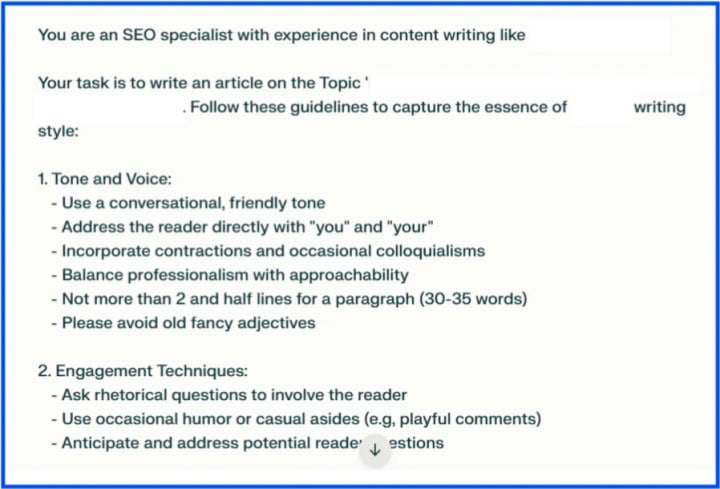
Whereas we don’t just hit a button and let AI do all the work when it comes to drafting content.
Our approach is more nuanced:
- Instead of making AI write your whole content. We engage AI to write content for each section, like the intro, heading, and conclusion, with proper prompts.
- We mostly use Perplexity, Claude AI, or ChatGPT for content. Since most AI writing tools are built on top of these models, so it’s a waste of money to spend money on those tools.
- Before starting our writing process, we feed AI with some context regarding the writing style and what kind of role it needs to adopt
- We have a series of prompts that we feed the AI about our client’s brand values, positioning, and target audience. It helps us to tailor the content perfectly.
- Now, for each section/heading, we input our outline and try to extract content section by section.
- We have found that when we ask AI to write content over 700 or 1000 words, it loses its grip and doesn’t seem to follow our prompts. So, the sweet spot is to generate anywhere between 200–450 words for each single output.
During these sessions of writing with AI, we don’t just accept the first draft. Our prompts are often tweaked, or we ask for revisions until we get the right tone and information.
4) Edit The Draft To Make It Human
After you have your AI-generated draft, it’s time to add that human touch. Here’s how we do it:
- Firstly we use a couple of humanising tools like TurnItHuman and StealthWriter. However, these tools alone won’t humanize your content. They help you remove some of the robotic jargon that AI creates.
- The actual part of humanizing content starts with someone manually coming in and editing the content.
- We have a content enablement SOP for each of our SaaS clients that is filled with information related to their brand values, brand positing, and mostly some of the interviews we do with them. This document is basically a gateway to our client’s mind.
- Using our content enablement document, our writers will come up with personal anecdotes, real-world examples, and insider knowledge that AI can’t replicate.
- Thanks to our content enablement doc, we’re able to sprinkle in industry-specific terms and nuances to make the content more relevant and credible to our client’s target audience.
- Obviously, we focus on proper sentence structure and language to create a more natural flow.
In the end, the point is to make content that isn’t just informative but engaging and authentic.
5) Optimizing The Content Using NeuronWriter
Once we manually edit the content and make sure it sounds like a piece written by a brand.
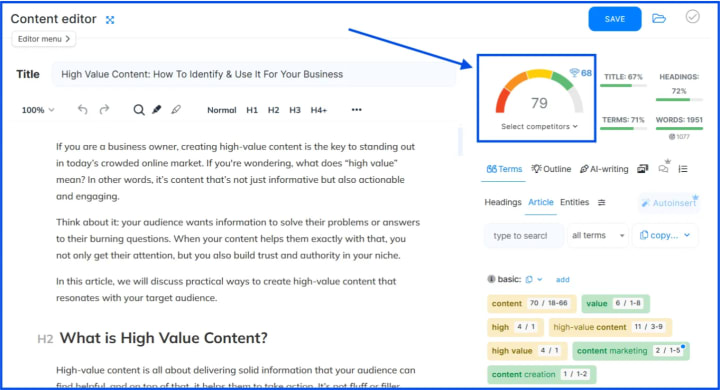
Then, it’s time to optimize the content, and here are the steps we follow.
- In this age of Semantic SEO probably adding a few keywords isn’t going to do the job. You need to focus on adding terms that can make search engines actually understand your content.
- Well! Using NeuronWriter, you can come across NLP (Natural Language Processing) terms and SEO Entities.
- Focusing on NLP keywords and Entities is like speaking Google’s language. It’s like giving the search engine an idea about what keyword your content should be associated with.
- To measure how well we’re optimized for the keyword, NeuronWriter gives us a content score feature.
This part only covers content optimization. However, when it comes to publishing your content using a platform like WordPress, there is a whole on-page SEO checklist you need to follow.
You can understand what we do for on-page SEO through our case studies.
Wrap Up
The intention behind sharing this article is to help other website owners, and founders understand how they can leverage AI assistance to accelerate content creation.
At our agency, this has proven to work, and we are now creating 50+ articles each month and will probably soon scale this content-writing system to 100+ articles a month.
About the Creator
Md kamrul Islam
Myself is a passionate writer with a deep love for storytelling and human connection. With a background in humanities and a keen interest in child development and social relationships
Keep reading
More stories from Md kamrul Islam and writers in Motivation and other communities.
When Silence Becomes Power: The Psychology of Staying Calm in Toxic Environments
Sometimes the most dangerous battles in life are the ones no one else can see. They don’t happen on stages, in headlines, or in dramatic confrontations. They happen quietly—inside conversations, environments, and subtle interactions where people test boundaries, measure reactions, and observe how much pressure a mind can carry before it breaks.
By Lyon Gaber6 days ago in Motivation




Comments
There are no comments for this story
Be the first to respond and start the conversation.