
How to Start a Cosmetic Business Without Funding: Zero-Cost
Start a cosmetic business with no money. Step-by-step zero-cost ideas, legal basics, DIY production, free marketing, and a launch checklist.


You want to launch a cosmetic brand, but worry you don’t have money. That fear stops many good ideas. You’re not alone. Low-cost and zero-investment routes exist and work. You can also start selling your first bottles from home, building repeat buyers, and scaling without loans.
In this guide, I will explain product ideas, legal basics, low-cost production methods, free marketing tactics, and simple launch steps. By the end, you’ll know how to start a cosmetic business with no money and what to do next.
How to think like a zero-investment founder
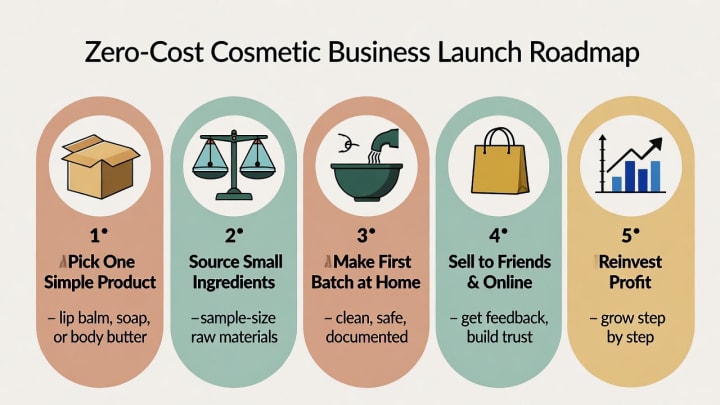
It would be a matter of exchanging time and expertise for money to launch a beauty brand without funding. Center on three: clarity of product, safe, simple formula, and sales to the end consumer. Use one product idea that you can produce or acquire at low cost. Keep packaging minimal. First, sell to friends, the local market, and the online market. This decreases risk and develops proof of concept.
Choose the right cosmetic business idea
If you’re asking how to start a cosmetic line with no experience, select products that are simple, safe, and legal. Examples of cosmetic business ideas for beginners:
- Solid bars (soap, shampoo bars) — simple ingredients, no big bottles.
- Lip balms and tinted balms — tiny batches, easy to test.
- Simple serums (single active, like vitamin C or niacinamide blends) — small volumes.
- Body butters and scrubs — low-cost inputs, handmade.
- Makeup basics from home — e.g., pressed powders or tinted powders.
These let you start a skincare business for free or nearly free because raw materials are inexpensive and equipment needs are minimal.
Legal basics you must handle early
Legal compliance is what I need to emphasize as an expert. Cosmetics are regulated. You should not use unsafe ingredients and unlawful statements. The regulations in most areas demand proper labeling, lists of ingredients, and truthful statements. When you say it treats acne or reduces wrinkles, the regulators will consider the product to be a drug, but not a cosmetic - that would set off a different approval process. Maintain factual claims: it is safer to state such things as moisturizing, softens, or helps soothe skin.
When you sell across borders in the future, get to know about local labeling regulations and voluntary safety testing. Formulations, batch records, and supplier invoices are early documented, and this is what gives you trust and shields you.
Make your first batch with zero or very low cost
You can start producing small batches at home. Steps:
- Choose a simple formula with 4 -8 ingredients.
- Obtain small quantities of source raw materials through bulk suppliers or a co-op. Purchase sample packs instead of pallets.
- Apply kitchen-grade tools that are specific to cosmetics (scale, double-boiler, glass containers). Cleanliness matters.
- In self and close others, document reactions. Keep notes.
In case of the failure to produce at home, white-label manufacturers or private-label manufacturers are good options since they accept small minimums. Other makers will give you a chance to design the label as they make small batches of the label- this saves you on the start-up capital.
Low-cost branding and packaging
It does not need costly designers for branding. Create free mockups and logos. Packaging should be kept to a minimum to save money and waste by using plain and affordable tuck top mailer boxes. Good photos are more important than anything when listing products online. Another thing is to capitalize on superior packaging and never compromise on it.
Pricing, margins, and simple bookkeeping
Even with low costs, the price for profit. Calculate all costs: ingredients, packaging, labels, payment fees, and delivery. Add your time as an expense. Aim for at least 50%–70% gross margin on retail price in the early days so you can reinvest. Keep simple spreadsheets of sales and costs. As you grow, hire an accountant or use a basic bookkeeping app.
Market your low-budget beauty brand effectively
The no-money marketing is concerned with integrity and integrity. Demonstrate the crafts of your products. Ethical use of before/after photos. Publish brief videos of usage. Provide early-sale packages. Get testimonials and place them on the product pages.
Use search-friendly words in listings: “how to start a makeup business from home” and “start a skincare business for free” are search phrases customers might use when researching small brands, so weave helpful content around them.

When and how to scale safely
Scaling should only be done when you have a repeat sale and positive feedback. Make tiny reinvestments with profit: buy more ingredients to make a superior unit price, professional labeling, or take better photos. Take into consideration small pre-order launches to finance every expansion. Production should only be outsourced when the demand is higher than your ability.
In case you are going international in the future, revisit regulatory measures in every market, like product notification systems, and ingredients allowed may be different. This is where the professional compliance assistance will have a trade-off.
Quick checklist before first sale:
- Finalized simple formula and batch record.
- Ingredient list and label mockup.
- Photos and short product video.
- Sales channel set up (marketplace or one-page site).
- Pricing and shipping plan.
- First few samples in customized cosmetic boxes and at least two testimonials.
Follow these, and you’ll launch without needing capital.
Can I legally sell cosmetics I make at home?
Yes, often, however, depending on the region. You need to use correct listings of ingredients, no drug claims, and local safety advice. Record-keep and begin selling locally as you become aware of any necessary notices or registrations.
How do I make a skincare product safe with no lab?
Begin with simple and familiar ingredients in small quantities. Observe high standards of hygiene, record batches, and patch-test. When you are going to make blanket sales, invest in stability or microbial testing in the future.
What’s the fastest way to get initial customers with no budget?
Offer samples to friends, post honest demos on social media, list on marketplaces, and attend local markets. Use pre-orders to fund larger runs.
Do I need a business license to start selling?
Locations have varying requirements. The local sales and general business registration can be chosen by many small makers. Pick local regulations and maintain documents and receipts of taxes.
Bottom Line
It is quite possible to open an establishment in the cosmetic industry without capital. Get one plain product, learn early, write down, and marketing with low cost helps you make your first buyers. Gradually increase profits. It is possible to establish a reliable brand of beauty with no prior background of skillful adherence, explicit branding, and consistent reinvestment. Before time, care, and credibility can win battles, large budgets are frequently beaten by them in the initial phases.
About the Creator
Cristina Baker
I’m Cristina Baker, a business and market expert with 8+ years of experience helping brands and entrepreneurs grow. I share insights, strategies, and ideas that inspire growth, spark curiosity, and turn challenges into actionable results.
Keep reading
More stories from Cristina Baker and writers in Motivation and other communities.
Why Minimalist Living Is Becoming Popular Worldwide
Introduction Over the past decade, minimalist living has shifted from a niche lifestyle choice to a widely discussed global movement. Across different cultures, age groups, and income levels, people are intentionally simplifying their lives by reducing excess possessions, distractions, and commitments. This shift is not driven by aesthetics alone; it is rooted in psychological well-being, changing social values, and the realities of modern life. As urbanization increases and digital environments become more complex, minimalism offers a structured response to overwhelm. Understanding why minimalist living is becoming popular worldwide requires examining its principles, psychological effects, and role in broader global lifestyle trends.
By Cristina Baker2 months ago in Motivation
Stop Making Excuses. Someone Is Already Doing What You Think Is Impossible
The Brutal Truth About Excuses : Right now, somewhere in the world, someone with fewer advantages than you is doing the exact thing you believe is impossible. They might have less money. Less education. Less support. Yet they are moving forward while many others remain stuck in the same place — not because they lack potential, but because they are trapped in a cycle of excuses. Excuses are comforting. They protect us from failure and embarrassment. But they also quietly steal our potential. The uncomfortable truth is that the biggest obstacle for most people is not lack of ability. It’s hesitation.
By Shahid Zaman5 days ago in Motivation


Comments
There are no comments for this story
Be the first to respond and start the conversation.