
Grief Is Just Love with Nowhere to Go
I thought grief ended after the funeral. I didn’t realize it had only just begun.

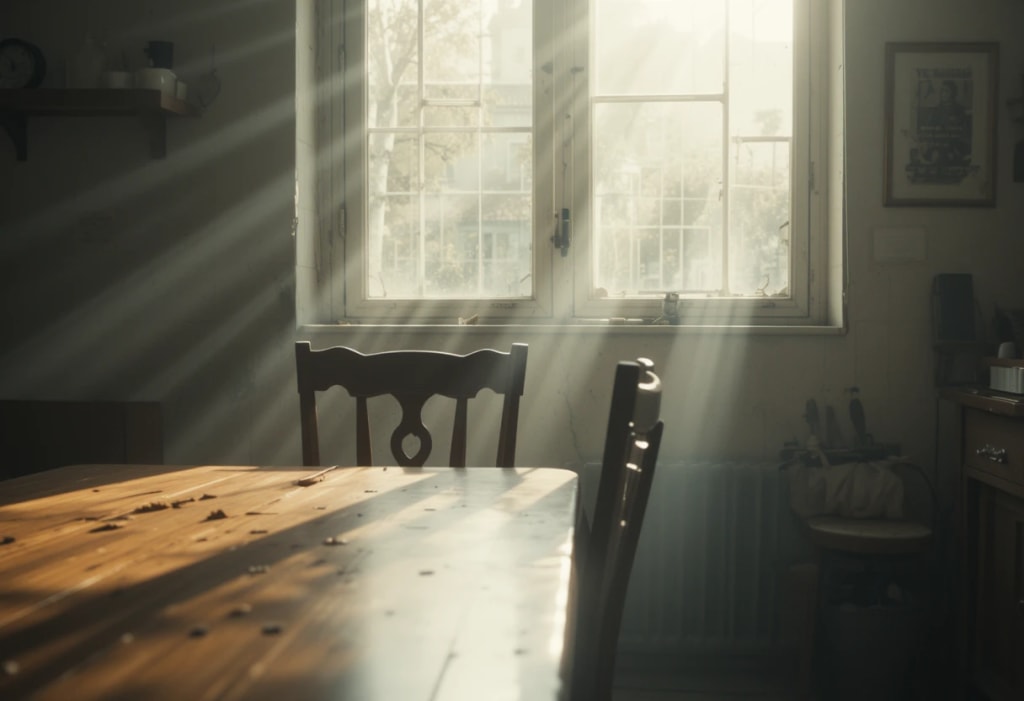
Grief Is Just Love with Nowhere to Go
They told me grief would come in waves.
They didn’t say some waves would come years later, quiet and sneaky, in the middle of doing dishes, or folding laundry, or hearing a song you forgot they loved.
They didn’t say that some waves wouldn't crash but instead soak into everything—your voice, your sleep, your silence.
They didn’t say that grief isn’t always loud.
Sometimes, it’s a whisper. A missing fork at the dinner table. A voicemail you can’t delete. The way no one uses their name anymore, like saying it aloud might open a wound we’ve all tried to suture shut.
The day after my mother died, I ironed a dress shirt for my brother.
I remember thinking how strange it was—this world where she was no longer breathing but starch still mattered. Where funeral clothes had to be wrinkle-free, and people brought pies to the house like dessert could fill the hole she left behind.
I remember thinking: Why does everything look the same?
The kitchen. The street. My toothbrush.
How could the sun keep rising like it didn’t notice the Earth had cracked?
The truth is, grief didn’t arrive like a tsunami. It arrived like fog.
Slow. Quiet. Creeping into everything before I realized I was walking through it blind.
And I walked through it for a long time.
I still do.
I used to think grief was a moment. An event. The crying at the funeral. The shaking hands. The tight hug from someone you barely know who says "she’s in a better place."
But grief isn’t a moment. It’s a place. A country you move to and never quite leave. You learn the language. You learn where not to step. You learn that some days, you’ll miss them like air.
You keep living, yes.
But you live differently.
Like there’s a window cracked somewhere inside you—letting in both the cold and the memory of warmth.
Grief, I’ve found, is just love that doesn’t know where to go anymore.
It used to go to her.
Into birthday cards, late-night texts, shared laughter at the ridiculous things only we found funny. Into her hands when she’d squeeze mine at the grocery store for no reason at all.
Now that love has nowhere to land. So it floats. It aches. It stings in strange places.
Some mornings, it settles in my throat.
Some nights, it curls beside me like a ghost I never invited.
No one tells you that grief can look like anger. Like exhaustion. Like forgetting where you left your keys for the third time in a week. Like not answering messages because you’re too tired to pretend you’re fine.
No one tells you that grief isn’t just about missing someone—it’s about everything you didn’t get to say.
The fights you didn’t get to apologize for.
The thank yous you didn’t say loudly enough.
The way you thought you had more time.
But grief has taught me things, too.
It’s taught me that love doesn’t vanish just because someone does.
It’s taught me that crying in the car is normal. That laughing at their favorite joke six years later is healing. That smelling their old sweater isn’t weird—it’s sacred.
Grief has taught me to be softer with people.
Because I now understand we’re all carrying something invisible.
A name we don’t say.
A photo we don’t post.
A hurt we revisit when the world goes quiet.
Some days, I’m okay.
The sun feels warm, and the world feels kind, and I can say her name out loud without choking on it.
Other days, she is everywhere.
In the smile of a stranger.
In the way someone tilts their head when they laugh.
In the sudden urge to call her, even though I know the number doesn’t work anymore.
And still, I reach.
That’s the thing about grief.
Even when you know better, your heart still reaches.
If you’re grieving, and you’re reading this, I want you to know something:
You’re not broken.
You’re not behind.
You’re not failing.
You’re learning how to love someone in their absence. And that is one of the hardest, most human things you will ever do.
There is no map for this. No timeline. No checklist.
Grief doesn’t follow logic. It doesn’t follow time.
It just follows love.
So, let your grief breathe.
Let it be messy. Let it curl up in your chest some nights and disappear the next.
Let it show you what mattered.
Let it remind you of the depth of your capacity to care.
Because grief, in all its sharpness and silence, is proof that we dared to love someone more than we could bear to lose.
And that, in itself, is something beautiful.
Something worth honoring.
I once thought grief was an ending. Now I know—it’s just another form of love.
And love, no matter how bruised or quiet, is always worth carrying.
About the Creator
Keep reading
More stories from waseem khan and writers in Motivation and other communities.
A Look at Life: Through the Cracks, the Light Still Comes In
The Story: I once met a man on a train who told me that he only understood life after he stopped trying to understand it. At the time, I was 22, freshly out of university, and convinced that life was something you could figure out if you just tried hard enough. I had my planners, my five-year goals, and a coffee addiction to fuel the illusion of control.
By waseem khan6 months ago in Motivation
Looking back: 2025 was a beast
It's difficult to know how to start this. I've suggested that it's been a tough one from my title and in many ways, it has; however, there is an argument that it's not been that extraordinary at all, merely this wonderful thing we call "life" with all its climaxes and pitfalls.
By Rachel Deeming27 days ago in Motivation
everything happens for a reason
People often say everything happens for a reason. Let's understand why. One day in a forest, a young man came to meet a wise saint. He was very sad and crying. The saint asked what happened. The young man said, "Everything I had is gone." Robbers stole everything. I have nothing left. Not even a way to go home. How can this be good? It's the worst thing ever. How can you say it's for the better? The saint replied, "Let me explain through a story," the saint began. Once a terrible flood hit a small village, washing away everything. A poor farmer's family lost even their little store of grain. The farmer's son said calmly, "It's okay, father. Let it go. Whatever happened happened for good." The farmer got angry and said, "Why are you saying such foolish things? Everything we had is gone. We don't even have food or shelter. He shouted at his son, "Go away. Leave me alone." The boy left in tears. But as evening came and the boy hadn't returned, the farmer felt regret. Suddenly, a rescue boat came and saved them. A villager said, "You scolded that boy for no reason. He was right. We got saved after all." But the farmer said, "How is this good? We still have no home, no food. What will we do now?" His wife said, "We may not have money, but don't lose hope. We'll manage somehow. I'll start working in nearby houses to earn a little. That will help us survive." The next day, the farmer went to the city to find work. He looked everywhere, but didn't get any work. He was worried. How would he take care of his family? They had no real house, just a small heart made from straw. One day, the farmer looked at his poor crops and felt even more hopeless. He said, "My son left home, too. I have lost everything." And people still say, "Whatever happens is for the best. How can this be good?" His wife consoled him. Don't worry so much. Try again. Things will get better. The Palmer agreed and went to search for work again. But again he found nothing. On the way back he met a saint. The saint asked him what was wrong. The farmer explained how the flood took everything. His house food and how life had become very hard. The saint said exactly that's why I'm saying what happened was good. The farmer got angry. How can you say that? I'm suffering. I have nothing. Even my son left me. The saint calmly said, "The answer to all your questions will come with time. Don't worry." That night, after the saint had spoken, the farmer sat quietly, thinking deeply about the words. He wondered if it could really be true that everything happens for a good reason. Later, the farmer got a job at a rich merchant's house. The merchant was kind and paid well. He even offered the farmer a house nearby to live in. One night, someone knocked at the farmer's door. When he opened it, he was shocked. It was his son. The son said, "You moved and didn't even tell me. I searched and found you here. I left that day and went to the city to find work. I got a small job first and then I saved enough to start a little tea stall. Slowly, I built a better life." The farmer was overjoyed. As his son spoke, he realized that even when everything seems wrong, life has a bigger plan, one that only time can reveal. The young man who was listening to this story said, "Okay, but in my case, everything was stolen. What good is in that?" The saint smiled and said, "Actually, I found something in the forest. Here, take this. It was a glowing stone." The young man realized it was a philosopher's stone, a magical stone that turns iron into gold. He said, "If my stuff hadn't been stolen, I wouldn't have come to the forest. I wouldn't have met you, and I wouldn't have found this treasure." So, friends, what did we learn from today's story? No matter how bad things get, time changes everything. Painful moments pass. Never make decisions in bad times that you'll regret later. Even the worst situations often lead to something better.
By nawab sagar6 days ago in Motivation
Wild Card Weekend Recap: What Happens Now?
I think I figured out why I love Wild Card Weekend so much. It's because it's the first playoff anything of the calendar year. The NFL season starts in the fall, and once upon a time, the champion was crowned either on or slightly before New Year's. The evolution of the NFL schedule has resulted in the playoffs starting just into the New Year, and currently, the final week of the season falls on the first weekend of the New Year, with Wild Card Weekend coming a week after that. So yes, chronologically, the NFL's Wild Card Weekend serves as the first playoff anything of the calendar year.
By Clyde E. Dawkins6 days ago in Unbalanced



Comments
There are no comments for this story
Be the first to respond and start the conversation.