
Goal setting model for high performance and motivation (1000+ experiments back it up)
Proven model for effective goal setting

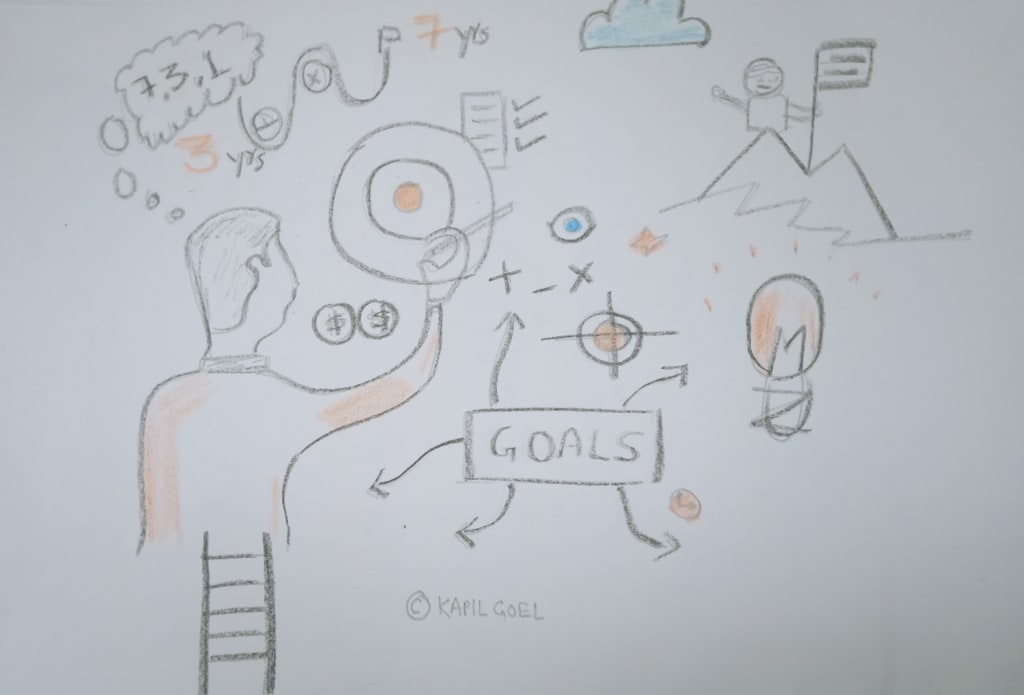
Goal setting is not new anymore. You would have heard and learned about S.M.A.R.T. (E.R.) goal-setting frameworks. Plenty of detail is available on the internet related to this framework.
I experienced that the SMART framework didn't answer everything for the goal setting. It didn't prompt me to calibrate my goals so that I can be engaged better while executing goals. I noticed minor gaps in it. I am not trying to disprove the SMART framework here. I am trying to bring another perspective on what worked for me and what didn't.
During my research, while writing this article, I thought of going deeper into the history of goal setting models backed with extensive research and studies. I found one popular name 'Locke'.
Locke's work became popular because of his extensive research on the goal-setting model and its impact on the performance and motivation of a creative individual. His model applies to personal goal setting and organization goals.
Setting goals is the first step in turning the invisible into the visible - Antony Robbins
In 1968 Edwin Locke revealed his research paper on "Theory of task motivation and incentives".
Later Gary P. Latham came up with goal setting and it's linking with performance.
In 1990, both had jointly come up with a 4CF goal-setting model. To support the model they conducted 1000+ laboratory and field experiments in the last 25 years.
This model has successfully answered - How an effective goal setting can be used to improve the performance and motivation of an individual or organization?
Goals have an energizing function. The higher the goal, the greater the effort invested - Latham & Locke
Duo came up with 5 principles of effective goal setting and its association with high performance and motivation.
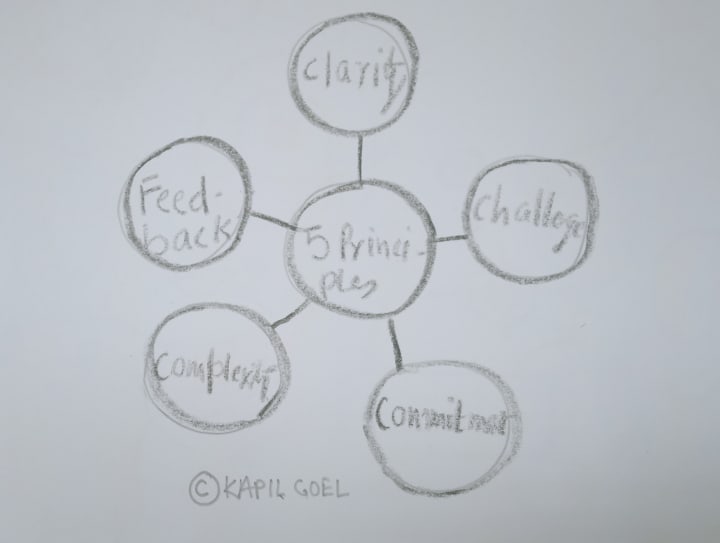
5 Principles of goal setting (4CF)
Clarity (C) - Every goal should have clear details added to it. If you have a goal to climb a big mountain. Is it clear? Is it compelling enough? You have to figure out the specifics. Specifics will help to provide a plan to act. You can use the following questions to get clarity around the goal (example) -
Challenge(C) - If you define a simple goal, you can achieve it easily. You will not put any effort into finding different ways to achieve your goals. Whereas on the other side challenging goals will make you find a better solution for every obstacle you encounter. It will make you engaged, action-oriented, and motivated to take bold actions.
The challenging goals should also be realistic and achievable. Avoid signing up for the goals, which are very simple or unrealistic. Let us look at examples -
- Easy Goal: I will train 100 people in one session on agile fundamentals by X date and secure a feedback score of 4/5.
I have taken this type of training in the past, I know the details. I am more confident. I can deliver it with minimal preparation and get good feedback from participants. I may not put a high degree of effort to research more on the subject. Resulting in lower self-engagement.
- Challenging Goal: I will train 100 in one session people on advanced agile topics by Y date and secure a feedback score of 5/5.
There are few areas of agile, which I haven't trained anyone. I need to prepare and work hard to make participants absorb the advanced topic. I need to think about various examples while training. This kind of preparation will keep me engaged and energized. It will compel me to work harder, smarter. Make sure I secure the good feedback from the participants.
Let us say, you only have a requirement to deliver a training on the fundamentals. So you can look forward to adding a twist to a simple goal and make it challenging. You can target to score 5/5 or add more details to your goal, like during the training you will make participants do a role play as one of the modules. This will make you think and engage and do above and beyond.
Commitment (C) - Without commitment, no goal will produce good results. You should be accepting the goal. You should be the owner of the goal. If there is no commitment, you will not put an effort. It will become an overhead. No matter how much you make it specific and challenging you will not be motivated to accomplish it. Often organizations face challenges when they do not involve people since inception.
I prefer not to sign-up for any goal, which is not clear to me. Rather I do think on the purpose and outcome of the goal first. Once I have clarity, I commit.
Complexity (C) - Adding too much complexity will be overwhelming. It may lead to a drop in morale, productivity, and performance. Make sure to calibrate the complexity and adjust to a moderate level. Providing adequate time and the right information to achieve the goal is essential to succeed.
Breaking down bigger complex goals and into small sub-goals or tasks will also help to simplify and get the clarity. Dividing sub-goals into manageable tasks will make the work even easier to achieve it.
Managing the tasks at the micro-level will give you the confidence to execute and see the micro results. It will create a reinforcement loop that will keep you moving towards your goal.
Feedback (F) - Continuous review and getting feedback for your goals will keep you on the track.
You can either get the feedback from others or create a system to generate the self-feedback. You can get the feedback during execution or reaching a milestone. In both cases, it should allow you to think and course correct. That will result in better engagement and motivation.
I do weekly check all of my goals and look for opportunities to improve. This gives me the strength to think differently and engaged.
Listing a few of the research facts on the goal setting
- People who write their goals are more likely to succeed by 50%.
- Only 8% of people who plan for new year resolutions, see the results of what they thought.
- Goals held in the mind are more likely to be jumbled up with the other 1500 thoughts per minute
- Sharing your goals with a close confide is proven to increase the chances of you achieving your goal.
- Setting goals is the first step in turning the invisible into the visible
- Goals have an energizing function. The higher the goal, the greater the effort invested.
Locke's theory will work for an individual and teams working for the organization. For achieving the best results from the employees there are 3 key drivers to follow before applying the 4CF.
Key drivers for 4CF to work effectively
Provide autonomy: Employee needs to have an autonomy and degree of freedom to choose the work.
Engage since inception: Employee needs to be engaged since the inception of the work being planned. They need to know the why and what of the initiatives.
Right skills: Essential knowledge and skill set is required.
The three things that motivate creative people - Autonomy, Mastery, Purpose - Daniel H. Pink (author of Drive)
Conclusion
Goal setting is having an impact on an individual's performance. Those who set difficult goals perform better than who sets easy goals.
Key points to remember -
- Pen down your goals, write details, and commit to it.
- Make them challenging and moderately complex.
- Create a system to provide you a regular feedback.
- Engage people, create an environment of autonomy, and develop the skill set.
In addition to the goal-setting, I also wanted to share one of the values which I follow, part of my manifesto. It helps me to progress every day for my set goals, remain engaged and motivated.
My manifesto value - Growth Over Goals (Value more on growth over goals, however, both plays an important role to succeed)
Do you have goals written? Do they challenge you?
Cheers !!
Kapil Goel
About the Creator
Kapil Goel
I coach and empower people to explore their passion and purpose (www.kapilgoel.com)
Keep reading
More stories from Kapil Goel and writers in Motivation and other communities.
How to stay motivated all the time? (reality or myth)
You might have learned about the motivation myth from the various sources around. However, in this read, I am going to provide you an enquiry based discovery to motivation reality. Stay tuned and focused till the end of the post.
By Kapil Goel5 years ago in Motivation
Looking back: 2025 was a beast
It's difficult to know how to start this. I've suggested that it's been a tough one from my title and in many ways, it has; however, there is an argument that it's not been that extraordinary at all, merely this wonderful thing we call "life" with all its climaxes and pitfalls.
By Rachel Deeming27 days ago in Motivation
Wild Card Weekend Recap: What Happens Now?
I think I figured out why I love Wild Card Weekend so much. It's because it's the first playoff anything of the calendar year. The NFL season starts in the fall, and once upon a time, the champion was crowned either on or slightly before New Year's. The evolution of the NFL schedule has resulted in the playoffs starting just into the New Year, and currently, the final week of the season falls on the first weekend of the New Year, with Wild Card Weekend coming a week after that. So yes, chronologically, the NFL's Wild Card Weekend serves as the first playoff anything of the calendar year.
By Clyde E. Dawkins6 days ago in Unbalanced




Comments
There are no comments for this story
Be the first to respond and start the conversation.