
Creativity Is a Process, Not an Event
Why true creativity unfolds over time, through persistence, curiosity, and growth ---

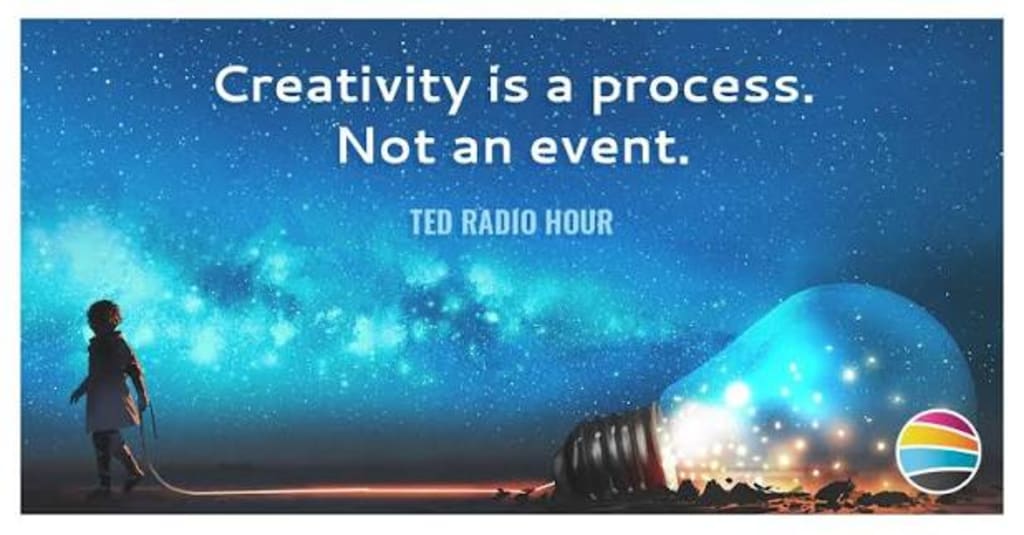
When we think of creativity, we often imagine a lightning bolt of inspiration—a single, magical moment when an artist paints a masterpiece, a scientist makes a discovery, or a writer pens the perfect line. But in reality, creativity doesn’t work like that. It’s not a single event; it’s a process—one that evolves through time, effort, and many small steps forward.
The world’s most creative minds, from Leonardo da Vinci to Steve Jobs, didn’t rely on random moments of genius. Instead, they built their creativity through consistent curiosity, learning from mistakes, and refining their ideas over and over again. Understanding this process helps us realize that creativity isn’t reserved for a few gifted people—it’s something we can all develop.
---
1. The Myth of the “Creative Moment”
The biggest misunderstanding about creativity is that it happens all at once. Movies and books often show inventors or artists having sudden bursts of inspiration. But most creative achievements are the result of many small moments of progress that build on each other.
Take Thomas Edison, for example. When asked how he invented the light bulb, he famously said, “I didn’t fail 10,000 times. The light bulb was an invention with 10,000 steps.” His creativity came from patience, experimentation, and persistence—not from a single spark of brilliance.
Similarly, musicians like Taylor Swift or filmmakers like Christopher Nolan spend months—or even years—developing a song or a story. Each draft, rewrite, and experiment brings them closer to the finished masterpiece. Creativity, at its core, is slow and deliberate work.
---
2. Curiosity: The Starting Point of Creative Thinking
Every creative process begins with curiosity. The desire to explore, question, and understand is the foundation of all innovation. When people stay curious, they’re more likely to discover unexpected connections and new perspectives.
For instance, Albert Einstein once said, “I have no special talent. I am only passionately curious.” His theory of relativity didn’t appear overnight—it was the result of years of questioning how time and space interact.
Curiosity encourages us to see the world differently. It pushes us to ask “What if?” and “Why not?”—questions that spark the creative process and keep it moving forward.
---
3. Observation and Experimentation
The next stage in the creative process is observation—noticing details others overlook—and experimentation, testing ideas in different ways. Creative people often take inspiration from their surroundings and use their senses to discover patterns, problems, or possibilities.
Artists study light and color. Writers listen to conversations and emotions. Scientists observe natural phenomena. Through this process of watching and experimenting, they begin to form new ideas.
For example, the painter Claude Monet didn’t just paint water lilies once. He painted them hundreds of times, observing how light changed the same scene throughout the day. His creativity was built through repetition and experimentation—not a single moment of genius.
---
4. Failure as Part of the Process
If creativity is a process, then failure is one of its most important steps. Every mistake teaches something new and brings the idea closer to success.
The inventor James Dyson tested over 5,000 prototypes before creating the world’s first bagless vacuum cleaner. Each failure gave him insight into what worked and what didn’t. Without persistence, his creative vision would have remained just an idea.
In art, science, and business, creative people embrace failure as feedback. They understand that mistakes aren’t signs of weakness—they’re essential parts of learning.
---
5. The Role of Time and Reflection
Creativity needs time. Ideas often grow in stages, with periods of active work followed by rest and reflection. During quiet moments—while walking, cooking, or daydreaming—the brain continues to process ideas subconsciously.
Psychologists call this the incubation stage of creativity. It’s when solutions appear to “come out of nowhere,” but in truth, they’ve been forming beneath the surface for some time.
For example, the mathematician Henri Poincaré once described how an important insight came to him as he stepped onto a bus—after days of frustration with a complex problem. His brain had been quietly working in the background, piecing things together.
Creativity thrives when we give ourselves time to think, step back, and let ideas mature naturally.
---
6. Collaboration and Sharing Ideas
No creative process happens in complete isolation. Collaboration often brings fresh perspectives that push ideas forward. Sharing thoughts with others—friends, mentors, or teammates—helps refine and expand creative work.
Consider how The Beatles evolved as musicians. Their creativity didn’t just come from individual talent, but from the way they inspired and challenged each other. Each member contributed something unique, and together they created music that changed the world.
In today’s connected world, creative collaboration happens across borders and disciplines. Scientists, designers, and artists use online platforms to share ideas and co-create innovations faster than ever.
---
7. Discipline Turns Ideas into Reality
While imagination starts the creative process, discipline finishes it. Turning ideas into something real—whether it’s a painting, invention, or book—requires focus and hard work.
The author J.K. Rowling spent years writing Harry Potter while working as a teacher and raising a child. Her success didn’t come from a single flash of inspiration, but from years of dedication to her craft.
Discipline ensures that ideas don’t fade away. Creativity may begin with inspiration, but it survives through routine effort—drafting, editing, and improving until the final version is ready to share with the world.
---
8. Embracing the Journey
Ultimately, creativity is less about a destination and more about the journey.
About the Creator
Fiaz Ahmed
I am Fiaz Ahmed. I am a passionate writer. I love covering trending topics and breaking news. With a sharp eye for what’s happening around the world, and crafts timely and engaging stories that keep readers informed and updated.
Keep reading
More stories from Fiaz Ahmed and writers in Motivation and other communities.
Absolute Success is Luck. Relative Success is Hard Work.
People often say that hard work guarantees success, but reality is more complicated. The truth is that absolute success—becoming the best in the world, the richest, or the most famous—is often shaped by luck. Being born at the right time, meeting the right people, or catching the right opportunity can change everything. Yet relative success—doing better than most, improving yourself, and achieving stability—comes from hard work, persistence, and skill.
By Fiaz Ahmed 4 months ago in Motivation
What’s Next for Marienna Mercedes Rathgeber Joiner?
For the past decade, Marienna Mercedes Joiner has built a reputation online as an entrepreneur, business strategist, marketing expert, and personal brand mentor helping creators and founders turn their knowledge into profitable online businesses and brands.
By Marienna Mercedes5 days ago in Motivation


Comments
There are no comments for this story
Be the first to respond and start the conversation.