
Bengali newspaper The Daily Ittefaq
The Daily Ittefaq

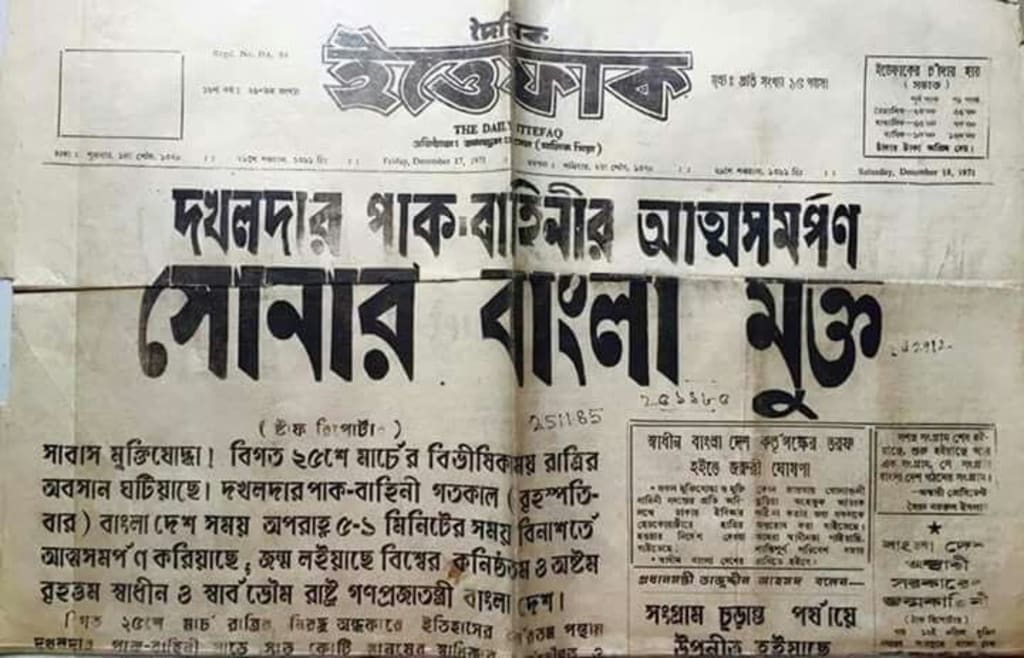
The image shows the front page of the Bengali newspaper The Daily Ittefaq published on December 17, 1971, the day after the official surrender of the Pakistani military in Dhaka during the Bangladesh Liberation War.
The headline in bold Bengali reads:
“দখলদার পাকবাহিনীর আত্মসমর্পণ - সোনার বাংলা মুক্ত”
“The occupying Pakistani forces surrender – Golden Bengal is free”
Translation and Summary of the Main Article:
The article celebrates Bangladesh’s victory and the surrender of the Pakistani army on December 16, 1971. It mentions:
• General A.A.K. Niazi, commander of the Pakistani Eastern Command, surrendered with about 93,000 troops to the joint forces of the Indian Army and Mukti Bahini (Bangladeshi freedom fighters).
• This surrender marked the end of the Bangladesh Liberation War and the birth of the independent nation of Bangladesh.
• The article praises the bravery and sacrifices of the freedom fighters, civilians, and allied forces, highlighting that after nine months of bloody struggle, the country is finally free from occupation.
• The report emphasizes that the dream of “Sonar Bangla” (Golden Bengal) has now been realized.
This was a historic day for the Bengali people, commemorated annually as Victory Day (Bijoy Dibosh) in Bangladesh on December 16.
Would you like a full English translation of the full text or a cleaned-up version for presentation?
Certainly! Here’s a more detailed summary and partial translation of the front page of The Daily Ittefaq, dated Friday, December 17, 1971, the day after the victory of Bangladesh in the Liberation War:
⸻
Headline:
“দখলদার পাকবাহিনীর আত্মসমর্পণ - সোনার বাংলা মুক্ত”
Translation: “The occupying Pakistani forces surrender — Golden Bengal is free”
⸻
Main Article (Partial Translation and Summary):
“স্বাধীন বাংলাদেশ!”
“Independent Bangladesh!”
After a long nine-month struggle, marked by the sacrifices of millions and a brutal genocide by the Pakistani army, Bangladesh is finally free.
On December 16, 1971, at around 4:31 PM, the commander of the Pakistani Eastern Command, Lieutenant General A.A.K. Niazi, signed the instrument of surrender in Dhaka, in the presence of Lieutenant General Jagjit Singh Aurora of the Indian Army and senior Mukti Bahini commanders.
More than 93,000 Pakistani soldiers surrendered — the largest surrender of troops since World War II.
The whole country erupted in joy. People flooded the streets with tears of happiness, shouting slogans of “Joy Bangla” and waving the new red-green flag of Bangladesh.
The article honors the martyrs of the liberation struggle and recognizes the heroism of the Mukti Bahini and the support of the Indian Armed Forces in achieving this historic victory.
⸻
Side Columns Include:
• An announcement that radio stations broadcast the surrender live, and people in every corner of the country listened in awe.
• Calls for nation-building now that freedom has been achieved.
• Emphasis on unity, peace, and rebuilding a “Sonar Bangla” — a prosperous and golden Bangladesh.
⸻
This newspaper front page is not just a piece of news—it is a symbol of Bangladesh’s rebirth. Would you like a line-by-line English translation of the entire main article, or a historical background explanation of the events leading up to this surrender?
Absolutely. Here’s a deeper explanation and historical context of the front page of The Daily Ittefaq from December 17, 1971, which declared Bangladesh’s independence through the surrender of Pakistani forces:
⸻
Background of the Headline: “Sonar Bangla Mukt” (Golden Bengal is Free)
The Liberation War of Bangladesh began on March 26, 1971, following the brutal crackdown by the Pakistani military on unarmed civilians in Dhaka on the night of March 25, known as Operation Searchlight. The West Pakistani regime, led by General Yahya Khan and Zulfikar Ali Bhutto, refused to accept the election results of 1970, in which the Awami League, under Sheikh Mujibur Rahman, won a clear majority.
This triggered:
• Mass killings and atrocities, particularly targeting Bengali civilians, intellectuals, and Hindus.
• A full-fledged independence movement supported by the Mukti Bahini (freedom fighters).
• A humanitarian crisis, with over 10 million refugees fleeing to India.
⸻
Role of India and the Final Assault:
India, under Prime Minister Indira Gandhi, extended support to the Mukti Bahini and eventually entered the war on December 3, 1971, after Pakistan launched airstrikes on Indian airbases. This marked the beginning of the Indo-Pakistani War of 1971, which lasted just 13 days—one of the shortest full-scale wars in history.
On December 16, 1971:
• Pakistani forces led by Lt. Gen. A.A.K. Niazi surrendered to Indian Army General Jagjit Singh Aurora at the Racecourse Ground (now Suhrawardy Udyan) in Dhaka.
• The formal surrender was signed in front of international media.
• This surrender marked the birth of the independent nation of Bangladesh.
⸻
Significance of the Newspaper Front Page:
• The Daily Ittefaq was one of the most influential newspapers in East Pakistan (now Bangladesh), known for its pro-independence stance.
• This front page reflects the official and emotional confirmation that Bangladesh had achieved complete liberation.
• The bold headline “Sonar Bangla Mukt” (Golden Bengal is free) expresses the fulfillment of a national dream.
• The issue commemorates Victory Day (Bijoy Dibosh), which is still celebrated every year on December 16.
⸻
Legacy and Historical Impact:
• The surrender of 93,000 Pakistani troops remains the largest since World War II.
• The war cost an estimated 3 million lives, with countless others affected by rape, displacement, and destruction.
• Bangladesh emerged as a sovereign nation, with Sheikh Mujibur Rahman later becoming its first Prime Minister.
⸻
This newspaper page is more than a historic document; it’s a symbol of freedom, resilience, and national identity.
Would you like me to recreate this newspaper in English with the same design and layout, or are you looking for more personal stories from that time?
About the Creator
Reporter Rupom
I am on reporter on Bangladesh news
Keep reading
More stories from writers in Motivation and other communities.
One Hard Thing
Stop me if you’ve heard this one before: You have the number, you know your schedule- you’ve even picked out the perfect day and time to make this appointment. Shoot, you’ve even picked out alternative days and times just in case their schedules can’t accommodate you!
By Taylor Rigsby12 days ago in Motivation
~ Fired ~
— Ai Intrusion ~ Are you Next ~ Is Ai Evolution after your job? — Few workplaces haven't been affected. Ai is in supermarkets, at doctors' offices, and even monitoring farms. I just can't think of anything this machine is not getting into, can you? For instance: Education ~ Law and Tech jobs will one day have a major influence or be taken over by these inanimate machines, with accuracy and vigor. From mechanics' diagnoses to a wide variety of everyday jobs, including fast food workers, with this input having the ability to cut their unnecessary work hours. I'm certain all of us have been touched by this with our short stories and colorful headings, have you? Even comments are very questionable 'Non-Robot' insertions.
By Jay Kantor5 days ago in Journal


Comments
There are no comments for this story
Be the first to respond and start the conversation.