
All I need is:
A hook, some yarn, and a pair of Fiskars

Sitting under a canopy of hundred-year-old pine trees in my northern Montana home, I pondered the long winter months setting in for the season. Like the weather, my life was in a winter of its own, gray, bleak, void of the new life I found in my children and grandchildren several states away.
I mentally surveyed my supply cabinet of embroidery and tatting thread. So much color. So much happiness waiting for me to embrace every time I opened that box of miscellaneous leftovers and thrift store finds.
I learned to crochet from my great-grandmother when I was eight years old. Ironically, as a lefty, I learned how to wind this soft and sensual thing called yarn around the calm, cool surface of my aluminum hooks by laying on my back, watching my great-grandma from the floor. In those days, the 1970s, my family wasn't knowledgeable about reaching out to a hyperactive, difficult learner like me who was very good with creative endeavors and in the "dummy" category when it came to most things academia.
I took up a craft accidentally that wove itself around my heart and stayed with me for a lifetime. As a young adult, when pushing through a decades-long marriage overflowing with stress and mandatory relocation, I turned to crochet to survive. I longed to pick up that aluminum needle and expertly intertwine it into a ball of thread. Parched of relaxation and escape, I used that small, fingering release to restore my soul.
By the time 2010 rolled around, I'd crocheted so many blankets my children begged me to stop. I turned to the Internet for free crochet patterns and found an International community that became my extended family. They spoke every language on the planet. But through the magic of Facebook translation, I learned that regardless of where on this planet we existed, the love of crochet made us a family.
Moving, moving, moving. Always moving. By the time my oldest daughter turned 18, we had moved ten times. And each move was motivated by my partner's tremendous anger. Once the kids were gone, there were half dozen more. I'd missed planning the daughter's wedding, the birth of my grandchildren, and countless birthdays. My daughters attended college classified as "homeless," and the chasm that spread between us drilled into the ground like an oil well rigger.
But crochet was present. The small bag with yarn, hooks, a pattern, and Fiskar's scissors tucked into a plastic ziplock sat close by everywhere I moved.
The move to northern Montana was particularly hard. I arrived with the contents of my airline bags and one of our family dogs. I'd given up. Id' accepted that part of marriage was sticking it out no matter how many bad times overwhelmed the good times. This misery was my destiny. And this time, my yarn, my hook, and my scissors were gone too.
I still owned crochet supplies and a library of fluffy colorful yarn, but it was located at the other end of the country and only something I could visit as long as I paid my storage bill. The depression and void became too much. Food wasn't enough of an anxiety release, and crochet was out of the question. That's when I found the neighborhood thrift store.
For a dime, and sometimes a quarter, my local thrift store supplied the drug I needed to survive. One hook, some Fiskars, and some yarn. This hunt for crochet supplies became a joy. The smaller the town I visited, the higher chance I would find a lovingly used needle, sculpted with time and repeated use that some other family relative did not realize was so important and gave away. Always looking for something smaller to do, keeping it small enough to carry with me next time I moved, I took up thread crochet. Tiny metal needles, thin decades-old, and discarded thread were the object of my passion, my obsession for calm.
I hopped onto the Internet and learned the history of the crochet hook, the craft itself, how to spot an antique needle, and why closely-cherished crochet hooks made of cattle bones were special. In my own private world, I cherished tiny metal sticks and discarded thread. On payday, I allowed myself $20 for supplies.
The first Christmas I spent in northern Montana, missing my children and wishing I was enjoying the kids' families, I realized my annual depression would strengthen. To ward off my own deep and disturbing distress, I latched onto the idea that I could buy a brand-new embroidery floss at Walmart for a quarter, crochet the tiny hanks together, and make something beautiful. I made my first crochet nativity; Joseph, Mary, and the baby Jesus.
My passion for amigurumi crochet dolls skyrocketed. After that, I slowly accumulated unused embroidery floss, crochet, and tatting threat to make a brand new, happy, colorful, custom world just for me to inhabit and live. That world of dolls and caravans and circus creatures relieved my constant stress, calmed my growing fears, stabilized my always aching heart.
Northern Montana continues to be my favorite relocation spot to date. But the impending winter months signaled a very real and annual desire to prepare for the days when the sparkling blue and white snow would stop me from leaving the heat of my bed. Color. Happiness. Boy, did I need those things.
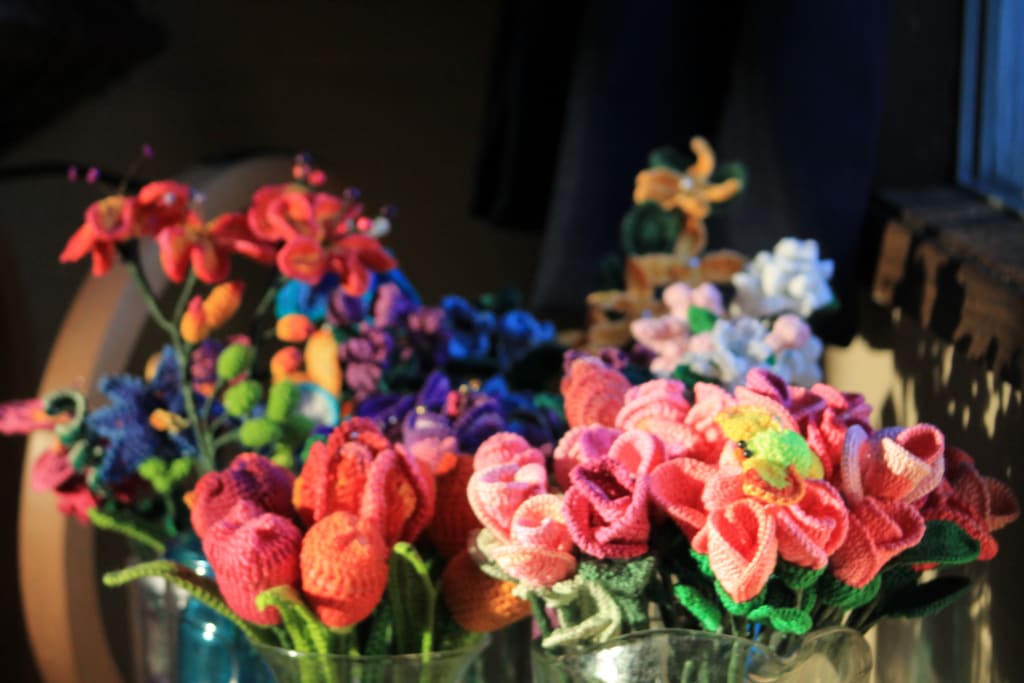
Days before, I'd been on Pintrest looking at crochet dolls, and I thought to myself that my world would be an even happier escape if I could outfit that land with a rainbow of flowers and life. What a perfect use for all that embroidery thread. The hunt was on. I made crochet trees, doll swings, bushes, and flowers. The outcome was so beautiful I craved more.
The Internet is a glorious place, and a forum called Ravelry was popular. Free and paid patterns popped up for flowers of all kinds. Bloggers posted countless free foliage designs I used to create a garden of life. With every tiny flower I created, my heart jumped a little more. Each payday, I spent my allotted sum buying floss, flower tape, wire, tools, and of course, an extraordinary pair of Fiskars I kept in a jar next to my nighttime eyeglasses for steady, dependable use.
As time passed and my small collection got me through another depressing holiday season, I realized that I needed to crochet myself a flower shop with which to line my wall and celebrate the glory of color under the windows of my home. And the hunt was on for more realistic, more detailed, more intricate patterns. That is where my Facebook groups taught me an important lesson.
Crochet subsets abound, and I am a member of dozens of groups. I offer my advice to younger crocheters looking for guidance, and I gather inspiration from northern European crochet artists that sculpt life-like art the size of my hand. I roam around the world looking for special entrepreneurs whose dedication is as focused as my own.
In 2017, Hurricane Maria loomed south of theUnited States. I'd joined the Flawless Crochet Flowers Facebook Group and paid to participate in one of her incredible classes. (Letecia Lebron has such immense talent!) Just before it was time to start our class, Hurricane Maria swept over Puerto Rico and wiped out our teacher's home. She lost everything, just like me. I, my fellow classmates and Facebook followers, worried and prayed and repeatedly checked for word from our fearless leader. None of us cared about the class, the money, the time, or anything else. Regardless of our place on the planet, we were all united in our concern for our teacher.
Several days later, our teacher's sister notified us that she was alright. She lost her home and her belongings, but she and her family were safe and on their way south to her sister's house to recover. When the American government failed to provide supplies and services, we were on hand to help, to fight for our brethren we'd never seen, never heard. When the time was right, the class occurred, and every time I look at the bamboo plant I made at that class, I think about how much I love to crochet, our teacher, and the fact that my International family is just on the other side of my computer screen. The art of crochet saves my heart again.
With crochet and the Internet, no country is off-limits. I've worked with Italian, Dutch, German, Ukraininan, and Romanian designers who all provided patterns in several languages. And my crochet flower shop, as well as my doll collection, grew more beautiful with each creation.
I still move today, though the stress is gone because the danger of anger no longer exists. I am reconnected to my children and grandchildren and am so happy to share my love of crochet with them. The very best part of this story is that my seven-year-old granddaughter and six-year-old grandson wanted to learn this art. It was finally time for me to share this global family with my most precious grandbabies. I bought each of them a calming aluminum hook, a skein of yarn, and a pair of Fiskars.
In a month, I move into the home of my grandchildren. I will arrive with a moving van of supplies, the experience of being a craft store crochet teacher myself, and the desire to help instill in them the love of crochet. If they are not ready, we can explore sewing, papercraft, origami, painting, or whatever strikes their creative muse. When I unpack those boxes, the kids can help me set up more than 50 tiny dolls less than six inches tall, my pirate's ship, my animal carnival, my Pinnochio marionette, my ice cream truck, and my camping trailer. Instead of using crochet to escape stress, it will be a vehicle to escape an ugly world and fill it with life, love, and color.
About the Creator
Keep reading
More stories from writers in Motivation and other communities.
One Hard Thing
Stop me if you’ve heard this one before: You have the number, you know your schedule- you’ve even picked out the perfect day and time to make this appointment. Shoot, you’ve even picked out alternative days and times just in case their schedules can’t accommodate you!
By Taylor Rigsby4 days ago in Motivation
10 Things You Should Know About Bishop Dwight Reed and His Ministry Work
Faith-based leadership is founded on more than just titles; it calls for long-term commitment, expertise, consistency, and service. Bishop Dwight Reed's decades of leadership, organisational growth, and community-focused outreach demonstrate these attributes in his ministry. Here are ten key ideas that illustrate the organisation, vision, and significance of his work for readers who want a comprehensive picture of him and how his ministry operates.
By Smith Colin about 16 hours ago in Motivation
The Path to Salvation
The late autumn evening air filled the monk's lungs, but it wasn't the season that chilled his bones. The heavy-handed presence of evil he had sensed upon entering the woods surrounding this mountain village had not bothered to conceal itself from him.
By Made in DNA8 days ago in Fiction




Comments
There are no comments for this story
Be the first to respond and start the conversation.