
7 Tips To Get Rich Slowly
Dont Work For Money , Make Money Work For You.
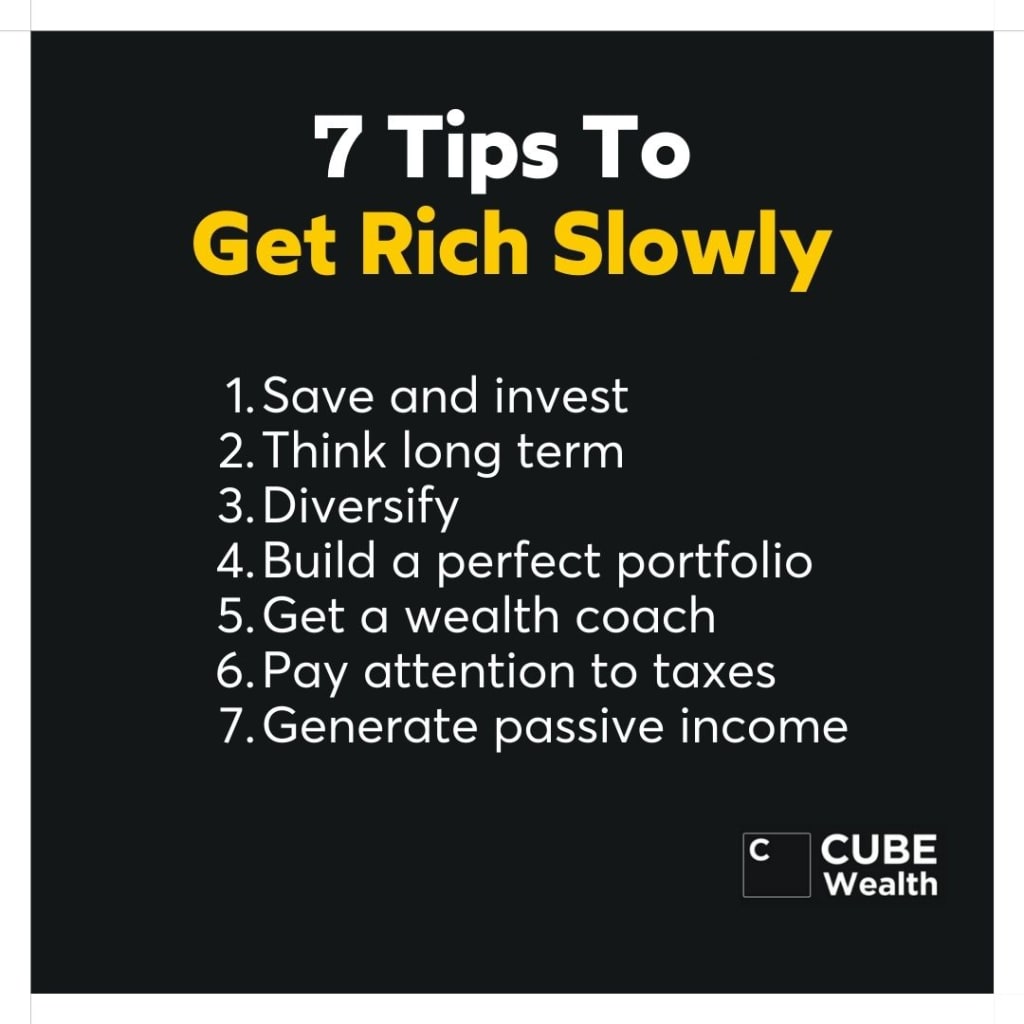
- Save and Invest:
Saving and investing are two important components of personal finance that are essential for building wealth and achieving financial security.
Saving refers to setting aside a portion of your income for future use, usually in a savings account or a similar low-risk investment vehicle. The purpose of saving is to have a financial cushion to cover emergencies, pay for big-ticket items, and provide a source of funds for future goals. It's important to have a regular saving habit and to avoid dipping into your savings unless it's necessary.
Investing, on the other hand, is putting your money into financial products or assets with the expectation of earning a return. This could include stocks, bonds, mutual funds, real estate, and more. The idea behind investing is to put your money to work for you, so it can grow and compound over time. While investing carries more risk than saving, it can also offer greater potential for return.
- Think Long Term:
The phrase "think long term" refers to the mindset of considering the future consequences and impact of present actions, rather than solely focusing on immediate results. It's a philosophy that prioritizes making decisions and taking actions that will have positive effects not just in the short-term, but over the long haul.
For example, investing time and resources into developing skills, building strong relationships, or creating a sustainable business model that provides long-term benefits rather than quick wins. It's a way of approaching life and work with a view to making choices that will pay off in the future, rather than just in the moment.
Thinking long-term requires discipline, patience, and a willingness to forgo immediate gratification for the sake of future success. But it also leads to a more fulfilling and sustainable life, as well as a better world overall.
- Diversify:
Diversification is a risk management strategy that involves spreading investments or resources across a variety of different areas or sectors. The idea behind diversification is to reduce the overall risk of an investment portfolio by spreading investments across multiple assets or industries.
For example, instead of investing all of one's savings in a single stock or sector, a diversified portfolio might include investments in stocks, bonds, real estate, and commodities. This way, if one investment performs poorly, it won't have a significant impact on the overall portfolio, as the gains from other investments can help balance it out.
The principle of diversification can be applied to many areas of life, not just financial investments. For example, a company might diversify its product offerings or a person might diversify their skill set.
In summary, diversification is a strategy for reducing risk by spreading investments, resources, or efforts across a variety of different areas or sectors, with the goal of reducing the overall impact of any single investment or loss.
- Build A Perfect Portfolio:
Building a perfect portfolio refers to the process of creating an investment portfolio that is well-rounded and diversified, with the goal of maximizing returns and minimizing risk. A perfect portfolio is one that is tailored to an individual's specific financial goals, risk tolerance, and investment time horizon.
To build a perfect portfolio, an individual must first determine their financial goals, such as saving for retirement, buying a home, or generating income. Then, they must assess their risk tolerance, which is the level of risk they are willing to accept in their investments. With these two factors in mind, they can then choose a mix of investments, such as stocks, bonds, real estate, commodities, and others, that align with their financial goals and risk tolerance.
It's important to note that building a perfect portfolio is not a one-time process, but rather an ongoing effort that requires regular monitoring and rebalancing. As an individual's financial goals and risk tolerance change over time, their portfolio should be adjusted accordingly.
- Get A Wealth Coach:
A wealth coach is a professional advisor who helps individuals and families make informed decisions about their finances and investments. The goal of a wealth coach is to help clients build and maintain wealth over the long term by developing a comprehensive financial plan that takes into account their current financial situation, future goals, and risk tolerance.
A wealth coach can provide a range of services, including budgeting and cash flow management, debt management, investment planning, tax planning, estate planning, and retirement planning. They can also help clients understand their financial situation and make informed decisions about their investments, including stocks, bonds, real estate, and other assets.
Working with a wealth coach can provide many benefits, including increased financial literacy, improved financial decision-making, and reduced stress and anxiety related to finances. A wealth coach can also help clients create a clear financial plan and provide accountability and support to ensure that they stay on track and reach their financial goals.
- Pay Attention To Taxes:
Paying attention to taxes refers to being mindful of the various tax implications of financial decisions and taking steps to minimize the tax liability associated with those decisions. Taxes can have a significant impact on an individual's financial situation, and by paying attention to taxes, individuals can keep more of their hard-earned money and maximize their wealth.
Some common tax-saving strategies include maximizing contributions to tax-advantaged retirement accounts, such as IRAs and 401(k)s, taking advantage of tax deductions and credits, and carefully managing taxable income. For example, individuals can reduce their taxable income by contributing to a traditional IRA or 401(k), which reduces their taxable income in the current year and grows tax-free until withdrawal.
Individuals can also pay attention to taxes when making investment decisions. For example, they can choose investments that are tax-efficient, such as index funds, which tend to have lower turnover and generate fewer capital gains than actively managed funds.
- Generate Passive Income:
Generating passive income refers to creating sources of income that require little or no ongoing effort on the part of the individual receiving the income. Passive income can be generated from a variety of sources, such as rental properties, dividend-paying stocks, and online businesses, among others.
The key idea behind passive income is to create a stream of income that continues to flow even if the individual is not actively working. This allows individuals to have a more secure financial future, as they have multiple sources of income that can help support them if their primary source of income decreases or is lost.
ThankYou for spending your valuable time by reading this valuable Tips.
I hope you Understand These Tips and take steps on it.
THANK YOU..
About the Creator
Saravana
Hi myself saravana i am 16y/o.
Keep reading
More stories from Saravana and writers in Motivation and other communities.
You're the average of the five people spend the most time with
Your close relationships shape your habits and behavior. Your close relationships have a powerful impact on shaping your habits and behavior. The people you spend the most time with, whether it be family, friends, or coworkers, can influence your actions, thoughts, and beliefs. For example, if you spend a lot of time with someone who has a healthy lifestyle, you may find yourself picking up similar habits, such as exercising regularly and eating nutritious food. On the other hand, if you spend time with individuals who have negative habits, such as smoking or negative mindset, you may find yourself adopting similar habits. This is because the people you surround yourself with can serve as role models and shape your behaviors.
By Saravana 3 years ago in Motivation
How Great Leaders Communicate
The moment she walked in the room, skeptics. The business was losing money. Moral reached its lowest point. Engineers updated their resumes without fuss and board was three weeks away from pulling the plug completely. Maya had no PowerPoint deck, no images and no expensive corporate script when she stepped to the front of that conference room.
By StoryNest6 days ago in Motivation
The Marathon of Hope: The Story of a Man Who Never Ran Out of Courage
Sometimes life takes away something very precious from us just to see how strong we really are. This is the true story of a young man named Terry Fox. Terry was a very active boy who loved sports. He was a basketball player and a runner. He had big dreams for his future. But when he was only eighteen years old, he felt a sharp pain in his right knee. When he went to the doctor, he received the most terrible news: he had bone cancer.
By Hazrat Umer6 days ago in Motivation
Review of 'Man on the Run'
My wife and I saw Man on the Run, a nearly 2-hour documentary on Amazon Prime, about Wings, Paul McCartney's group that flew around the world from shortly after The Beatles broke up in early 1970 to shortly after John Lennon was murdered at the end of 1980, making a Beatles reunion forever impossible.
By Paul Levinson6 days ago in Beat



Comments
There are no comments for this story
Be the first to respond and start the conversation.