
Whispers of Port na hAille
Arthur felt a memory in his bones, for a place he'd never seen.
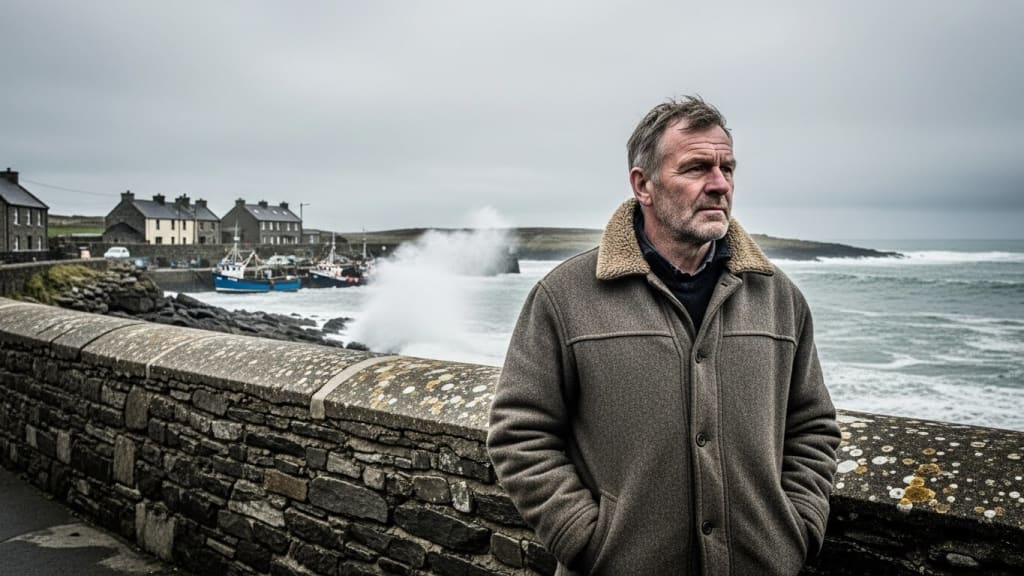
Arthur’s hands knew wood, knew metal, knew the stubborn refusal of an old engine and the yielding give of a well-planed plank. His workshop smelled of sawdust and oil, a familiar comfort, a constant in a life marked by quiet routines. Every morning, before the sun properly cleared the neighbour’s maple, he’d be there. Coffee in a thick ceramic mug, the low hum of the fluorescent light, the silent agreement with the tools hanging on the pegboard, waiting. He was a man of few words, his thoughts mostly private affairs, tucked away behind eyes that had seen forty-odd years of the same sky. The world outside his garage, the one beyond the town limits, felt distant, almost theoretical.
Then came the estate sale. An old widow’s house, packed to the rafters with a lifetime of things. Arthur wasn’t looking for anything, just helping out a buddy who needed an extra pair of hands to haul out a rusty anvil. But in the dusty corner of a forgotten attic, shoved beneath a moth-eaten quilt, he found a box. Inside, a photo album, its leather spine cracked, pages brittle. Sepia-toned ghosts looked back at him, strangers from another time. He almost put it back, but a face, an old man with eyes like polished stones, held him. He paid the two dollars, an impulse he couldn't explain.
That night, at his kitchen table, the album spread open under the harsh glow of the overhead light, he saw it. Not just pictures, but a place. A village clinging to a rugged coast, stone houses huddled against a churning grey sea. Small fishing boats, paint peeling, nets drying on rocky shores. Wind-bent trees, low stone walls, a narrow lane snaking up to a distant, unseen hill. He’d never seen anything like it. And yet, an ache started in his chest, low and deep, like a forgotten muscle twinging to life. A profound, unsettling familiarity. He traced a finger over the grainy image of a child on a cobblestone street, and for a breath, he felt the chill of the sea wind, the dampness of the air, the distant cry of a gull.
He spent weeks with that album. Martha, his wife, would find him at odd hours, hunched over the kitchen table, sometimes a magnifying glass in hand, studying the tiny details. The way the smoke curled from a chimney. The precise angle of a fishing skiff hauled onto the sand. The craggy faces of the men in heavy sweaters. He bought old maps of Ireland, spread them out next to his blueprints, searching. He found the village, or what he was sure was the village, etched into the coast of County Clare: Port na hAille. Port of the Cliff. The name felt right, tasted right on his silent tongue.
It made no sense. He was Arthur, from Ohio. His people had been here for generations, solid ground, no salt spray in their blood. He'd never even left the continent. Yet this place, these spectral photographs, they whispered to something deep inside him, a language he understood without ever having learned it. It was like remembering a dream you couldn't quite grasp, a half-formed image of belonging. He felt foolish, chasing a ghost, but the feeling wasn’t going away. It burrowed in, a dull throb, demanding attention.
He started saving. Small chunks, tucked away from workshop earnings, from odd jobs. Martha, she didn't ask. She just watched him, the way he moved now, a subtle purpose in his steps. One evening, months later, he placed a travel brochure on the table, face down, next to her knitting. She picked it up, turned it over. 'Ireland,' she said, not a question, not a judgment, just a quiet observation. He nodded. That was it. No big speeches, no declarations. Just a plan, unfolding, slow and steady like the tide.
The journey was long, a blur of airports and unfamiliar accents. He felt heavy, worn out, not from the travel itself but from the anticipation that had been building for months, years, maybe a lifetime. The plane, the train, the bus that rattled through narrow, winding roads, past green fields and stone walls, towards the coast. His stomach clenched. What if it wasn't there? What if the feeling, so real, so potent, evaporated the moment he set foot on the ground?
Then, through a sudden break in the mist, he saw it. Port na hAille. Not the pristine, sepia-toned perfection of the album, but real. Grittier. More alive. The wind, colder and sharper than he’d imagined, whipped off the sea, carrying the unmistakable tang of salt and kelp. The houses, a riot of faded pastels and stark white, clung to the hillside like stubborn mussels. The boats in the harbour were scarred, working vessels, not picturesque props. He stood there, on the edge of the road, the chill seeping into his bones, and felt a quiet tremor, not of disappointment, but of recognition.
He walked the narrow, winding lanes, the cobblestones uneven beneath his heavy boots. The air was thick with the scent of turf smoke and brine. He passed an old woman, her face a web of wrinkles, hauling a basket of laundry. Her eyes, a startling blue, met his for a moment. She gave a curt nod. He nodded back, a slow, instinctive movement. There was no grand revelation, no sudden memory flooding his mind. Just a settling, a deep, quiet understanding. Like finding the final, missing piece of something he hadn't known was broken.
He found the sea wall, the one in the photograph, battered by endless waves. He leaned against the rough stone, watching the water churn, the gulls circling, crying their ancient, lonely calls. The salt spray misted his face, tasted sharp on his lips. This wasn't a place he knew, not in the way he knew his workshop, his own backyard. But it felt right. It felt like breathing after holding your breath for too long. He closed his eyes, let the wind buffet him, and for the first time in his life, he felt absolutely, completely, in his proper place.
About the Creator
HAADI
Dark Side Of Our Society
10 Things That Can Change Your Life in Six Months If You Stay Consistent
1. Remove Harmful Distractions One of the biggest productivity killers today is constant distraction. Porn, excessive social media, and mindless entertainment steal hours from your day without giving anything meaningful in return. These habits may seem harmless at first, but over time they slowly drain your focus, motivation, and energy.
By The Curious Writer3 days ago in Men


Comments
There are no comments for this story
Be the first to respond and start the conversation.