
Weight of Softness
My father’s hands were maps of labor

My father’s hands were maps of labor. They were calloused, nicked with scars from tools and machinery, and permanently stained with grease. They could fix a carburetor, frame a wall, and, on rare occasions, administer a disciplinary spanking that stung for days. They were not hands for gentle things.
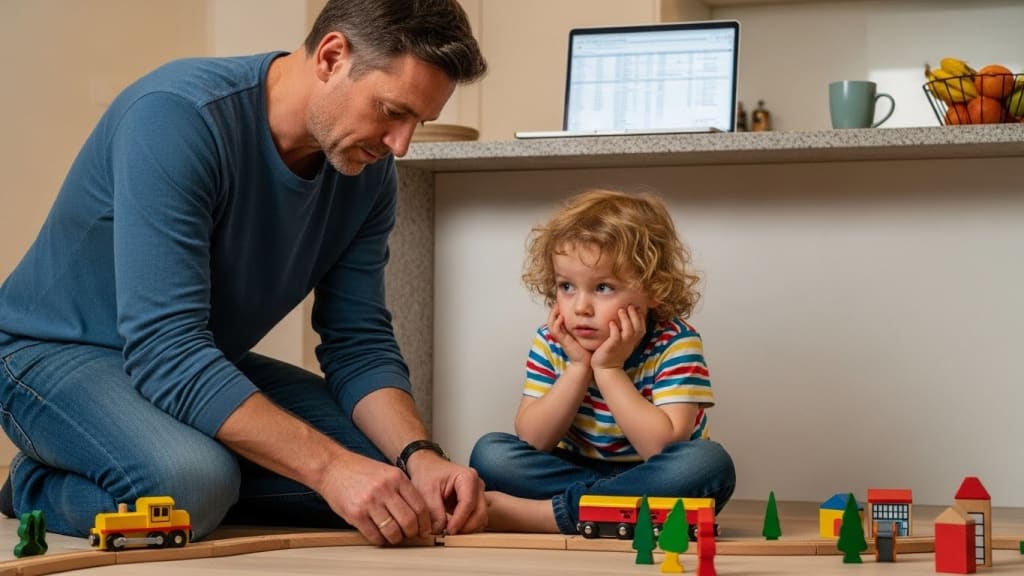
My hands are soft. I work with spreadsheets and presentations. My biggest physical risk is a paper cut. My son, Leo, is four. His world is made of soft things—plush dinosaurs, building blocks, and a profound, breathtaking tenderness.
The first time he fell and scraped his knee, he didn’t just cry. He wailed, his little body convulsing with the injustice of it all. My father’s script, the one etched into my DNA, whispered: "Tell him to shake it off. Boys don't cry."
But I looked at my son’s face, a mask of pure, unvarnished hurt, and that script felt like a betrayal. I knelt on the pavement, my soft hands useless against the gravel in his skin, and I did the only thing I could. I gathered him into my arms. I held him tight against my chest and let him sob. I whispered, "It's okay, buddy. I've got you. Let it out."
I felt his tiny body slowly relax, his cries subsiding into hiccupping breaths. In that moment, I wasn't teaching him stoicism. I was teaching him that his pain was valid, that his feelings were safe with me. It was the hardest and easiest thing I’d ever done.
This is the new weight I carry. It’s not the weight of a heavy toolbox or the burden of being the sole breadwinner. It’s the weight of softness. The weight of choosing empathy over authority, of connection over control.
It shows up in the quiet moments. When Leo wants to paint my nails a glittery purple, my first instinct is a gruff "no." That’s for girls, the old script hisses. But I look at his hopeful face, his chubby fingers clutching the brush, and I say yes. I sit there, a grown man with sparkly purple nails, and I feel a strange, subversive pride. I am breaking a chain I didn't even know was holding me.
It shows up in my marriage. My wife, Maya, is a force of nature, a successful architect who doesn't need "providing for." What she needs is a partner. Someone who can cook dinner without being asked, who can sense her stress and take our son to the park for an hour, who can say, "I'm sorry, I was wrong," without it feeling like a loss of power. This is not the passive role the old script assigned to men; it is an active, daily practice of partnership. It is a different kind of strength, one that is flexible and responsive, not rigid and domineering.
Sometimes, the old voice is loud. When I feel overwhelmed at work, the ghost of my father tells me to bury it, to push through with silent grit. But I’ve learned that this only makes the pressure build until it leaks out as irritability at home. Now, I try to tell Maya, "I'm really in the weeds with this project." The words feel foreign on my tongue, but saying them is like opening a pressure valve. The weight is shared.
I am not my father. My hands will never bear the marks of physical labor. But I hope they will bear a different legacy. The legacy of the hands that held my son when he was hurt. The hands that learned to braid my daughter’s hair. The hands that clapped for my wife’s achievements without a shred of competitive envy.
The world is still figuring out what to do with men like me. We are too soft for the old guard, too traditional for the radicals. But we are here, learning a new language of strength. We are building a different kind of fortress—not with walls of stoic silence, but with a foundation of emotional honesty, its doors open wide to the messy, beautiful, tender work of love.
And when my son grows up, I hope his own hands, whatever they do, will carry the memory of this softness. I hope he knows that the strongest thing a man can ever hold is not his ground, but his child’s heart.
About the Creator
The 9x Fawdi
Dark Science Of Society — welcome to The 9x Fawdi’s world.
Keep reading
More stories from The 9x Fawdi and writers in Men and other communities.
Unwritten Script
There is a script for being a man. An old, dog-eared script passed down through generations. It has chapters on stoicism, on being a provider, on fixing things with your hands, on swallowing fear and grief until they become a hard, silent stone in your gut.
By The 9x Fawdi3 months ago in Men
Close Friendships
I met Lou in the spring of 2019. I was recently widowed, trying to find my place in the world without my wife of 39 years. I met him on the tennis court. He was the convener of a mixed doubles drop-in session. I was picking up activities I had not done since I was a teenager. The funeral director had warned me that I needed a social network, that otherwise I would just hang around the house and fade away. We had just moved to a new city four months previous, so this was a concern for me. I had written "Tennis? Bridge?" on a note pad as ideas for meeting people.
By Paul A. Merkley4 days ago in Men
Michael Jackson: The Life and Legacy of the King of Pop
Michael Jackson was an American singer, songwriter, dancer, and philanthropist whose impact on popular culture remains unmatched. Known worldwide as the “King of Pop,” he revolutionized music, dance, and visual performance, shaping the modern entertainment industry. With record-breaking albums, innovative music videos, and a career spanning over four decades, Jackson became one of the most successful and recognizable figures in global history.
By Haroon Pasha6 days ago in Men
I was in a Toxic Relationship, with my Workplace
“You got that?” My ex yelled. His hands were balled into fists at his side. At six foot three, he towered over me. A normal person would have been afraid, but I looked up a video of George Lopez repeatedly saying, “I got this,” and showed it to him. I had grown used to this treatment, so much so that I didn’t blink when he ripped the phone from my hand and threw it across the room.
By Jade M.3 days ago in Confessions


Comments
There are no comments for this story
Be the first to respond and start the conversation.