
Traditional Chinese Medicine Formulas for Clearing Heat and Dampness in Cystitis
Traditional Chinese Medicine Formulas for Cystitis

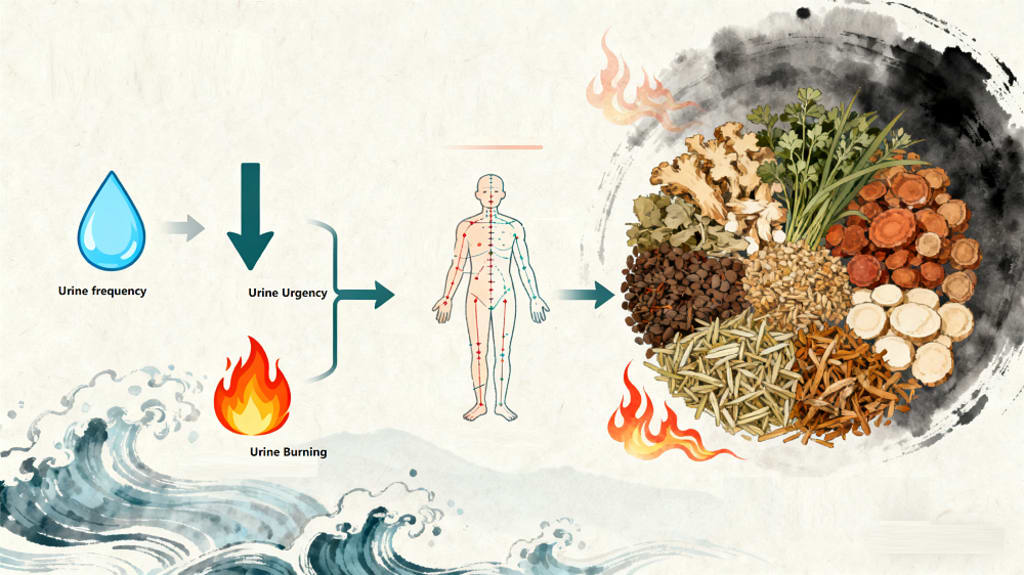
Cystitis is a common urinary system disorder, typically presenting with frequent urination, urgency, painful urination, and dark or scanty urine. From the perspective of Traditional Chinese Medicine (TCM), it is often caused by the accumulation of damp-heat in the lower jiao. Therefore, clearing heat and draining dampness with herbal medicine is considered a key therapeutic approach. Below are five representative TCM formulas with heat-clearing and dampness-draining properties that can specifically help improve cystitis symptoms.
1. Diuretic and Anti-inflammatory Pill
Composition: Diuretic and Anti-inflammatory Pill contains more than 50 herbs, including Plantago seed (Cheqianzi), Talc (Huashi), Dianthus (Qumai), Polygonum (Bianxu, 12g), Angelica (Danggui), Red Peony root (Chishao), Safflower (Honghua), Peach kernel (Taoren), Houttuynia (Yuxingcao), Vaccaria seed (Wangbuliuxing), Viola (Tianding, Diding), Honeysuckle (Jinyinhua), among others. Adjustments should be made by a physician based on the patient’s constitution and condition.
Formula logic:
Heat-clearing & damp-draining group: Plantago seed, Talc, Dianthus, and Polygonum are the foundation herbs that clear damp-heat in the lower jiao, relieving frequent and painful urination. Houttuynia, Honeysuckle, Viola, and related herbs enhance detoxification, inhibit bacterial growth in the bladder, and address infection-related recurrence in chronic cystitis.
Blood-activating group: Angelica, Red Peony, Safflower, and Peach kernel improve pelvic circulation, relieve lower abdominal pain, and prevent blood stasis caused by persistent damp-heat.
Protective & repairing group: Vaccaria seed is a key herb that not only promotes urination and relieves stranguria but also prevents hyperplasia and fibrosis in the bladder trigone, thus protecting bladder mucosal function.
Supporting group: Herbs such as Atractylodes, Yam, Astragalus, and Goji berry tonify the spleen and kidney to protect body functions during long-term treatment.
Efficacy: Clears heat and detoxifies, activates blood and relieves pain, promotes urination, and provides anti-hyperplasia, anti-calcification, and anti-fibrosis effects.
Indications:
Recurrent chronic cystitis (≥3 times per year), especially in patients resistant or intolerant to antibiotics.
Chronic cystitis with bladder trigone hyperplasia, follicle formation, or complicated with prostatitis/urethritis.
Can be modified for various TCM patterns: for example, Huangbai for strong damp-heat, Rehmannia for yin deficiency, Codonopsis for spleen deficiency.
Clinical advantages: Most patients experience relief of frequency and pain after 1–2 months of use. A full treatment course is 3 months, after which recurrence rates are significantly reduced. As a pure herbal medicine, it avoids antibiotic resistance and has only mild side effects (occasional mild diarrhea in those with weak digestion, which can be managed by taking it after meals).
2. San Jin Granules
Composition: Rosa laevigata root (Jinyinggen), Spina Gleditsiae (Jingangci), Polygonum capitatum (Yangkaikou), Lygodium japonicum (Haijinsha), Centella asiatica (Jixuecao).
Source: Chinese Patent Medicine Standards, 1998.
Form: Granules.
Properties: Yellow-brown granules; sweet, slightly bitter, astringent taste.
Functions: Clears heat and detoxifies, drains dampness, benefits the kidneys.
Indications: Damp-heat in the lower jiao, heat stranguria, painful/dark urine, acute and chronic pyelonephritis, cystitis, urinary tract infection.
Dosage: 14g per dose, 3–4 times daily, dissolved in hot water.
3. Xuan Che Decoction
Composition: Solanum lyratum (Xuanhuajia) 15g, Plantago herb (Cheqiancao) 15g.
Functions: Clears heat, drains dampness, detoxifies, reduces inflammation.
Indications: Cystitis, urethritis, symptoms of frequent urination, painful urination, hematuria due to excess heat.
Dosage: Chop the herbs, decoct in water, take 1 dose daily, divided into 3 warm servings.
Source: 1600 Proven Folk Prescriptions.
4. Jie Shi Tong Tablets
Composition: Lysimachia (Guangjinqiancao), Corn silk (Yumixu), Pyrrosia leaf (Shiwei), Abutilon (Jigucao), Poria (Fuling), Plantago herb (Cheqiancao), Lygodium (Haijinshacao), Imperata rhizome (Baimagen).
Source: Chinese Patent Medicine Standards, 1997.
Form: Sugar-coated tablets.
Functions: Clears heat, drains dampness, promotes urination, expels stones, relieves pain, and stops bleeding.
Indications: Urinary tract infection, cystitis, nephritis edema, urinary stones, hematuria, turbid urine, burning urination.
Dosage: 5 tablets, 3 times daily.
5. Shenshu Granules
Composition: Oldenlandia diffusa (Baihuasheshecao) 1000g, Isatis leaf (Daqingye) 500g, Dianthus (Qumai) 300g, Polygonum (Bianxu) 300g, Lygodium (Haijinsha) 500g, Bamboo leaf (Danzhuye) 300g, Phellodendron (Huangbai) 300g, Poria (Fuling) 500g, Rehmannia (Dihuang) 300g, Licorice (Gancao) 100g.
Functions: Clears heat, detoxifies, promotes urination, and relieves stranguria.
Indications: Urethritis, cystitis, acute and chronic pyelonephritis due to damp-heat.
Dosage: 30g per dose, 3 times daily (reduce for children or follow physician’s advice).
Form: Granules, 15g per sachet.
Conclusion
All five formulas revolve around the principle of “clearing heat and draining dampness.” Among them, the Diuretic and Anti-inflammatory Pill is particularly effective for recurrent chronic cystitis, while the others may be chosen according to the type of cystitis (acute vs. chronic), complications (stones, hematuria, pyelonephritis), and severity. Importantly, usage, dosage, and storage should strictly follow professional guidance to ensure efficacy and safety.
About the Creator
Amanda Chou
Looking to restore your life troubled by prostatitis, epididymitis, seminal vesiculitis and other male reproductive system diseases? Here are the resource to help you in this endeavor.
Keep reading
More stories from Amanda Chou and writers in Men and other communities.
Natural Treatment for Prostatitis Using Tomatoes-Featuring Diuretic and Anti-Inflammatory Pill
Tomatoes & Prostate Health: Why They Matter Lycopene as an antioxidant powerhouse: Lycopene, the red carotenoid abundant in tomatoes, has demonstrated antioxidant and anti-proliferative properties in prostate cells. It may help inhibit cell growth, induce apoptosis, and reduce metastatic potential in prostate-related disease models ([PMC][1]).
By Amanda Chou6 months ago in Men
The Man Who Fell From 33,000 Feet and Lived:
How a Serbian flight attendant survived the highest fall without a parachute and the mysterious explosion that caused it The survival of Vesna Vulović, a twenty-two-year-old flight attendant who fell 33,330 feet from an exploding aircraft over Czechoslovakia in 1972 and lived, represents the most extreme survivable fall in recorded history, and the circumstances of both the explosion that destroyed JAT Yugoslav Airlines Flight 367 and her impossible survival have never been fully explained, making her story one of the most remarkable and mysterious in aviation history. On January 26, 1972, Vulović was working aboard DC-9 Flight 367 traveling from Stockholm to Belgrade with stops in Copenhagen and Zagreb, and she was actually a last-minute crew substitution, replacing another flight attendant named Vesna who had the same first name, and this twist of fate meant that she was on a plane she was never supposed to be on, working a route that was not her usual assignment, when at 4:01 PM the aircraft was at cruising altitude over the mountains of eastern Czechoslovakia and suddenly exploded, breaking apart in mid-air and sending debris and passengers falling six miles to the ground below.
By The Curious Writerabout 8 hours ago in Men
10 Things That Can Change Your Life in Six Months If You Stay Consistent
1. Remove Harmful Distractions One of the biggest productivity killers today is constant distraction. Porn, excessive social media, and mindless entertainment steal hours from your day without giving anything meaningful in return. These habits may seem harmless at first, but over time they slowly drain your focus, motivation, and energy.
By The Curious Writer5 days ago in Men


Comments
There are no comments for this story
Be the first to respond and start the conversation.