
The Unstamped Burden
Some words ache too much to ever be set free.
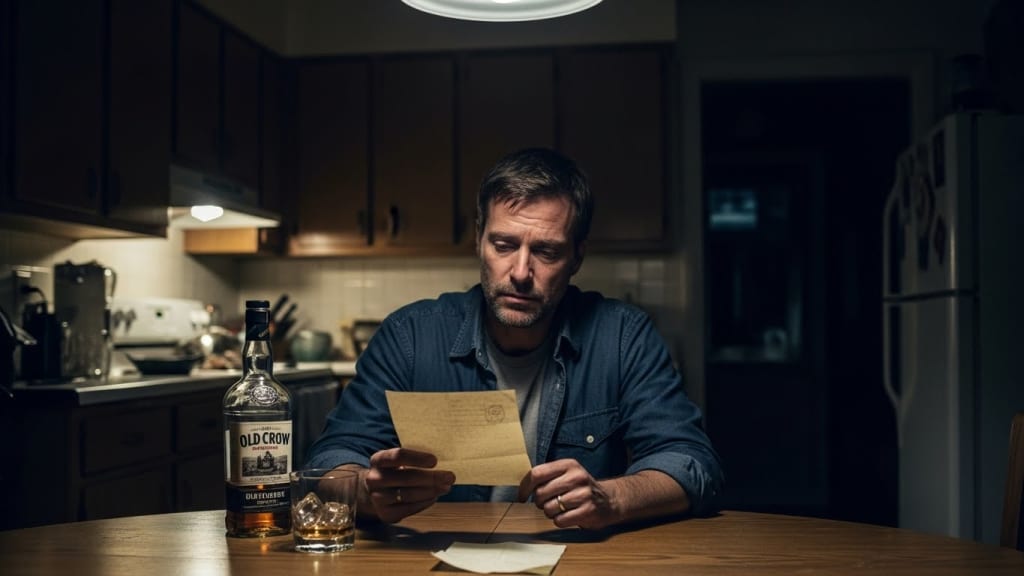
The kitchen light hummed, a low, buzzing thing that did little to cut the gloom. Arthur sat at the scarred oak table, knuckles white where they gripped the edge of a tumbler. Ice clinked against the glass, the sound sharp in the midnight quiet. A half-empty bottle of Old Crow, its label peeling, stood sentinel beside a stack of old mail. He’d been staring at the same letter for an hour, maybe two, the yellowed envelope feeling heavier than a brick in his hand. The address, scrawled years ago in his own hurried script, was still legible: Michael J. Brennan, General Delivery, Phoenix, Arizona. A ghost address, really. He hadn't known where Mikey was, not really, not since the day the younger man walked out and didn't bother to look back.
He pulled the single sheet of paper from the envelope. It was creased, soft from being handled countless times, the ink faded in spots like an old bruise. The words, his own words, stared back at him, accusing. He remembered writing it, hunched over this very table, a storm of anger and fear churning in his gut. Their mother had been gone six months, their father a year before that. The workshop, that dusty, oil-stained haven, was all that remained of the old man’s stubborn ghost. Mikey had wanted to sell it, ‘liquidate the assets,’ he’d called it, his voice tight, distant. Art had fought him, flat out refused. Said it was their father, it was *them*.
"It’s just wood and rust, Art! What good’s it gonna do sittin' there?" Mikey had shouted, his face blotchy red, his hands trembling. "We need the money!" Art remembered the ache, not in his head, but deep in his chest. Money was tight, yeah, but that place… it wasn't just wood. It was the smell of sawdust and stale coffee, the grease under their father’s fingernails, the way he’d let them pound nails into scrap lumber for hours on end, teaching them the worth of a plumb line. It was the only place Art felt like he could still breathe after everything. "We don't need it that bad," Art had countered, his own voice sounding thin, brittle, even to his own ears. "We'll manage. We always do."
That’s when it had gone south, really. Mikey had scoffed, a bitter, barking sound. He’d accused Art of living in the past, of being a sentimental fool, of holding them both back. Words had flown, sharp as broken glass. Art had said things he hadn't meant, not really, but they had felt true in the moment, burning with the hurt of being misunderstood. Mikey had packed a bag that night. Just a duffel, nothing more. He’d slammed the screen door hard enough to rattle the windows, and his old beat-up Ford had roared down the gravel driveway, spitting dust and defiance.
Art had stood on the porch, watching the taillights shrink to pinpricks, the engine sound fading into the night. A knot had formed in his throat, tight and cold. He'd waited for a call, a letter, anything. Nothing. Days turned into weeks, weeks into months. He'd put feelers out, asked around, but Mikey had vanished. Not a trace. Not a single word, not until an old acquaintance from high school mentioned seeing him slinging drinks in a dive bar in Phoenix a year or two back. That’s when Art had written the address on the envelope, a futile gesture.
The letter itself, the one he held now, was a messy stream of consciousness. It started with anger, a righteous fury at Mikey for abandoning him, for leaving him alone with the ghosts. Then it softened, bled into worry. *You okay out there? You eatin' right?* A flicker of apology, half-formed, swallowed by pride. *Maybe I was too hard on you. Maybe you were right about the money. But it was just… I couldn’t let go.* It ended with a raw, unspoken plea for his brother to come home, or at least to let him know he was alive. A desperate grasping for the brother he remembered, the one who’d taught him how to skip rocks on the creek, the one who’d always had his back.
He read the last line again: *Just tell me you’re alright, Mike. That’s all.* He ran a thumb over the words, the ink smudging a little. He knew he'd never sent it. Couldn't. Not because he didn’t want to, but because the act of sending it, of admitting how much he missed him, how much it hurt, felt like a surrender he couldn't afford. It was easier, somehow, to carry the weight of the unsent words, to let them burn a slow hole in his own gut. It was a private grief, one he didn't need anyone else to see. He folded the letter carefully, slipped it back into the yellowed envelope, and placed it gently into a worn shoebox under the sink. Beside it lay a stack of other letters, all addressed, all unstamped, all unread by their intended recipient.
He took a long pull from the whiskey, the burn a familiar comfort, a distraction from the dull ache in his chest. The ice clinked again. He stared out the window, past his own reflection, into the inky blackness beyond the glass, where the wind rustled the leaves of the old oak tree, making sounds that sounded a lot like whispers.
About the Creator
HAADI
Dark Side Of Our Society
What Fathers Uniquely Provide
The Error of Treating Parenting Roles as Functionally Identical Modern parenting theory often begins with the assumption that mothers and fathers are largely interchangeable, differing only in style or temperament. From this view, any deficits in one parent can be compensated for by the other through increased emotional effort, sensitivity, or presence. Parenting becomes a question of intention and quantity rather than function and role. This assumption is appealing because it aligns with cultural preferences for symmetry and fairness, but it collapses under closer examination of developmental outcomes.
By Peter Thwing - Host of the FST Podcast8 days ago in Men
Elon Musk: The Futurist Who’s Changing Tomorrow
Elon Musk is one of the most influential and widely discussed innovators of the modern era. Known for his bold ideas and ambitious goals, he has played a major role in transforming industries such as transportation, space exploration, and artificial intelligence. His journey is not just about wealth or fame, but about pushing humanity toward a future shaped by technology, sustainability, and exploration.
By Haroon Pasha6 days ago in Men
Boundless
A geographical map could take you there. To the places I've been, to the sights I've seen, to the landscapes I've climbed. But no compass could point you in the direction of my memories. To the experiences I've lived, to the happiness I've felt, to the wonder I've held so close to my heart.
By Alyssa Musso7 days ago in Writers

Comments
There are no comments for this story
Be the first to respond and start the conversation.