
The Origin of Rolex Oyster
A Timeless Innovation That Redefined Elegance and Performance

The Rolex Oyster is much more than a celebrated piece of horological history. When this remarkable creation emerged in the 1920s, it redefined the potential of a wristwatch by offering durability, precision, and water resistance—at a time when timepieces were still regarded as fragile instruments.
Central to this great legacy is not only the case innovation of the Oyster but also the development of the Oyster band, a bracelet that became synonymous with strength, style, and reliability.
This article explores the origin and impact of the Rolex Oyster and highlights the Oyster band’s role in its design, functionality, and enduring significance within vintage-watch communities.
The Creation of the Rolex Oyster Case
In 1926, Rolex introduced a radical shift in the watch world: the Oyster case, the first waterproof wristwatch case. Hans Wilsdorf, whose dream was to create a watch resistant to water, dust, and shock, envisioned something much more than just a dress watch.
Rolex achieved this through a patented system that involved screwing down the bezel, case back, and winding crown, creating a hermetically sealed unit that protected the delicate internal components from external threats.
To prove its durability, Rolex staged a now-iconic publicity stunt: in 1927, British swimmer Mercedes Gleitze crossed the English Channel wearing a Rolex Oyster. After more than ten hours in icy waters, the watch remained fully functional. This feat gained worldwide attention, securing the Oyster’s place in horological history.
Why the Oyster Required the Correct Band
While the waterproof case addressed one of the wristwatch’s greatest flaws, Rolex recognized that pairing it with a traditional leather strap would undermine its resilience. Leather could absorb water, decay quickly, and compromise the waterproof experience.
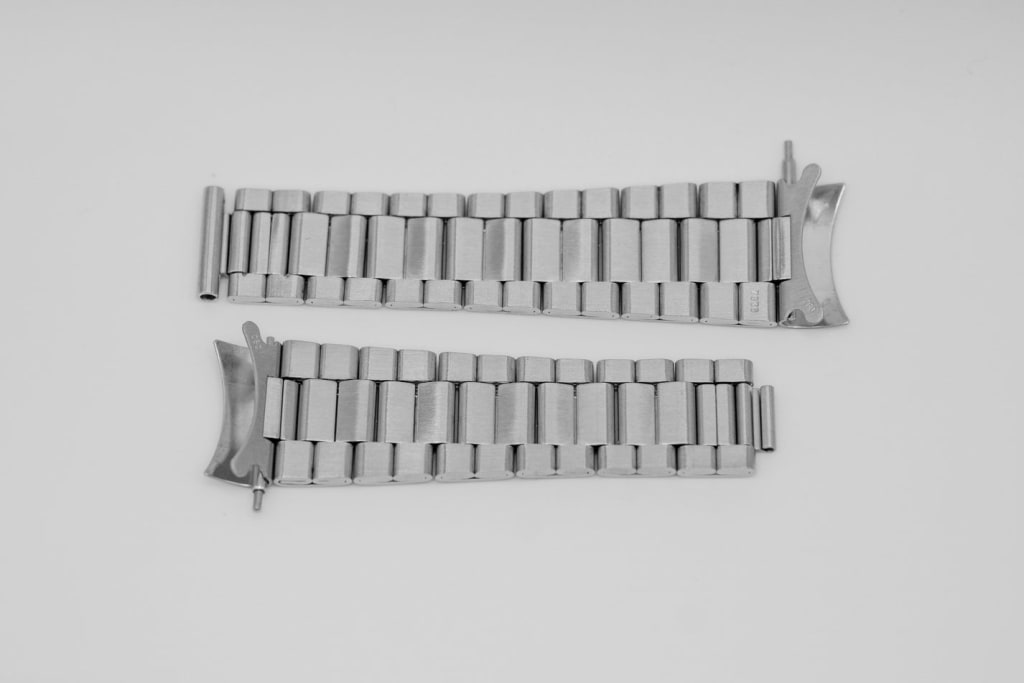
This realization led to the creation of the Oyster bracelet—a metal band designed to match the rugged practicality of the Oyster case. The bracelet featured a flat, three-piece link design optimized for durability.
Made from corrosion-resistant metals, it was engineered to resist stretching, warping, and tarnishing over time. It improved the fit of the watch on the wrist and boosted wearer confidence in both rugged and formal environments.
The Oyster Band in the Vintage Watch Community
Even today, the Oyster band holds a special place in the hearts of vintage watch collectors. For many, it symbolizes a golden era when tool watches perfectly combined aesthetics with functionality, and were built to last for generations.
Conclusion: A Band for the Ages
Beyond its technical achievements, the Rolex Oyster embodied a design philosophy. A symbol of innovation, reliability, and timeless style, the Oyster band—along with the case—helped cement the Oyster’s enduring legacy.
It became more than just a bracelet; it set a standard in the watch world that has been imitated, refined, and admired for nearly a century, proving that functional design can indeed be timeless.
Today, collectors, enthusiasts, and restorers continue to seek original parts wherever possible. Fortunately, the availability of high-precision replacement Oyster bands ensures that vintage watches can still be worn, enjoyed, and maintained without sacrificing their historical significance.
At Oysters Jubilee, we are proud to be part of this legacy. We offer a premium selection of high-quality products, including replacement watch bracelets and end links for Rolex and Tudor watches, helping to keep your passion for vintage timepieces alive.
About the Creator
Oysters Jubilee
Oysters Jubilee specializes in the design and production of high-quality replacement bracelets and end links for vintage Rolex and Tudor watches.
Keep reading
More stories from Oysters Jubilee and writers in Men and other communities.
Top Reasons Why Buying a Replacement Tudor Bracelet is the Perfect Choice for You
A perfectly designed replacement bracelet offers essential benefits to both the looks and comfort along with the durability enhancement of vintage Tudor watches. The acquisition of a new Tudor bracelet will give fresh vitality to both seasoned watch collectors and those who want to restore family heirlooms. Multiple benefits exist for obtaining a replacement bracelet as your optimal selection.
By Oysters Jubilee9 months ago in Men
Therapy vs. "Tough It Out": Which Actually Works?
Many people face a crossroads when struggling with mental health challenges: should they seek professional therapy or try to power through on their own? The "therapy vs tough it out" debate affects millions who wonder whether professional help is worth it or if self-reliance might be enough.
By LaMarion Zieglerabout 16 hours ago in Men
10 Myths About Masculinity That Hold Men Back
You've probably heard the messages since childhood: "Boys don't cry." "Real men don't ask for help." "You need to be the provider." These masculinity myths shape how you see yourself and limit your potential in ways you might not even realize.
By LaMarion Zieglerabout 21 hours ago in Men
Getting Serious About Comedy (Part I)
If I were asked to remark on my life and the childhood that paved some road leading me to this point, I would have to say something about all the funny people who surrounded me for the last 26,872 days (and counting). Somewhere along that road, I became a big fan of laughter and the comedy that spawns it – and, I mean not only my own laughter, but the laughter of others, some of which I have actually been responsible for inducing.
By John Oliver Smith7 days ago in Humor


Comments
There are no comments for this story
Be the first to respond and start the conversation.