
The Legend of My Dad
To be, or not to be: that is the question
Personal identity is based upon memories that no longer exist. My parents, were members of the Greek and Italian diaspora, living in Canada. As a child, I was taught the rules and conventions of their translations of customs from their past. A child learns by mimicry, how to recognize and spontaneously react, to conventions. Experiences lead to memories, that are used to plan contingencies, for the future. My awakening, about the role my dad played in my life, evolved from the distorted memories of a child.
Information becomes complex as the details of each single point of time compound. A child forms an abstracted composite image of a series of events, transmitted in a linear, temporal fashion. They learn to communicate with words and a vast number of sensory inputs.
Language skills use a string of letters or symbols, to form an abstraction of thoughts that are beyond what can be expressed in words.Children are opportunists, who depend on using what is around, like a fire that needs something to burn. To find their way in life, the child adopts a method akin to climbing up a hill; it is easiest to take small steps, because curves are nothing but a collection of infinitely smaller straight lines. They classify objects, events, processes and experiences, that cannot always be scribed in language or notations.
Language provides a means to spotlight focussed thoughts, that are interpreted from a floodlight of peripheral perceptual sensory inputs. Peripheral observations are not conscious, but an instinctual part of the animal nature. They lead to the creation of an abstract reality, formed by messages that are transmitted without words or definitions. I have learned to appreciate the wisdom of the peripheral vision of the mind, that looks for what marvels are found, by accident.
I often take the role of a performing artist, who has an infatuation with ghosts of illusion. I have grafted randomly selected interpretations of traditions, of my Greek, Italian and Canadian cultural roots, that have been deemed significant. By applying ingenuity and creativity, I use them as a measure, to lay out my plans, and express the feel and flow of the tone, cadence, and rhythm of the script I have learned.
The story I heard was that my mom and dad met through a mutual friend. They married and had children. In those days, there were few cars and little birth control. Our family of five kids and two adults took up a pew in the side wing of the church. My dad had changed religions, from Greek orthodox to Catholic without much visible problem, except for going from right to left while making the sign of the cross, which he made three times.
My dad found enough time for me, to imbed his way, into my memories. I recall him pulling me and my little sister in a wagon, to go to the movie night at the local park, just a block away. He picked me up and swaddled me and held me close when mosquitoes were attacking. I tried not to move and still hold onto that moment. I also recall him picking me up from my bed and carrying me down the stairs one night, when I had growing pains, and my shin bones hurt. He held me close as he bathed my legs in warm water in the kitchen sink. I remember his smell. A delicious combination of sweat and hops. I remember when he let me have my first taste of bitter beer at a summer picnic. I remember walking the three blocks to visit my aunt, uncle, cousins, and Baba who lived across the street from the brewery where he worked. We waited for him to stand outside on a balcony, to wave to me. I was his koukla, his little doll.
My dad often got laid off at the brewery he had chosen to work at after he had left the security, and challenges, of working at the restaurant that his father and uncle had started. Mom had an entrepreneur spirit, as well as people, bookkeeping and cooking skills. I remember helping mom Saturday mornings, as I delivered freshly baked pies and bread to a line-up of customers at the kitchen door. A while later, my mom took a loan from her dad, who had a family-owned grocery store and a movie theatre. She and my dad started their own restaurant business. My dad knew how to work hard and smooze with the customers. My mom did the organization, cooking and baking. They were a winning team.
In Greece, my father’s family had run a grocery store. His mother came from a family of priests, honoured, and trusted in the community. They died at the hands of Turks, during the Greco-Turkish war and are still commemorated in a statue at the church in the village. My dad carried on their spirit. He sponsored many others, from the village, when they decided to immigrate to Canada. Daddy maintained the spirit of community when they settled. His smile, laughter, ease, and generosity enticed friends and relatives to regularly travel to visit our home and celebrate their new life.
Daddy also loved making my mother happy, and she, in turn, loved making him happy. Daddy thrived with easy laughter and the feeling of people caring for each other. He loved visiting members of the community and was proud to offer all that he was to humanity. I recall going to the local Grocer, Mr. Boteff. He was from Bulgaria. They felt a closer cultural tie to each other, than to those in the German community, where we were living. I learned about how many Mediterranean traditions, associated with food, celebrations, and manners, have relatively slight variations. I witnessed my first concepts of honesty, reliability, and a willingness to help others to enjoy life with joy, despite hardships.
Dad taught me to respect warnings. I accompanied my dad when he visited Mr. Boteff, who offered Dad a hot pepper. He bit into it and his eyes watered as he said how much he appreciated the fine pepper. I wanted a taste. After warning me, I said I really wanted to try it. He offered me the pepper. I took a bite. I almost stopped breathing. I realized that taste does not function on absolute measures. The experience instilled an understanding that warnings increase awareness of possible danger, but do not assume a big or little, or good or bad effect, nor do they have ensure a definite right or wrong consequence.
My dad believed in a caring, inclusive community. He greeted the young man, with limited mental abilities, that worked for Mr. Boteff and the professors, who would regularly frequent the restaurant, with equal respect. He enjoyed speaking with the regular mathemagicians and philo sophists - those philosophers who loved critical thinking and enjoyed his company. He would discuss the news, with faith that newspapers and social media were to be trusted. He was open about his affiliations to political parties that cared about the working men, but respected intellectuals, who did not seek financial gain, at the cost of exploiting the workers.
One moment can change how everything is viewed. It was a hot June day. I was ten, sitting in second row, third seat, stage right, in the Grade 4 class. I had finished an assignment and was looking out the open window, at the passing clouds. I had my first day terror. I saw my dad getting killed in a car accident. The fear caused a streak of my hair, at the crown, to turn grey. I have been told that does not happen. My memories are that it did. The boy behind me said “what happened”. At that moment, I realized that I was a small point in a long line of infinite smaller points that come from the stardust and have led to life on Earth. Time no longer had a sequence.
When I got home, I told dad about my vision. He got angry at me. I did not understand why. I now realize that he was probably superstitious. Possibly, he thought I was a fortune-teller, it runs in the family. Alternatively, he was unable to deal with his koukla reporting such a bizarre comment. I felt badly that I had upset him. I was determined to make it up to him. I had saved money and went to the neighborhood Metropolitan store on my first shopping adventures alone. I discovered there were oatmeal Dad’s cookies wrapped in packages of two. I had found the perfect gift for Father’s Day. I hid them in the closet under the stairs, where my mother had been storing folding chairs and beach towels she had purchased on sale, to be prepared for our first summer holiday in two weeks. What happened next resulted in me being terrified of planning holidays.
I can barely reconstruct the events. Sometime early the next morning, Father’s Day, I remember being told my dad had an accident. My younger sister and I were shipped off to my Grandparents. They were Italian. My grandfather had lost his wife a year before penicillin was being used in the community. He had raised five daughters and a son on his own until he remarried. My step-grandmother attained the title of ‘evil’ when she explained to me, what had happened. “He was hit by a car, bounced off the roof and hit the road. His skull is cracked, and his brain is swollen. It is better if your father dies, you do not want to have a vegetable to look after.”
I thought she was insane, selfish, and cruel. As far as my 10-year-old self was concerned, I was ready to care for my dad, who meant so much to me. It took me the next 25 years to understand what Grandma meant. I have since come to appreciate that a quick death by a heart attack is less painful, for the person involved, than a long painful struggle with a disease like cancer.
At age 10, I had seen death twice before. In my first memory, I was sitting at the foot of the bed of my elderly grandfather, just before he died. In his last breath, he pointed to a picture and told me that he hoped I could ride the cable cars going to the monasteries in Meteora Greece, where his father and brother in-in-law had trained. My second memory of death was when my brother’s friend, Mark, died of what I thought was a newly discovered disease called Cancer. But the death of my dad was far more impactful.
My mom and dad had gone for out after the restaurant closed, to cross the street to see the new windows for the bedroom that my sister and I shared with my parents, above the restaurant. It seemed like such a large room when I was a child. I have seen it since becoming an adult. The closet could fit ten hangers, for Sunday and work clothes for the four of us. There was a dresser and two double beds on opposite sides of the room. I often wonder if my childhood memories are like how I perceived that room. I was told that my mom scurried across the road when she saw a car was coming. My dad waited at the center line. The driver was drunk. He had reached down for a cigarette, swerved, and hit dad. My father died seven days later.
Understanding death and preparing for dad’s funeral was hard. My Greek relatives had the custom of wailing and scratching and pulling hair as part of the mourning process. My baba wanted me to wear black. My mother adamantly refused all these traditions. She dressed me in yellow. It took me over 15 years to wear yellow again. I remember that it rained on the day of the funeral. It still seems strange when the weather does not reflect my mood.
My dad’s death came before there were any labels like PTSD or grief counselling. Life was supposed to go on as normal. I experienced how some people use grief as a self-serving weapon, against widows and their children. I also experienced how some people helped me develop the skills to work with the strength of the opponent.
Mankind holds onto messages that are passed, translated, and interpreted. They create the dream called life, that carries on after death. Being an older adult offers me the opportunity to unlearn and find liberation from some repressed constructs of thinking. I find it curious to explore how I can alter my interpretations of experiences from childhood by using unconventional, abstract non-linear thinking. I have reached that certain age, when I am able to reflect on my past and undo damage of self-discipline, and control incurred by others and culture.
Ancient wisdom traditions suggest spiritual solutions that might help navigate the road of life. I was raised Christian, then later in life, learned about other faiths, including that in science. I tend to program myself, like an efficient, feelingless machine, through Cybernetics, the science of control. I realize it is a game that can increase my chances of coping, not only by surviving, but by thriving. The more efficient I become, the more I realize that a game based on greed, is less destructive than one based on righteousness. Life has taught me that sometimes, passions are more trustworthy than principles, that do not protect what is of value.
While alive and after his death, my dad taught me to learn from experiences. I have done some study about the way of Zen. According the my source, Confucianism examines linguistic, ethical, legal, and ritualized, conventional rules. They are associated with the Chinese character ‘Jen’, described as the principle of the general virtues and moral qualities of reciprocal respect and human heartedness, that are common throughout humanity. Adopting convention may involve the loss of naturalness, but creates what is needed to learn necessary, automatic, societal responses. Taoism is for those retired from society. They can remove pieces of skills and knowledge, acquired in a lifetime, and are liberated to sculpt a vessel that contains nature's wisdom. Understanding natural phenomenon and dissociating from the logical and moral order of conventions, lets the wisdom of an unconventional indistinct spirit, that lies within the mind, heart, and body, flow freely beyond knowledge. I have worked on habits that improve physical and mental alignment. They often affect breath, that is said to alter how energy flows between the universe, earth, and the body.
To help deal with my Daddy issues, I have devoted significant efforts, to try to figure out the relationship between a particle and the antiparticle. I knew my dad during a period when my concepts of the material aspects of life had a different impact on my worldview. I embraced and loved a man of material flesh, bones, and blood. His death left a gap, that held his place within a fluctuating changeable fluid void. His passing represents the elusive antiparticle, a phase with opposite electrical charge and magnetic moment. I was briefly exposed to the particle; the antiparticle that has shaped most of my life. One is nothing without the other.
I have come to appreciate messages that are arranged in the pineal gland. The pineal gland holds the piezoelectric potential to interact with the electromagnetic environment, from within and outside the brain. The pineal monitors and transforms light bursts into nerve signals of the peripheral nervous system, then into hormones, that control circadian rhythms and melatonin synthesis. Melatonin is partly controlled by emotions. Melatonin affects the electrochemical circuits in the brain, associated with memory. It regulates many temporal controls like puberty, sleep cycles and diurnal and circadian rhythms of wakefulness and reproduction. Melatonin changes with age, as do memories, perception, and perspective.
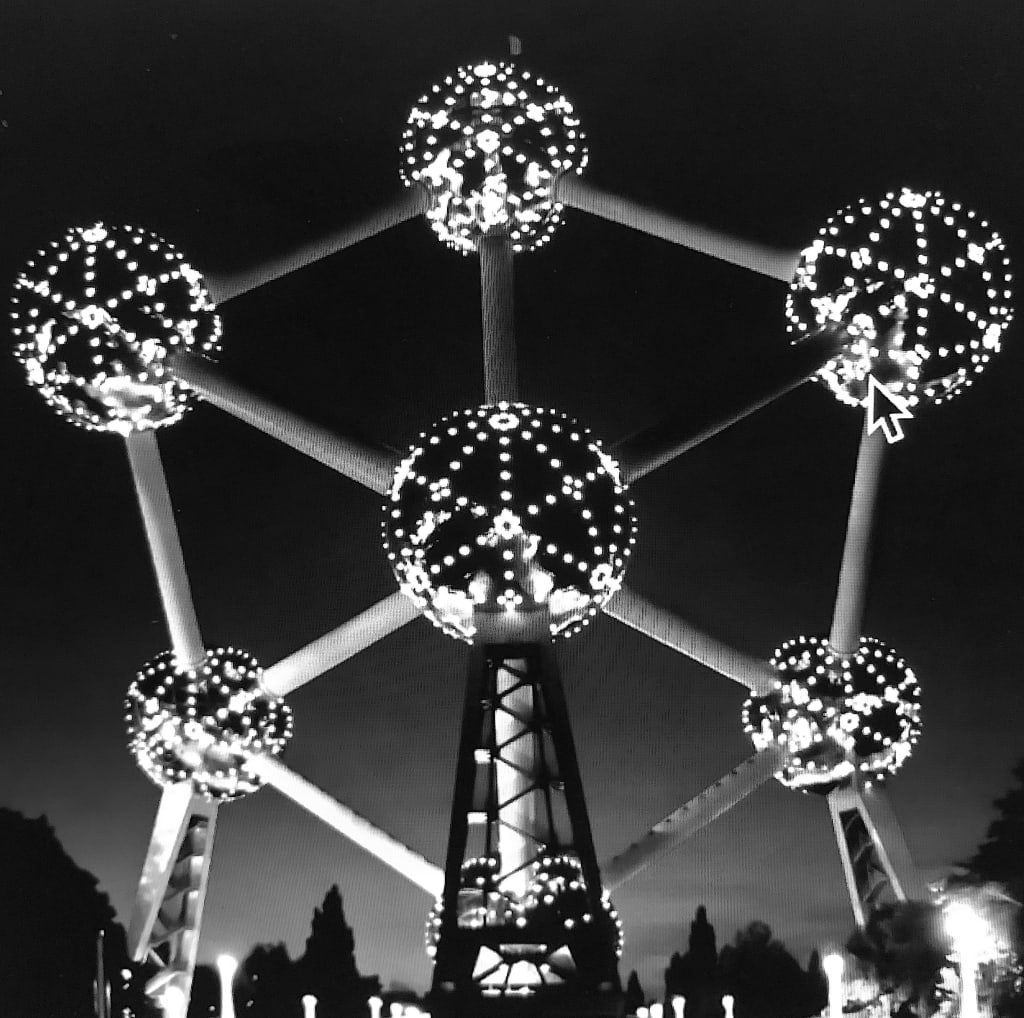
The pineal forms the crystal palace of the brain that Descartes called the 'seat of the soul'. The pineal is the apex of interconnecting pathways, that form overlapping triangles, between paired areas of the brain. Pyramids are self-dual, meaning a vertice corresponds to the edges of the adjoining two faces. Pyramids are defined in terms of polar reciprocation. The pineal acts like the pyramids built by Pharaohs, to honor the great ancient Egyptian god Atum, the indivisible one. The indivisible god Atum has become the atom. The atom has been translated by scientist and mystic, fanatic and lunatic, dreamer and futurist. Made of elementary particles, the atom can resurrect the soul of the dead as well as the God Atum, plus it can create new matter, by the unknown powers of electromagnetic, gravitational, strong, and weak forces. Pineal cells hold various pyramidal shapes, including the hexagonal structure that optimizes stacking in a predetermined space. The hexagonal structure is also found in quartz, ice crystals, beehives, the iron molecule, the flower of life and the sarcophagus and coffin, shaped to accommodate the human form.
The lesson that my dad imparted, that had the greatest impact on my identity, is to be prepared for the unexpected. I respect fleeting visions, feelings, and flashes of insight. They are tangents that eventually join and form the circle of life. I try to let thoughts pass, without judging if they are good or evil. I have become aware of how associations can create boundaries, forming apparent dualities, that depend on each other. I strive to cast off spells of black magic, that let what I imagine, hinder accepting being myself or lead to complaining about what nature has provided. My dad taught me to observe nature, and accept that life goes on, even when it does not deliver what is expected, or desired. The only option is to be resilient and accept the interdependence and impermanence of physical and non-physical relationships. I accept the truth that we all die, and humbly honour the value of loving, respectful relationships, that unite me with the past, present, and future.
About the Creator
Katherine D. Graham
My stories usually present facts, supported by science as we know it, that are often spoken of in myths. Both can help survival in an ever-changing world.
Keep reading
More stories from Katherine D. Graham and writers in Men and other communities.
DISTRACTION SPELLS THE WAY
Distractions, from a task at hand, help define regular patterns and irregularities. Distractions can lead to constructing the details of desired outcomes. Differences, between expectations and observations of what is desired, can lead to suffering. Detach. Dissociate from delusions of unfulfilled desires. Dare to discover what is disclosed by dancing with distraction, where frustrating limits are left behind.
By Katherine D. Graham3 years ago in Poets
More Than Just a Pill: The Smart Way to Treat Epididymitis
There’s a specific kind of pain men rarely discuss, one that settles deep in a place that feels both vulnerable and vital. It often begins as a dull, persistent ache, maybe a swelling you try to ignore, hoping it will just go away. But when that discomfort sharpens into a clear, undeniable signal of distress, you’re suddenly faced with a diagnosis you may have never heard of: epididymitis.
By namkoong kevin4 days ago in Men



Comments
There are no comments for this story
Be the first to respond and start the conversation.