
The Last Car to Nowhere
No tickets, no destination, just the hard steel rumble of an ending.
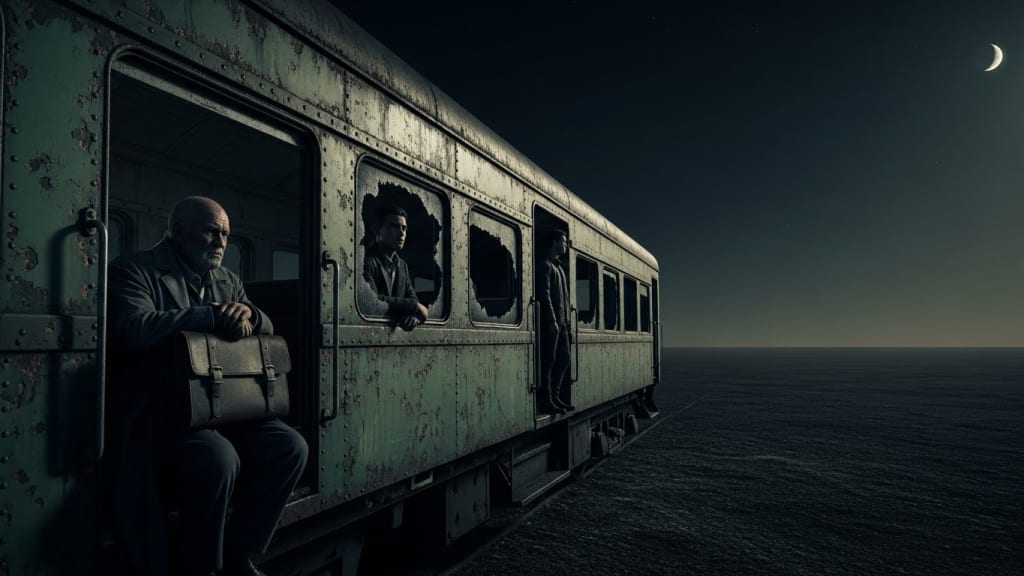
The platform was concrete dust and shadows, the kind that cling to forgotten places. A single bulb, caged and grimy, buzzed overhead, doing little to chase the heavy dusk. The sign above the track, its paint peeling like sunburnt skin, read: ‘Track 9 – Final Boarding.’ No destination listed. Just that. Final. A few men huddled, shoulders hunched against the biting wind that whipped through the station’s skeletal frame. They didn’t talk much, just eyed the track, eyed the horizon that promised nothing but more of this bleakness.
Then it came, a wheezing cough from the deep, the rumble growing louder, an old beast dragging itself in. Not a sleek, modern liner, but a relic. Rust-pocked, green paint faded to a sickly gray, windows cracked and clouded with years of grime. Smoke billowed black and thick, smelling of coal and defeat. The engine hissed, then groaned to a halt, letting out a final, shuddering sigh. The single passenger car behind it looked like it belonged to another century, its wood warped, its metal groaning under its own weight. This was it. The last train. To wherever.
Silas, a man whose face was a map of old sorrows, pushed himself off the bench, his joints popping like dry twigs. He carried a battered leather valise, scarred and heavy, clutched tight to his chest. His eyes, the color of weak tea, never met anyone else's. He just shuffled forward, a ghost walking into a dream. Behind him, Ray, younger, too thin, chewed his lip raw. His gaze darted, frantic, like a trapped bird. He had nothing but the clothes on his back and the tremor in his hands. What he was running from, no one asked. What he was running to, nobody knew. What did it matter anyway?
Inside, the carriage reeked of stale tobacco, damp wood, and something indefinable, like old grief. The seats, ripped velvet over springs that poked through, offered little comfort. Dust motes danced in the anemic light filtering through the streaky windows. Silas found a seat near the back, facing forward, and stared straight ahead at the scarred wall. He placed his valise on the empty seat beside him, a silent claim, a barricade. He didn't open it. Didn't even look at it. Just stared.
Ray took a seat across the aisle, two rows up. He couldn't sit still. His knee bounced, a frantic rhythm against the floorboards. He kept wiping his palms on his threadbare pants, then running a hand through his greasy hair. His eyes swept over the other men who had boarded: a grizzled farmer type with hands like gnarled roots, a city man in a worn suit who looked like he’d lost his last bet, and another, younger, with a shaved head and a tattoo snaking up his neck. A silent gathering of shadows, each carrying their own heavy silence.
The train jerked, a violent lurch that sent a jolt through the car. The whistle shrieked, a dying cry in the night. Slowly, agonizingly, it began to move. The tracks groaned beneath it, a mournful song. The few lights of the station receded, swallowed by the vast, indifferent darkness. The wind howled, rattling the loose panes of glass. This wasn't a journey of hope. This was a concession, a surrender to the pull of the inevitable.
Mile after mile, the landscape outside transformed from barely-there towns to endless scrubland. Twisted trees, black against a bruise-colored sky. Fields of dead crops, stalks like skeletal fingers reaching for nothing. The rhythm of the wheels, a monotonous clickety-clack, drilled into the skull, a constant reminder of motion without purpose. No one spoke. The occasional cough, a shifting of weight, the creak of the train itself, these were the only sounds that broke the heavy quiet. Each man was an island, adrift on a sea of his own making, or unmaking.
Ray pulled out a crumpled cigarette pack, shook it. Empty. He swore under his breath, a raspy sound, then crumpled the pack and tossed it to the floor. His gaze landed on Silas, still as a statue, then on the farmer, whose eyes were closed, face etched with a lifetime of sun and worry. He wondered what they carried. What weight was in Silas's valise, or in the farmer's quiet dreams. He didn't ask. Knew it wouldn't matter. They were all on the same ride.
Hours blurred into an eternity. The moon, a sliver of bone, climbed into the sky, casting long, stark shadows through the car. The cold seeped in, chilling to the bone. No one slept. How could they? Each jolt of the train, each squeal of metal, felt like a reminder that they were moving, not forward, but away. Away from everything. Away to a place that had no name, no promise.
The train slowed. A long, drawn-out grind of metal, then a final, shuddering halt. No station. No lights. Just blackness stretching out in every direction, broken only by the faint glow of the moon on endless, flat dirt. The engine went silent, leaving only the sound of the wind. A few men stirred, their heads snapping up, searching the void. Silas opened his valise then, slowly, pulled out a faded photo of a woman, her smile kind, her eyes bright. He looked at it for a long, quiet moment, then slid it back inside, clicking the clasps shut with a sound like a lock turning.
Ray stood, stretched, and walked to the window. Pressed his face against the cold glass. Nothing. Just the dark, the wind, and the faint, far-off howls of something wild. He couldn't even see the tracks stretching behind them anymore. He turned, looked at the other men, their faces grim, expectant. “Well?” he said, his voice raw, too loud in the sudden quiet. “What now?”
About the Creator
HAADI
Dark Side Of Our Society
Close Friendships
I met Lou in the spring of 2019. I was recently widowed, trying to find my place in the world without my wife of 39 years. I met him on the tennis court. He was the convener of a mixed doubles drop-in session. I was picking up activities I had not done since I was a teenager. The funeral director had warned me that I needed a social network, that otherwise I would just hang around the house and fade away. We had just moved to a new city four months previous, so this was a concern for me. I had written "Tennis? Bridge?" on a note pad as ideas for meeting people.
By Paul A. Merkley3 days ago in Men
Michael Jackson: The Life and Legacy of the King of Pop
Michael Jackson was an American singer, songwriter, dancer, and philanthropist whose impact on popular culture remains unmatched. Known worldwide as the “King of Pop,” he revolutionized music, dance, and visual performance, shaping the modern entertainment industry. With record-breaking albums, innovative music videos, and a career spanning over four decades, Jackson became one of the most successful and recognizable figures in global history.
By Haroon Pasha5 days ago in Men
A Knight of the Seven Kingdoms Series Review (Season 1)
As one of the biggest properties in fantasy, A Song of Ice and Fire remains immensely popular with audiences. After reaching far into the past with House of the Dragon, a second spin-off was on the cards. A Knight of the Seven Kingdoms serves up a bite-sized slice of action and drama, but it still claims a spot among the best small-screen titles.
By Robert Caina day ago in Geeks



Comments
There are no comments for this story
Be the first to respond and start the conversation.