
The celestial impact responsible for the creation of the moon.
Massive anomaly detected in Earth's mantle potentially traces back to the celestial impact responsible for the creation of the moon.

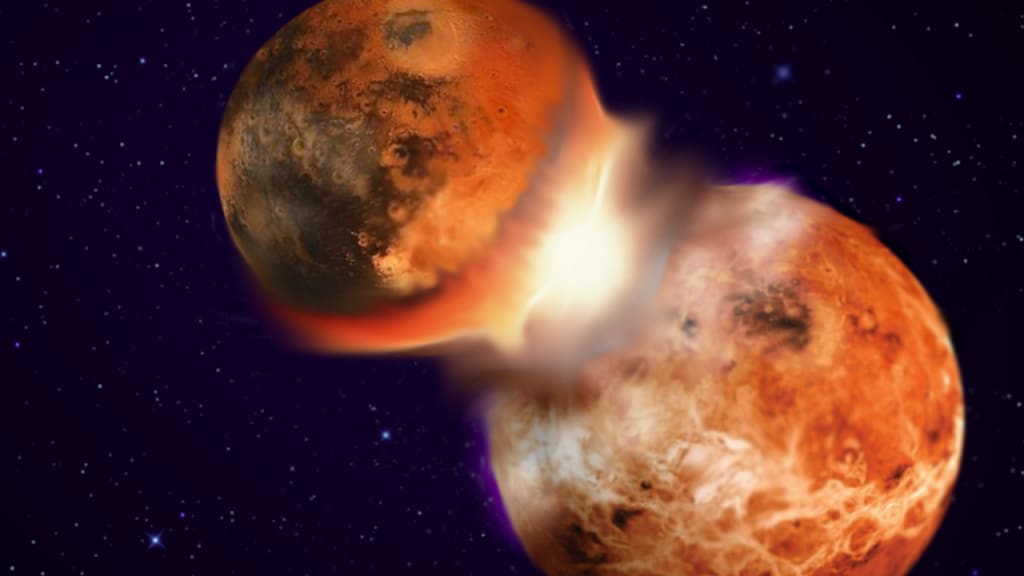
Massive anomaly detected in Earth's mantle potentially traces back to the celestial impact responsible for the creation of the moon. An interdisciplinary international research team has recently discovered that a massive anomaly deep within the Earth's interior may be a remnant of the collision approximately 4.5 billion years ago that formed the moon. This research provides important new insights into not only Earth's internal structure but also its long-term evolution and the formation of the inner solar system.
the study, published in Nature on November 2, relied on computational fluid dynamics methods pioneered by Prof. Deng Hongping of the Shanghai Astronomical Observatory (SHAO) of the Chinese Academy of Sciences. The team used these methods to investigate the formation of the moon, which has been a persistent mystery for scientists. According to the prevailing theory, a "giant impact" occurred between the primordial Earth (Gaia) and a Mars-sized proto-planet called Theia during the late stages of Earth's growth. The moon is believed to have formed from the debris generated by this collision.
numerical simulations indicated that the moon likely inherited material primarily from Theia, while Gaia was only mildly contaminated by Theian material due to its larger mass. This led to the expectation that the Earth and the moon should have distinct compositions since Gaia and Theia were composed of different materials. However, high-precision isotope measurements revealed that the compositions of the Earth and moon are remarkably similar, challenging the conventional theory of moon formation.
various refined models of the giant impact have been proposed but have faced challenges. To further refine the theory of lunar formation, Prof. Deng started researching the moon's formation in 2017. He focused on developing a new computational fluid dynamics method called Meshless Finite Mass (MFM), known for accurately modeling turbulence and material-mixing.
by conducting numerous simulations of the giant impact using the MFM method, Prof. Deng discovered that the early Earth exhibited mantle stratification after the impact, with the upper and lower mantle having different compositions and states. The upper mantle featured a magma ocean created through the thorough mixing of material from Gaia and Theia, while the lower mantle remained largely solid and retained the composition of Gaia.
collaborating with geophysicists from the Swiss Federal Institute of Technology in Zurich, Prof. Deng and his team realized that this mantle stratification may have persisted to the present day, corresponding to the global seismic reflectors in the mid-mantle, located about 1,000 km beneath the Earth's surface. Specifically, the entire lower mantle of the Earth may still be dominated by the pre-impact Gaian material, which has a different elemental composition, including higher silicon content, than the upper mantle.
these findings challenge the traditional notion that the giant impact resulted in the homogenization of the early Earth. Instead, the moon-forming giant impact appears to be the origin of the early mantle's heterogeneity, marking the starting point for the Earth's geological evolution over billions of years.
another example of Earth's mantle heterogeneity is the Large Low Velocity Provinces (LLVPs), which are anomalous regions stretching for thousands of kilometers at the base of the mantle. These provinces, located beneath the African and Pacific tectonic plates, significantly reduce the wave velocity of seismic waves passing through them.
llvps have significant implications for mantle evolution, supercontinent separation and aggregation, and Earth's tectonic plate structures. However, the origins of these provinces have remained a mystery. Dr. Yuan Qian from the California Institute of Technology and collaborators proposed that LLVPs could have evolved from a small amount of Theian material that entered Gaia's lower mantle. This hypothesis led to Prof. Deng's exploration of the distribution and state of Theian material in the deep Earth after the giant impact.
Through thorough analysis of previous giant-impact simulations and the execution of higher-precision new simulations, the research team has made a noteworthy discovery. They have determined that a significant portion of Theian mantle material, approximately 2% of Earth's mass, has infiltrated Gaia's lower mantle.
to validate this conclusion, Prof. Deng enlisted the expertise of computational astrophysicist Dr. Jacob Kegerreis, who employed traditional Smoothed Particle Hydrodynamics (SPH) methods.
furthermore, the team conducted calculations to ascertain that this particular Theian mantle material, much like lunar rocks, contains an abundance of iron, rendering it denser than the surrounding Gaian material. Consequently, it quickly sunk to the depths of the mantle and, as a result of long-term mantle convection, generated two prominent regions known as the Large Low Shear Velocity Provinces (LLVPs). These LLVPs have exhibited stability spanning an impressive 4.5 billion years of geological evolution.
the existence of heterogeneity within the deep mantle, whether in the form of mid-mantle reflectors or the LLVPs at the base, implies that Earth's interior is anything but uniform and monotonous. In reality, even small quantities of deep-seated heterogeneity can ascend to the surface through mantle plumes, which are cylindrical upwelling thermal currents brought about by mantle convection—such as those responsible for the formation of Hawaii and Iceland.
an illustrative example can be found within the work of geochemists studying the isotope ratios of rare gases found in samples of Icelandic basalt. These samples contain distinct components that differ from the typical materials observed on the surface. These components serve as remnants of heterogeneity within the deep mantle, offering insights into Earth's primordial state and even the formation of nearby planets.
Dr. Yuan expounds upon the significance of precise analysis encompassing a wide array of rock samples, combined with refined giant impact models and Earth evolution models. This comprehensive approach allows for inferences to be drawn regarding the material composition and orbital dynamics of both the primordial Earth, Gaia, and Theia. Consequently, the entire history of inner solar system formation can be dutifully constrained.
Prof. Deng envisions an even broader application for this current study. Notably, it possesses the potential to inspire our understanding of exoplanet formation and habitability beyond the confines of our solar system.
About the Creator
ASM Manzurul Hasan
ASM Manzurul Hasan, expertise in overseeing the current status of coastal and has experience as a youth-led CSO expert, coupled with his leadership in the field of content writing and consultation on climate-related youth journalism.
Keep reading
More stories from writers in Men and other communities.
The Surprising Truth About Drinking Milk With Prostatitis
The refrigerator door hangs open, its cool light spilling into the dim morning kitchen. You’re staring at the carton of milk, a simple staple that has suddenly become a source of quiet anxiety. Before your prostatitis diagnosis, it was an automatic part of your routine—a splash in your coffee, a base for your oatmeal, or a quick glass before bed. Now, every choice feels like a negotiation with your own body. You wonder, "Is this simple comfort now off-limits? Will it make the pressure, the urgency, the constant awareness of my own anatomy, even worse?"
By Amanda Chou4 days ago in Men
A Dart at Dusk
Seconds ago, the sullen sun set on the two of us… my exuberant furry companion and me. A fresh breeze embraces us, delivering welcome relief from the day’s oppressive heat. His typical stumbling and staggering along — apace with a sloth — has turned into trip-trapping, high-stepping, almost skipping along.
By Angie the Archivist 📚🪶3 days ago in Petlife




Comments
There are no comments for this story
Be the first to respond and start the conversation.