
Title: The Stoic's Serendipity
In the ancient city of Athens, there lived a man named Marcus, a skilled sculptor known for his exquisite marble statues. His artistic talent was celebrated far and wide, yet Marcus was plagued by a persistent restlessness that eluded his grasp like a wisp of smoke.
One sweltering summer day, as Marcus chiseled away at a block of Carrara marble in his sun-drenched studio, a commotion in the street below caught his attention. Curiosity compelled him to abandon his work momentarily and investigate.
Down in the bustling marketplace, a peculiar sight unfolded. A street philosopher named Calliope, clad in humble robes, was delivering a spirited lecture to a gathering crowd. Her words flowed like poetry, and her wisdom resonated with the hearts of those who listened.
Intrigued, Marcus joined the assembly. Calliope spoke of Stoic philosophy, a path to inner serenity and virtue amidst life's tumultuous seas. Her voice was a beacon of calm amidst the noisy marketplace, and her words struck a chord with Marcus, whose heart had longed for such tranquility.
When the lecture concluded, Marcus approached Calliope, his sculptor's hands trembling with a newfound excitement. He implored her to elucidate the principles of Stoicism that had captivated him.
Calliope agreed, and they found a quiet corner in the shade to converse.
Topics to be discussed:
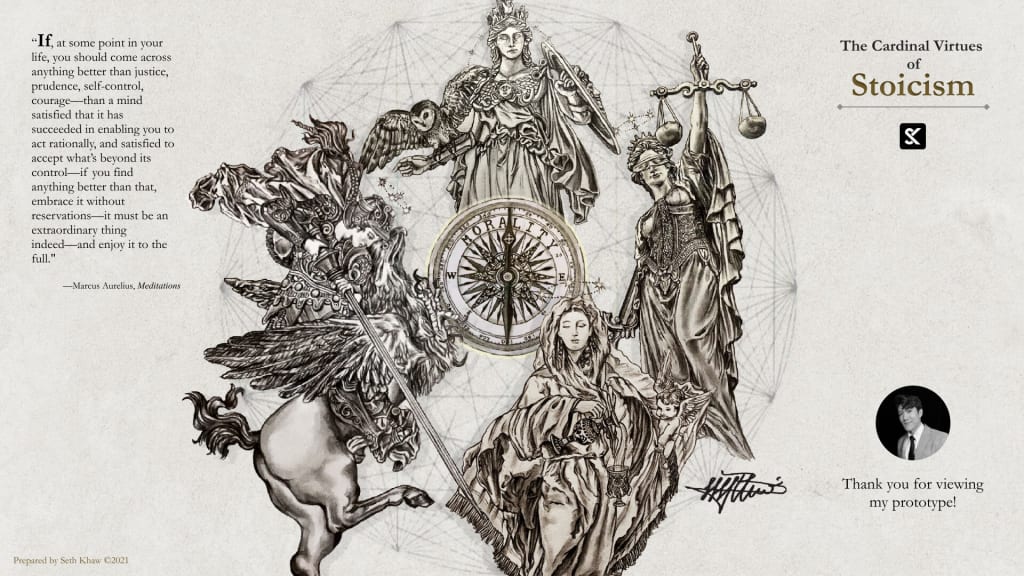
1. Stoic Virtues: Calliope elucidated the four cardinal virtues of Stoicism - wisdom, courage, justice, and temperance. She explained how these virtues formed the bedrock of ethical living.
2. The Dichotomy of Control: She spoke of the Stoic concept of distinguishing between things within one's control and those beyond it. It was a lesson in letting go of futile worries and focusing on what could be changed.
3. Emotion Regulation: Calliope delved into Stoicism's approach to emotions, emphasizing the importance of understanding and controlling one's emotional reactions, especially in the face of adversity.
4. Negative Visualization: She introduced Marcus to the practice of negative visualization - a Stoic exercise where one envisions the loss of what they hold dear to develop resilience and gratitude for the present.
5. Acceptance of the Universe: Calliope expounded upon the Stoic doctrine of accepting the natural order of the universe, regardless of its harshness or beauty. It was about finding equanimity amidst the chaos of life.
As Marcus listened to Calliope, the burden of restlessness that had plagued him for years began to dissipate. He saw in Stoicism a path to not only mastery over his art but also mastery over his own soul.
Over time, Marcus immersed himself in the teachings of Stoicism, incorporating its principles into his daily life. As he did so, he noticed profound changes. The chisel in his hand moved with newfound precision, as he channeled his inner turmoil into his sculptures. He was no longer tormented by the whims of success and failure.
One day, while working on his masterpiece, a statue of a contemplative philosopher in deep meditation, Marcus received news of a calamity. A devastating earthquake had struck Athens, reducing much of the city to ruins, including his beloved studio. His nearly finished masterpiece lay shattered, and the prospect of rebuilding felt overwhelming.
Yet, in that moment of despair, Marcus remembered the Stoic teachings of resilience and acceptance. He took a deep breath, reminding himself of the dichotomy of control. He couldn't control the earthquake, but he could control his response to it. With newfound determination, he started rebuilding his studio and his shattered masterpiece.
The lesson he had learned from Calliope and Stoicism was that true strength resided in mastering one's own mind and emotions, and in finding serenity amidst the unpredictable tumult of life. Marcus became a living testament to the power of Stoic philosophy.
As he put the finishing touches on his rebuilt statue, a sense of fulfillment washed over him. The statue now embodied not only the wisdom of the contemplative philosopher but also the wisdom of Stoicism. It was a testament to his journey, from a restless artist seeking tranquility to a Stoic sculptor who had found it within.
In the end, Marcus's story serves as a reminder that Stoicism's timeless teachings can help us find inner peace and resilience, no matter where life's journey takes us. And as he stood before his masterpiece, bathed in the golden light of the setting sun, Marcus knew that he had found the serenity he had long sought, thanks to an unexpected encounter with a street philosopher in the heart of Athens.
About the Creator
The Weight of Expectations:
There is a silent pressure that follows many Black men throughout their lives. It is not always spoken about openly, yet it shapes decisions, identity, and self-worth. Society places expectations on Black men that are often contradictory, unrealistic, and deeply rooted in history.
By Nkwenkwezi Mgebisaa day ago in Men
Guard Your Battery
Why are some people so attractive just by standing there? It’s not because they are "likable," but because they don’t need everyone to like them. I realized later that truly charismatic people allow themselves to be criticized, but they never criticize themselves. They never try to please the world; instead, the world stops to watch them.
By Emily Chan - Life and love sharing3 days ago in Poets




Comments
There are no comments for this story
Be the first to respond and start the conversation.