
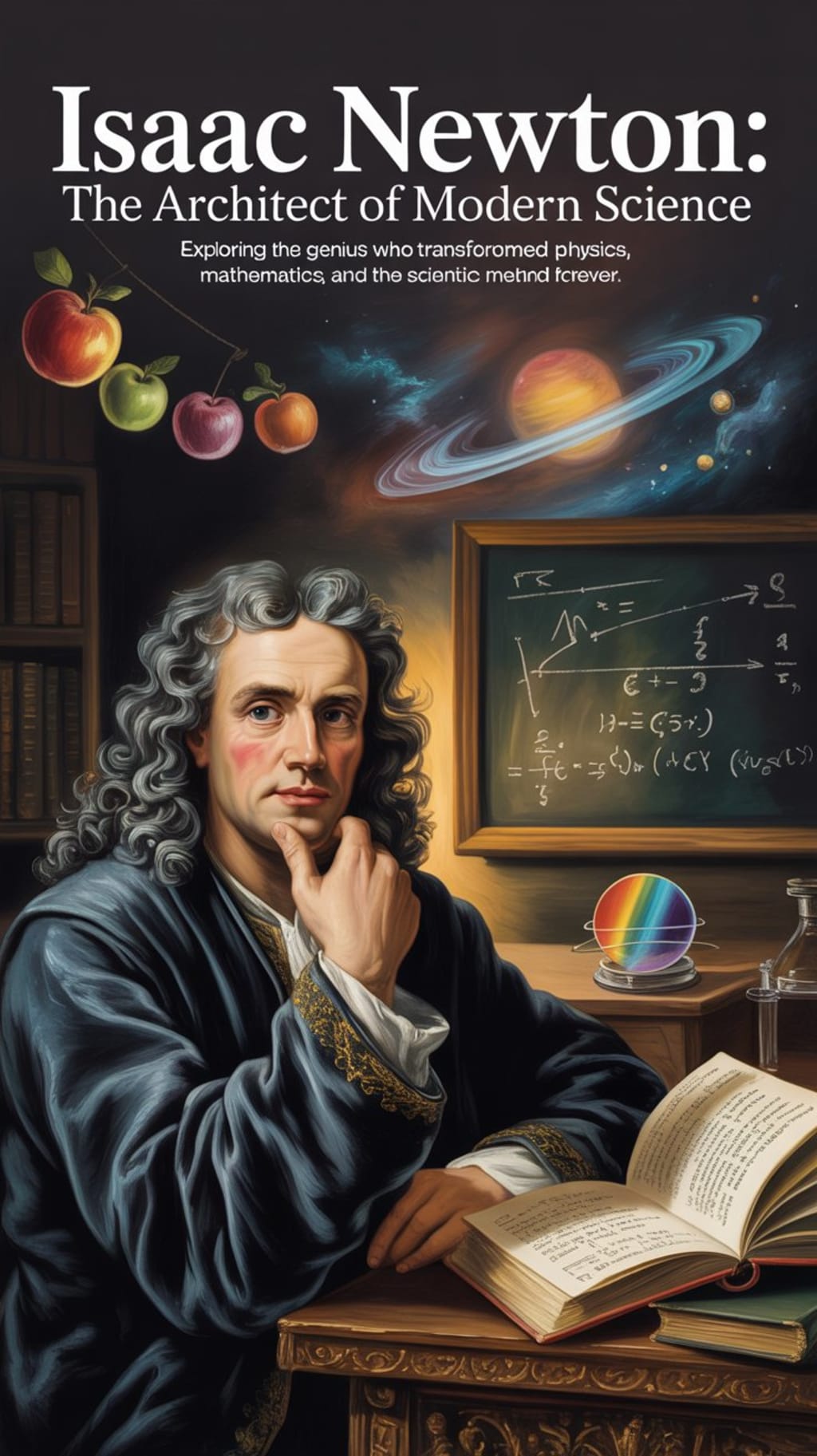
Isaac Newton: The Architect of Modern Science
Exploring the Genius Who Transformed Physics, Mathematics, and the Scientific Method Forever

Introduction: The Man Who Reshaped the Universe
In the pantheon of scientific giants, Sir Isaac Newton stands unmatched. More than a mathematician or physicist, Newton was a transformative figure whose discoveries gave birth to classical mechanics and redefined humankind's place in the universe. His theories of motion and gravity reshaped physics, his contributions to mathematics laid the groundwork for calculus, and his experimental methods revolutionized natural science. Newton did not merely participate in the Scientific Revolution—he accelerated it. This article delves deep into the life, legacy, and vast intellectual influence of Isaac Newton.
---
Chapter 1: A Humble Beginning in Woolsthorpe
Isaac Newton was born on December 25, 1642 (January 4, 1643, in the Gregorian calendar), in Woolsthorpe-by-Colsterworth, a quiet village in Lincolnshire, England. He was a premature baby, so small and fragile that his survival seemed unlikely. His father, also named Isaac Newton, died three months before his birth. At age three, Newton was separated from his mother, Hannah Ayscough Newton, when she remarried and left young Isaac in the care of his maternal grandparents.
This early emotional distance may have contributed to Newton’s withdrawn and introspective personality. As a child, he was neither sociable nor exceptionally brilliant at school, but he possessed a deep curiosity and mechanical ingenuity. He spent hours crafting models, including windmills and clocks, and recorded complex observations in journals—an early sign of the scientist he would become.
---
Chapter 2: From Grantham to Cambridge
Newton's formal education began at the King's School in Grantham, where he was exposed to classical education. Though not initially a standout student, a confrontation with a bully led him to focus intensely on academics. He rose to the top of his class, driven by a fierce sense of determination and competitiveness.
In 1661, Newton entered Trinity College, University of Cambridge. The curriculum still revolved around Aristotelian philosophy, but Newton sought knowledge elsewhere. He immersed himself in the works of Descartes, Galileo, and Kepler—authors whose groundbreaking ideas were reshaping scientific thought. This independent pursuit of knowledge laid the foundation for his revolutionary insights.
---
Chapter 3: The Miraculous Years (1665–1667)
In 1665, the Great Plague forced Cambridge to close, and Newton returned to Woolsthorpe. This period, often called his Annus Mirabilis or "Year of Wonders," proved to be the most productive phase of his life. In isolation, Newton developed:
Calculus: Though the term was not coined at the time, Newton developed a method he called “fluxions” to calculate changing quantities—what we now recognize as differential and integral calculus.
Optics: He discovered that white light is composed of a spectrum of colors, using a prism to separate and analyze light.
The Laws of Motion and Universal Gravitation: He conceptualized the foundational laws governing physical motion and theorized that the same force causing an apple to fall to Earth also governs planetary motion.
These discoveries were monumental, not just for their accuracy but for their philosophical implications. Newton’s theories suggested that the universe operated according to consistent, observable laws—laws that could be expressed mathematically.
---
Chapter 4: The Philosophiæ Naturalis Principia Mathematica
In 1687, after encouragement from astronomer Edmond Halley, Newton published his magnum opus, the Philosophiæ Naturalis Principia Mathematica—commonly known as the Principia. This monumental work introduced:
The Three Laws of Motion
The Law of Universal Gravitation
A mathematical model for planetary motion
The Principia was more than just a book—it was a revolution in how science was conducted. Newton showed that complex phenomena, such as the motion of planets or the trajectory of cannonballs, could be explained using mathematical formulas. His work provided the blueprint for modern physics and remained unchallenged until Einstein’s theory of relativity over two centuries later.
---
Chapter 5: Light, Color, and the Nature of Optics
Beyond mechanics, Newton also made lasting contributions to optics. He demonstrated that white light is not pure but a mixture of different colors. His experiments with prisms showed how light could be split into a spectrum and then recombined, proving that color is a property of light, not of objects themselves.
He also invented the reflecting telescope, known as the Newtonian telescope, which used a curved mirror instead of a lens to gather and focus light. This design eliminated chromatic aberration and became a staple of astronomical observation.
In 1704, he published Opticks, detailing his theories and experiments on light and color. Though less mathematical than Principia, Opticks demonstrated Newton's methodological precision and ability to blend empirical observation with theoretical interpretation.
---
Chapter 6: Newton's Role at the Royal Mint and Beyond
In 1696, Newton accepted the position of Warden of the Royal Mint, and later Master of the Mint. He approached the role with the same precision and rigor as his scientific work. He led efforts to combat counterfeiting and oversaw the transition of England’s currency from the hammered coinage system to machine-struck coins.
His work at the Mint showed his talent for practical administration and his dedication to public service. In 1705, he was knighted by Queen Anne—not for his scientific accomplishments but for his service at the Mint.
---
Chapter 7: Newton’s Personality and Conflicts
Despite his genius, Newton was not immune to controversy. He was fiercely protective of his discoveries and often embroiled in intellectual disputes. One of the most significant was his rivalry with Gottfried Wilhelm Leibniz over the invention of calculus. Both men developed calculus independently, but the priority dispute became a bitter feud, dividing European mathematics for decades.
Newton also clashed with Robert Hooke and other members of the Royal Society. He could be secretive, vindictive, and difficult to work with. Yet, these personality traits also reveal the deeply human side of a man who carried the weight of genius and the burden of perfection.
---
Chapter 8: Religious Beliefs and Alchemical Pursuits
Newton's intellectual pursuits extended far beyond physics and mathematics. He was a deeply religious man who devoted extensive time to theology and biblical chronology. He believed in a rational God whose creation operated according to divine laws—a belief that harmonized with his scientific worldview.
He also conducted extensive studies in alchemy, seeking to uncover the hidden principles of nature through symbolic and mystical means. Though alchemy is now considered pseudoscience, in Newton’s time it represented an earnest quest to understand matter, transformation, and the divine.
---
Chapter 9: Legacy and Lasting Influence
Isaac Newton died on March 20, 1727, and was buried in Westminster Abbey—a rare honor for a scientist at the time. His legacy is unparalleled. He not only changed how scientists approached nature but redefined the role of science in society. His ideas provided the foundation for the Age of Enlightenment and the Industrial Revolution, shaping the course of modern civilization.
Newton’s work set a precedent for empirical research and mathematical modeling. The phrase “standing on the shoulders of giants”, often attributed to Newton himself, symbolizes his recognition of past thinkers—but it is Newton’s own shoulders upon which generations of scientists have stood ever since.
---
Conclusion: The Eternal Flame of Newtonian Thought
Isaac Newton was not merely a man of science; he was a universe in himself. His intellect bridged the heavens and the Earth, the abstract and the concrete, the seen and the unseen. By distilling the complexities of nature into universal laws, Newton demonstrated that the world is knowable, predictable, and governed by reason. His vision continues to illuminate the path of inquiry, reminding us that through observation, reflection, and reason, humanity can grasp the very fabric of reality.
In every motion of a planet, every prism of light, every formula inscribed on a chalkboard—Newton lives on. He is the architect of modern science, and his legacy is eternal.
About the Creator
Keep reading
More stories from Sohail Abbas and writers in Men and other communities.
From Darkness to Destiny: The Unforgettable Journey of an Ordinary Soul
Introduction: When Life Doesn’t Go As Planned Life rarely follows the roadmap we imagine. Often, it takes sharp turns into the unknown—into hardship, loneliness, and fear. But sometimes, those very moments of darkness become the soil where seeds of greatness are sown. This is the journey of an ordinary man—me—who found himself on the edge of failure, and in that very edge, uncovered a purpose far greater than any dream he had once held. My tale is not unique, but it is honest. And in honesty, perhaps, we find hope.
By Sohail Abbas10 months ago in Motivation
The Wolf of Wall Street: The True Story So Wild Hollywood Barely Changed It
When The Wolf of Wall Street premiered in 2013, audiences quickly realized they were watching something different from a typical Hollywood drama. The film was loud, chaotic, outrageous, and often shocking. Directed by Martin Scorsese and starring Leonardo DiCaprio, the movie tells the story of Jordan Belfort, a stockbroker whose rise to wealth and power became one of the most infamous financial scandals in modern American history.
By Lukáš Hrdlička3 days ago in Men
Gangs of New York: The Violent Story Behind the Birth of Modern Manhattan
When Gangs of New York premiered in 2002, audiences were transported to a New York City that few had ever imagined. Directed by Martin Scorsese, the film is an epic historical drama portraying a city in chaos, where gangs fought for control and every street corner held danger. With its mix of political intrigue, revenge, and raw violence, the movie offers a window into a period that shaped modern Manhattan.
By Lukáš Hrdlička3 days ago in Men
Worth the Wait: Puerto Viejo, Costa Rica
Beach bumming in a small Caribbean beach town sounded like a perfect way to end our 6-month trip through Mexico and Central America. Or so we thought. The foul, fishy stench of rotten seaweed hit our nostrils as we stepped from the cramped bus and looked out at a rather depressing, empty, and underwhelming black sand beach. It was pouring with rain, and we had to quickly fish out our ponchos. We thought, this couldn’t be it, could it?
By Sh*t Happens - Lost Girl Travel7 days ago in Wander



Comments
There are no comments for this story
Be the first to respond and start the conversation.