
Imran Khan: From Cricket Legend to Pakistan’s Political Icon
How a World Cup Hero Transformed Into a Prime Minister Fighting for a New Pakistan
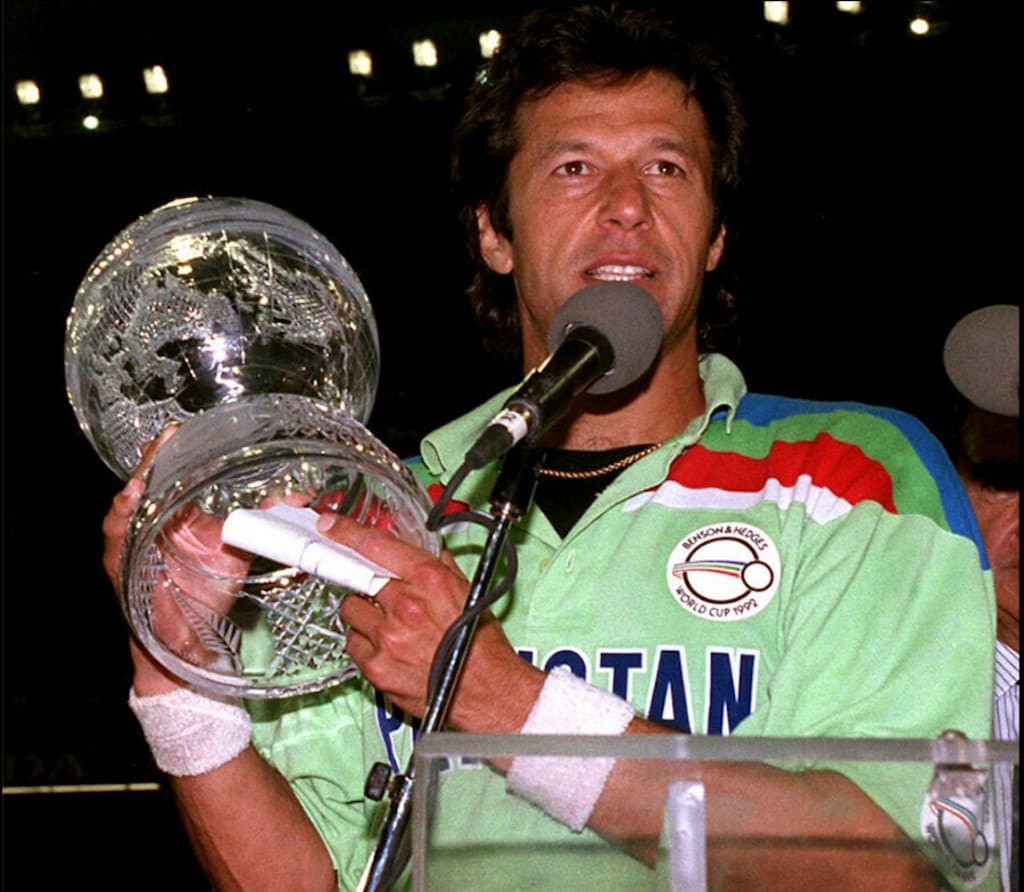
- Imran Khan is a name that resonates deeply in Pakistan and across the world. He first rose to fame as a world-class cricketer, leading Pakistan to its first-ever Cricket World Cup victory in 1992. But his journey didn’t end there. Driven by a desire for change, he transitioned into politics, becoming the 22nd Prime Minister of Pakistan in 2018. His life story is one of determination, resilience, and transformation—both personal and political.
(Image Suggestion 1: Young Imran Khan in cricket uniform holding the 1992 World Cup trophy)
The Cricketing Years: Building a Legacy
Born on October 5, 1952, in Lahore, Imran Khan belonged to a privileged background and studied at elite institutions like Aitchison College and Oxford University. His talent for cricket became evident early, and he joined Pakistan’s national team in 1971 at the age of 18.
Imran’s cricketing career reached its pinnacle in 1992 when he captained Pakistan to a historic World Cup win in Melbourne. It wasn’t just a victory on the field; it was a unifying moment for a divided nation. Khan’s charisma, discipline, and leadership turned him into a national hero.
(Image Suggestion 2: Imran celebrating with teammates after winning the World Cup)
Philanthropy: A New Beginning
After retiring from cricket, Imran Khan focused on philanthropy. His most significant achievement in this area was the establishment of Shaukat Khanum Memorial Cancer Hospital in Lahore in 1994, named after his mother who died of cancer. It became Pakistan’s first state-of-the-art cancer hospital offering free treatment to thousands.
He later founded Namal University in Mianwali, aiming to provide quality education to rural youth. These projects earned him respect beyond cricket and laid the foundation for his political credibility.
(Image Suggestion 3: Imran visiting patients or speaking at Shaukat Khanum Hospital)
Entering Politics: The Birth of PTI
In 1996, Imran Khan entered the political arena by founding the Pakistan Tehreek-e-Insaf (PTI), or the Movement for Justice. At the time, politics in Pakistan was dominated by two major parties—the Pakistan People’s Party (PPP) and Pakistan Muslim League (PML-N). PTI initially struggled, and many dismissed Khan’s political ambitions as unrealistic.
For over a decade, PTI failed to gain significant traction. But Imran remained committed, positioning his party as an anti-corruption force, promising a "Naya Pakistan" (New Pakistan) with justice, accountability, and good governance.
The Rise to Power
PTI's breakthrough came in the 2013 general elections, when it emerged as the second-largest party by popular vote. Imran Khan’s rallies attracted millions, especially youth and urban voters. His message of hope and change resonated with those frustrated by decades of corruption and mismanagement.
In 2018, after 22 years of political struggle, Imran Khan’s PTI won a majority and he became Prime Minister of Pakistan. His victory was hailed by supporters as the arrival of a new era.
(Image Suggestion 4: Imran taking oath as Prime Minister in 2018)
Imran Khan as Prime Minister: Achievements and Challenges
As Prime Minister, Imran Khan focused on improving the economy, reducing corruption, and investing in human development. His Ehsaas Program became Pakistan’s largest welfare initiative, aimed at poverty alleviation. He also prioritized healthcare through Sehat Cards and initiated massive tree-planting efforts to fight climate change.
However, his government faced serious challenges:
Economic instability, including rising inflation.
Accusations of failing to deliver on reform promises.
Tensions with opposition parties and establishment figures.
Despite these obstacles, many viewed his government as a sincere attempt at reform, even if imperfect.
(Image Suggestion 5: Imran addressing the nation or meeting international leaders)
Ouster and Political Struggles
In April 2022, Imran Khan was removed from office through a parliamentary vote of no-confidence. He claimed foreign interference and political conspiracy behind his ouster, sparking nationwide protests.
Even outside office, Khan remained a powerful political force. He continued to rally support, particularly among the youth and middle class, challenging traditional power structures and calling for fresh elections. His confrontations with the judiciary, military, and political opponents have kept him at the center of Pakistan’s political storm.
Legacy and the Road Ahead
Imran Khan’s legacy is multi-dimensional. As a cricketer, he gave Pakistan its greatest sporting moment. As a philanthropist, he built institutions that save lives and educate future generations. As a politician, he introduced a new political narrative centered on justice and self-reliance.
Whether or not he returns to power, Imran Khan has already etched his name in history as a man who dared to dream big and fought against the odds.
Conclusion
From cricket stadiums to the Prime Minister’s Office, Imran Khan’s journey is a remarkable tale of perseverance, transformation, and ambition. His life continues to inspire millions who believe that change, though difficult, is possible with vision and resolve.
About the Creator
127 Hours of Hell
Aron Ralston's unthinkable choice in a Utah canyon and the excruciating self-amputation that saved his life The human survival instinct is powerful enough to make us do things we would consider absolutely impossible under normal circumstances, and nowhere is this more dramatically illustrated than in the true story of Aron Ralston, a twenty-seven-year-old mechanical engineer and experienced outdoorsman who became trapped alone in a remote Utah canyon in April 2003 and made the unthinkable decision to amputate his own right arm using a cheap multi-tool knife in order to free himself from the eight-hundred-pound boulder that had him pinned against a canyon wall, and the fact that he survived this self-performed surgery and managed to rappel down a sixty-five-foot cliff and hike seven miles through the desert before finding help represents one of the most remarkable survival stories in modern history. Ralston's ordeal began on Saturday, April 26, 2003, when he drove alone to Canyonlands National Park in southeastern Utah for a day of solo canyoneering, a sport he was passionate about that involves hiking, climbing, and rappelling through slot canyons, and he deliberately chose not to tell anyone where he was going because he valued his independence and solitude and never imagined that this decision would nearly cost him his life and would become the detail that made his situation so desperately dangerous.
By The Curious Writerabout 9 hours ago in Men
The Man Who Fell From 33,000 Feet and Lived:
How a Serbian flight attendant survived the highest fall without a parachute and the mysterious explosion that caused it The survival of Vesna Vulović, a twenty-two-year-old flight attendant who fell 33,330 feet from an exploding aircraft over Czechoslovakia in 1972 and lived, represents the most extreme survivable fall in recorded history, and the circumstances of both the explosion that destroyed JAT Yugoslav Airlines Flight 367 and her impossible survival have never been fully explained, making her story one of the most remarkable and mysterious in aviation history. On January 26, 1972, Vulović was working aboard DC-9 Flight 367 traveling from Stockholm to Belgrade with stops in Copenhagen and Zagreb, and she was actually a last-minute crew substitution, replacing another flight attendant named Vesna who had the same first name, and this twist of fate meant that she was on a plane she was never supposed to be on, working a route that was not her usual assignment, when at 4:01 PM the aircraft was at cruising altitude over the mountains of eastern Czechoslovakia and suddenly exploded, breaking apart in mid-air and sending debris and passengers falling six miles to the ground below.
By The Curious Writerabout 9 hours ago in Men


Comments
There are no comments for this story
Be the first to respond and start the conversation.