
Do Men Have Only One Thing On Their Minds?
Is there any truth to the common notion? Maybe, maybe not.


The question is loaded. It pokes not just at male psychology but also at culture, religion, evolution, and even stereotypes we’ve all grown up with. Let’s unpack it because it’s way more complex than the simple (and insulting) notion that men are just walking bundles of primal libido.
On one level, let’s admit it: sex is essential to human life, survival, and the continuation of our species. Biological impulses drive everyone, not just men, toward reproduction — even though society likes to slap a double standard on it. Men are wired hormonally with higher testosterone levels, which science shows influences sexual desire. Does this mean men only have one thing on their minds? Of course not. That would reduce masculinity to a caricature, something most men would find insulting and reductive. We’re more layered than that. We’re not living in the Stone Age anymore; human beings have emotional, intellectual, and spiritual dimensions.
Throughout history, religions, philosophers, and thinkers have tried to answer this question too — though they often represented the male experience through their own cultural lens. The Bible, for instance, acknowledges men’s desires but also calls for self-control. “Turn my eyes away from worthless things; preserve my life according to your word” (Psalm 119:37). The emphasis here is on discipline, acknowledging that while lust exists, it doesn’t have to dominate a man’s mind or actions. In Christianity, this is seen as a higher calling — a victory over baser instincts. Jesus even said, “But I tell you that anyone who looks at a woman lustfully has already committed adultery with her in his heart” (Matthew 5:28). That’s a bold statement, acknowledging the human tendency to fixate on sexual attraction but challenging men to rise above it.
In Islam, similar themes emerge. Men are told to lower their gaze and guard their modesty (Quran, 24:30). This doesn’t mean desire doesn’t exist — it means it’s meant to be controlled, channeled, and balanced. Ancient Hindu texts like the Bhagavad Gita describe the struggle with desires as a battle within oneself. Alongside other distractions, lust is treated as one of humankind’s greatest hurdles on the path to enlightenment. These spiritual teachings all seem to point to one truth: men do have sexual desires, but the higher man learns to master them rather than be mastered by them.
Then you’ve got Freud stepping in with his two cents. Sigmund Freud, the father of psychoanalysis, theorized that basically every human action was motivated by Eros, or the sexual instinct. Even creativity, logic, and ambition spring from repressed sexual energy, he argued. It’s a grim but fascinating take, reducing human brilliance to nothing more than sublimated libido. But do modern men fit this mold? I don’t think so. Not entirely, anyway. Life’s a lot bigger than just sexual pursuit.
Take Marcus Aurelius, the stoic philosopher-emperor, whose meditations captured what it means to live virtuously despite urges or distractions. “You have power over your mind — not outside events. Realize this, and you will find strength.” Men, like women, are more than slaves to biology. We have the capacity for introspection, restraint, and noble action. That’s why, through history, you’ve had men create art, build civilizations, sacrifice their lives for causes greater than themselves — all things that cannot possibly be explained as an animalistic fixation on sex.
But let’s not ignore or diminish the obvious either: YES, sexual thoughts do occur frequently in the male mind. Studies confirm that men tend to think about sex more often than women. From a survival standpoint, it makes sense — higher reproductive rates were key to evolutionary fitness. Meanwhile, cultural reinforcements have hammered this hyper-focus home. The media constantly portrays men in a hypersexualized way, as beings whose sole mission in life is to “get the girl.” Think about James Bond, who’s portrayed as stylish, intelligent, brave — but what’s his primary subtext? Seduction and bedding women. That kind of representation seeps into how people, both men and women, view masculinity.
Not every man chases this stereotype though. I could name several examples: look at Jane Austen’s characters in Pride and Prejudice. Mr. Darcy broods, reflects, and changes himself to earn Elizabeth Bennet’s love — and not just because he wants her physically. Austen reminds us how layered men can be emotionally, capable of deep affection, loyalty, and complexity. Similarly, in real life, there are men who prioritize professional goals, their families, hobbies, art, or humanitarian work above anything sexual.
Even in relationships, having “one thing on their minds” isn’t true for most guys. Speaking personally, yeah, attraction’s a big part of love, but so is emotional connection, trust, and intellectual understanding. You want someone to respect, someone to rely on — not just someone to take to bed. Guys crave that too. It’s misleading to treat men’s emotional needs as secondary or nonexistent. Intimacy — both physical and emotional — feeds into the way many men build love.
Men are products of their environments, too. Let’s say you grow up constantly told that your worth is tied to how successful you are with women — what does that do to your psyche? It traps guys into this narrow definition of manhood, centered on conquest and desire. But society’s ideas about masculinity are slowly shifting (thankfully). More and more men reject the old clichés, learning that their strength doesn’t come from how many desires they pursue but from how many they can walk away from.
Philosophically, the question has its contradictions anyway. If men had nothing but lust in their hearts, how would they have constructed cathedrals, written symphonies, or developed breakthroughs in science? Men clearly think about more than just one thing. But maybe the question shouldn’t focus on what’s always on their minds, focusing instead on the kind of men they choose to be. Do they act on their higher ideals, or settle into instinct alone?
Final conclusion? It’s a stereotype — one with slivers of truth about biology, culture, and instinct. But men are so much more. At our best, we challenge ourselves, restrain what comes easily, and chase something bigger than mere satisfaction.__ After all, as Nietzsche said: “He who has a why to live can bear almost any how.” Guys just need to decide what their “why” is.
Read more at shownd.com
About the Creator
Ron C
Creating awesomeness with a pen. Follow me at https://twitter.com/isumch
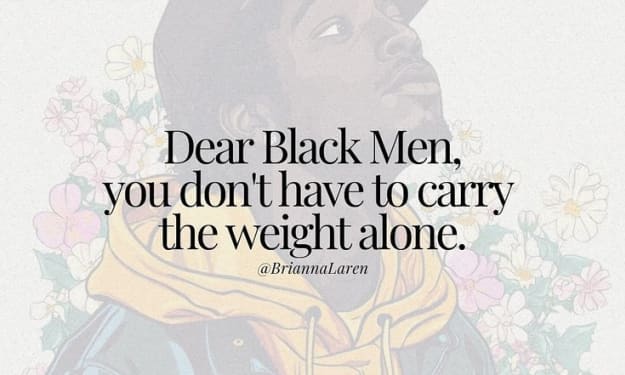
The Weight of Expectations:
There is a silent pressure that follows many Black men throughout their lives. It is not always spoken about openly, yet it shapes decisions, identity, and self-worth. Society places expectations on Black men that are often contradictory, unrealistic, and deeply rooted in history.
By Nkwenkwezi Mgebisa5 days ago in Men
The Departed: The Crime Thriller With a Twist That Still Shocks Fans
When The Departed premiered in 2006, audiences were introduced to one of the most intense crime thrillers of the modern era. Directed by Martin Scorsese, the film blends tension, violence, and psychological drama into a story that keeps viewers guessing until the very last moment. With powerful performances and a complex narrative about loyalty and betrayal, the film quickly became a landmark in modern crime cinema.
By Lukáš Hrdličkaa day ago in Men
Silken Chains
Silhouettes of the female form were given flesh and bone. Silken skin glistened under the spotlight. Dry ice rose around our Icons as they danced atop their podiums in the Square. Heralded for their beauty, their movements were slight, powerful, and sensual.
By Paul Stewart5 days ago in Fiction



Comments
There are no comments for this story
Be the first to respond and start the conversation.