
War and Peace
Hearts Entwined in the Shadow of Empire

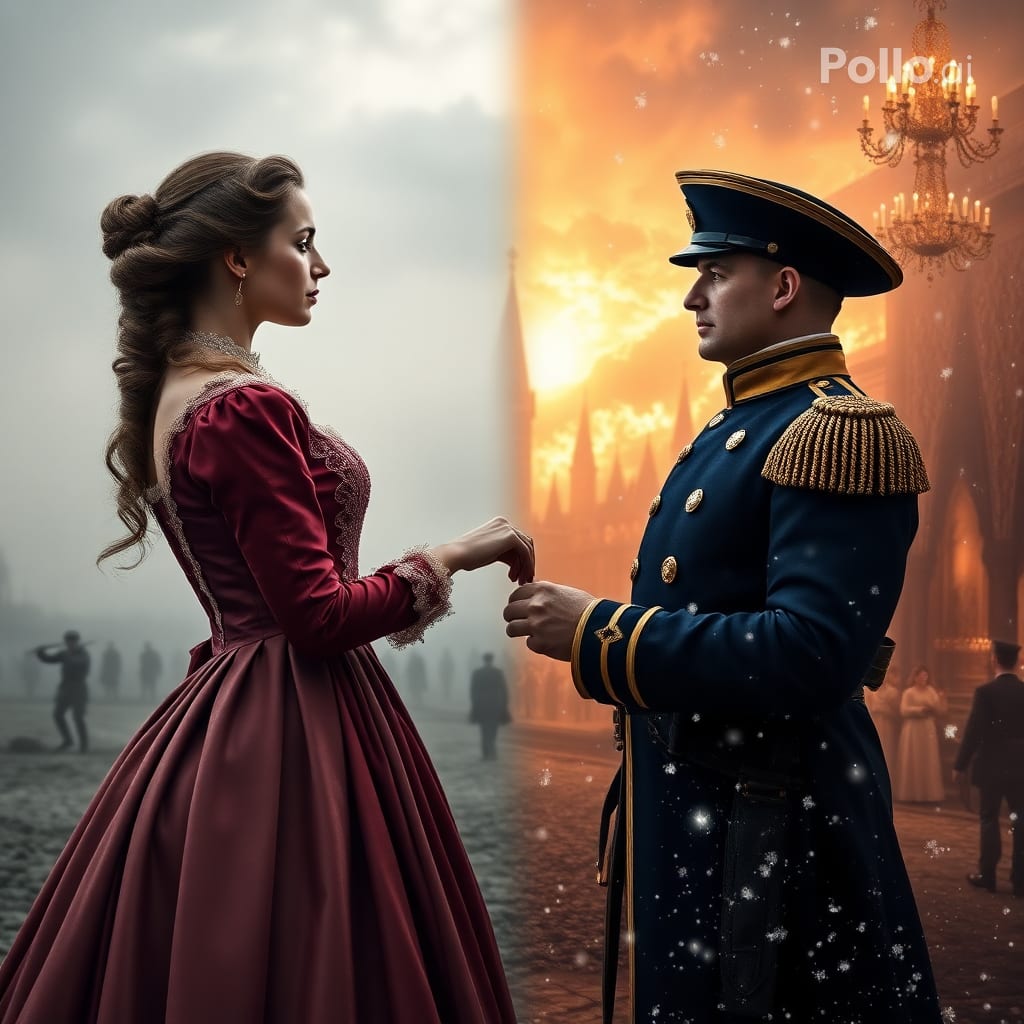
The ballroom glittered like a constellation trapped in chandeliers. Beneath them twirled ladies in silk and officers in polished boots, laughter floating above the strains of a waltz. But to Natalia Orlova, it all felt as if it were made of glass—too perfect, too fragile.
She stood near the column, away from the dance, her eyes fixed not on the swirling couples but on the tall young man who had just entered the room. He was dressed in the dark green of the Imperial Russian Army, snow still melting on his shoulders. His name was Captain Aleksei Mirov, and he had returned from the front lines with Napoleon’s Grande Armée still pressing at the empire’s throat.
Aleksei’s eyes found hers in an instant. No smile, no bow, just that look—like he had crossed half of Europe only to see if she still waited.
Natalia remembered the last time he’d looked at her like that. Two years ago, before the war tore everything apart.
June 1810
They had met in the orchards of the Orlova estate, when the world was green and Russia’s borders still untouched. Natalia was reading Voltaire aloud beneath a birch tree when Aleksei, a distant cousin of a family guest, had wandered too close and interrupted with a smirk: “Do you always seduce the Enlightenment under trees?”
She had thrown a crabapple at him. He ducked. They were inseparable after that.
But war changed men. And love, too.
In the years that followed, Aleksei had marched through fire and frost. He had written her from the fields of Austerlitz, from the blood-soaked forests of Eylau. His letters were sparse, censored, but full of longing. Natalia answered each one with the quiet devotion of a woman who refused to let war steal what it could not touch.
Until the letters stopped.
For nearly eight months, she heard nothing. Rumors came instead—Aleksei missing, perhaps dead, perhaps captured. Her family urged her to accept Count Dmitry Volgin, a wealthy diplomat with powerful ties in St. Petersburg.
She had nearly relented.
And now, Aleksei stood before her again, his uniform worn, his hands scarred, and yet… he had returned.
They met privately in the frost-bitten garden after the ball.
“I thought you were dead,” she whispered, her breath a plume in the air.
“I wanted to be,” he said. “But something kept me alive. You.”
“You didn’t write.”
“I couldn’t. I was taken prisoner in Saxony. I escaped.”
He paused, pulling something from his coat—a small, worn copy of The Aeneid, the one she had given him before he left. “This is all I kept.”
Natalia’s eyes welled, but she would not cry. Not yet.
“I was going to marry Dmitry,” she said flatly.
Aleksei looked away. “He’s safe. I’m not.”
“I don’t want safe.”
“But you deserve it.”
Their silence was broken only by the crunch of snow beneath her slippers as she stepped forward.
“I don’t care about empires, Aleksei. I don’t care about peace talks or generals or what the tsar thinks. I care that you came back.”
“And if they send me out again?”
“Then I’ll wait again.”
“You might wait forever.”
“I’ll wait longer.”
The peace they found in each other was short-lived.
By spring, Napoleon’s army had begun its fateful march into Russia. The Tsar demanded every able soldier. Aleksei was summoned once more. They were married in secret two days before his departure, in a chapel surrounded by candlelight and whispers.
“I will return again,” he promised, kissing her palm.
“You had better,” she whispered, “or I shall haunt you.”
Winter, 1812
The war swept through Russia like a storm of iron and fire. Moscow burned. The Russian army fell back and rose again like waves.
Natalia waited in St. Petersburg, her letters unanswered, her heart twisting tighter with each report of death. Until one cold dawn, a rider came. Not from Aleksei—but from the army command.
Captain Mirov was missing. Last seen at Borodino. Presumed fallen.
This time, there was no battlefield grave. No memento. Just a void.
Months passed.
Then, one evening, a knock on the Orlova estate door. Natalia opened it herself.
And there he was—limping, wounded, but alive.
“You promised to haunt me,” Aleksei said with a crooked smile. “I figured I should avoid that.”
She fainted into his arms.
Years Later
Their love became legend in the provinces. They had survived Napoleon, exile, revolution. They had raised children, planted birch trees in the old orchard. Aleksei never spoke of the war unless asked. Natalia never asked—she had already heard all she needed in the way he held her every night as if she were the anchor he had clung to in the darkest storm.
In the end, peace was not the absence of war. It was the promise kept by two hearts, entwined beneath the shadow of empire, refusing to break.
About the Creator
MR SHERRY
"Every story starts with a spark. Mine began with a camera, a voice, and a dream.
In a world overflowing with noise, I chose to carve out a space where creativity, passion, and authenticity
Welcome to the story. Welcome to [ MR SHERRY ]
Guard Your Battery
Why are some people so attractive just by standing there? It’s not because they are "likable," but because they don’t need everyone to like them. I realized later that truly charismatic people allow themselves to be criticized, but they never criticize themselves. They never try to please the world; instead, the world stops to watch them.
By Emily Chan - Life and love sharing3 days ago in Poets




Comments
There are no comments for this story
Be the first to respond and start the conversation.