
The Salt in Her Eyes
She dreamed of a sea she'd never seen, and he watched her drift.
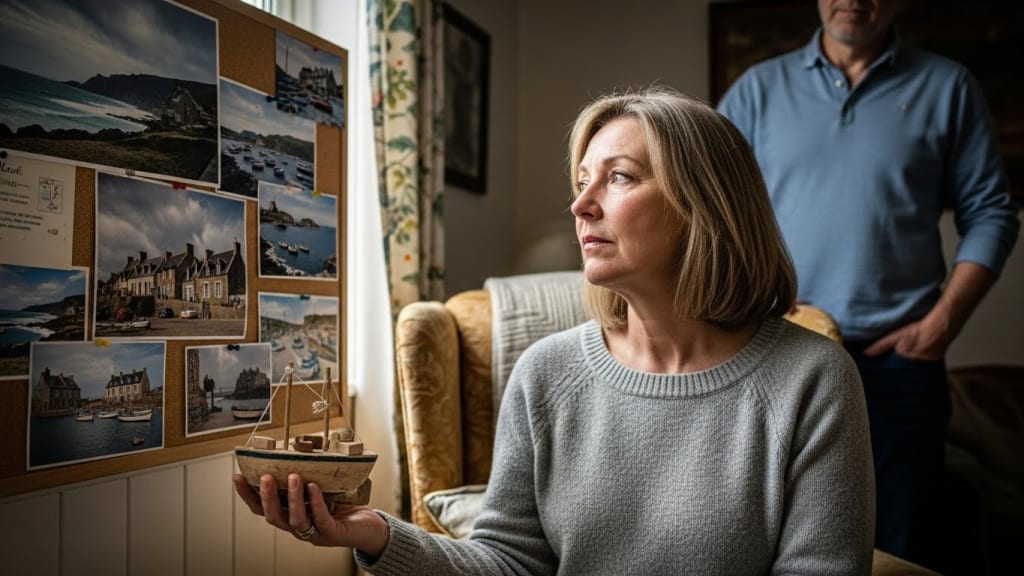
Sarah spent too much time in the small, sun-bleached corner of their living room, an old armchair swallowing her whole. Not watching TV. Not reading. Just staring at the photographs she’d pinned haphazardly to the corkboard next to the window. Mostly faded prints, postcards picked up from antique shops, blurry internet printouts. All of them of the same place: a sliver of the Breton coast in France, a tiny fishing village called Port-Guen. Rough-hewn stone houses, their roofs heavy with moss, huddled against a grey, spitting sea. Boats, small and sturdy, bobbing in a little harbor, nets drying on the quay.
Mark would see her there, night after night. Her fingers, gnarled now with forty-odd years of life, would trace the outline of a distant lighthouse. A woman in a dark shawl, her back to the camera, walking towards the waves. He’d be in the kitchen, clattering dishes, or slumped on the sofa, half-listening to a baseball game he didn’t much care about. But he’d feel her quiet presence, her deep, singular absorption in a place she’d never once set foot in. It wasn’t a vacation fantasy. It was something else. A yearning. A memory, almost, for a life that wasn't hers.
She talked about it sometimes, in fragmented sentences, usually after a glass of wine. The smell. “I can almost smell it, Mark. That particular kind of salty, damp air, like ancient rock and fish guts and cold rain.” She’d close her eyes, her brow furrowed, as if trying to pull the scent right out of the air. He’d nod, maybe grunt something noncommittal. He couldn’t smell it. He only smelled the dinner they’d just eaten, or the cheap pine cleaner Sarah liked to use on the floors.
Her grandmother, Marguerite, had come from somewhere near there, she’d said. Or a story about a great-aunt who’d run off with a fisherman. The details were always hazy, shifting. But the feeling was solid. Sarah swore she could hear the gulls. Not the screeching city gulls, but a different, wilder cry, carried on the wind straight into her bones. She’d spend hours on travel blogs, looking at maps, even trying to learn a few phrases of Breton. ‘Kenavo,’ she’d mutter, practicing the goodbye, her tongue clumsy around the unfamiliar sounds.
It sometimes made him feel a little… left out. Like she had a secret life he wasn’t privy to. He’d walk into the living room, and she’d jump, pulling herself back from the imaginary cliff edge. “Oh, hey,” she’d say, a little too brightly, her eyes still holding that distant, grey sparkle. He’d watch her, then look at the pictures. Nothing special. Just a cold, remote village. What was so captivating about it? He knew her, every freckle, every worry line, every inflection in her voice. But this longing felt like a stranger had moved in, right between them.
One Saturday, he was out running errands, staring blankly at a rack of postcards in a gas station, full of bright, cheesy tourist traps. He saw a small, polished wooden figurine, a stylized fishing boat, no bigger than his hand. Crude. Simple. Painted with chipping blue and white stripes. It felt… Breton. Or what he imagined Breton to be. He bought it. Didn’t even think twice.
He walked in the door, dropped the grocery bags, and just handed it to her. She was in her armchair, naturally. She looked at the boat, then at him, her eyes wide. Not a single word. She just took it, turned it over in her palm, her thumb tracing the rough grain of the wood. A tiny, almost imperceptible tremor ran through her fingers. He watched her. She finally looked up, her gaze softer than he’d seen it in days, maybe weeks. A tear welled in the corner of her eye, quick, defiant, and she blinked it away.
“It’s silly, isn’t it?” she whispered, her voice rough, hoarse. “To miss a place you’ve never even been.” He shook his head, sat on the armrest of her chair, and put a hand on her shoulder. Her skin felt cool through her thin sweater. He didn’t know what to say. He didn’t understand the missing, not really. But he understood *her*. And he knew this ache was real, as real as the bills on the counter, as real as the worn sofa they sat on, as real as the quiet hum of their lives together.
He leaned in, rested his chin on the top of her head. She smelled like her shampoo, and something else, something sharp and clean, like rain on stone. He held her, and the small wooden boat, a proxy for a distant sea, rested between their hands. The imaginary gulls still cried somewhere in her mind, he knew it. But for a moment, just for a moment, he felt the chill of that phantom wind too, blowing right through their little living room.
About the Creator
HAADI
Dark Side Of Our Society
It's 2026. Songs Turning 10 This Year
In 2016, we saw the rise of short form videos and what would lead to the birth of TikTok. We cannot forget the Snapchat filters no matter how cringe worthy some of them might have been. It was also the year in which the hit series Stranger Things debuted.
By Jasmine Aguilar6 days ago in Beat



Comments
There are no comments for this story
Be the first to respond and start the conversation.