
Beyond the Mirror’s Lie
A Love Story Where Beauty Learned to Speak Softly


In the town of Marrow field, beauty had rules.
It lived in clear skin, symmetrical smiles, and confident posture. It walked the streets wearing approval like perfume, receiving glances that lingered and doors that opened easily. Those who fit its shape were welcomed without question. Those who did not were quietly taught where they belonged.
Lina knew this better than anyone.
People had been calling her ugly since she was old enough to understand the word. Not cruelly—rarely with open malice—but with the casual certainty of a fact that needed no proof. Her nose was too broad, her teeth uneven, her skin marked with scars from childhood illness. Mirrors did not lie to her; people had already done that job.
So Lina learned to make herself small.
She dressed plainly, spoke gently, and laughed only when necessary. She learned that kindness was safer than confidence and silence less painful than hope. At twenty-three, she worked in the town library, a quiet building filled with dust, stories, and characters who loved without conditions.
That was where she first saw Aaron.
He walked in one afternoon like a rumor come to life. Tall, effortlessly handsome, with eyes that carried both warmth and curiosity. People noticed him instantly—heads turned, whispers followed. He looked like someone meant to be admired, someone who belonged to a different story than Lina’s.
She noticed him too.
But she did not imagine anything beyond that. Life had taught her better.
Aaron came to the library often after that. He sat near the windows, reading novels no one else seemed interested in. Sometimes he asked Lina for recommendations. Sometimes he simply smiled and nodded in greeting.
What puzzled Lina was not his presence—but his attention.
He listened when she spoke. Not politely, not distractedly, but fully. He asked her questions that had nothing to do with books. He laughed at her dry humor, as if it surprised and delighted him. When she looked away out of habit, embarrassed by being seen, he waited patiently for her eyes to return.
The town noticed too.
“Why does he talk to her?” people whispered.
“He could have anyone.”
“Maybe he’s just being kind.”
Lina told herself the same thing.
Aaron, for his part, had grown tired of beauty that demanded to be worshipped. He had dated women who were praised everywhere they went, women who admired their reflections more than conversations. He was not blind to beauty—but he was weary of how loudly it spoke.
With Lina, everything was quieter.
She noticed details others ignored. She spoke thoughtfully. She never assumed he would stay, never demanded attention. And there was something in her eyes—a depth shaped by survival—that made him feel seen in a way admiration never had.
They began walking home together after the library closed.
At first, Lina kept distance between them, both physically and emotionally. She expected disappointment to arrive eventually, as it always did. But Aaron did not rush her. He spoke about his fears, his uncertainty about the future, his frustration with being judged by his face rather than his heart.
That surprised her most of all.
“People think you have everything,” she said once, unable to stop herself.
“They think I have nothing to worry about.”
Aaron smiled sadly. “People think mirrors tell the whole story.”
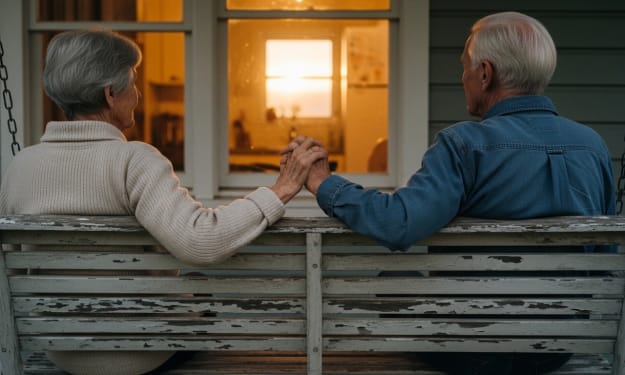
The day he held her hand for the first time, Lina froze.
Not because she didn’t want it—but because she didn’t believe it was meant for her. Her first instinct was to pull away, to protect both of them from embarrassment.
But Aaron held on gently.
“I know what people say,” he told her quietly. “I know what they think. But I don’t see you the way they do.”
Tears burned her eyes—not from joy, but from fear.
“Then you’re wrong,” she whispered. “Everyone else can’t be.”
Aaron shook his head. “Everyone else never bothered to look.”
When their relationship became known, the town reacted exactly as Lina had expected.
People stared. Some laughed. Others pitied Aaron. A few approached Lina with false kindness, asking how she had “managed” it, as if love were a prize stolen rather than shared.
The cruelty wasn’t always loud. Sometimes it was silence. Invitations stopped. Compliments disappeared. Lina felt the familiar weight of being tolerated rather than accepted.
And Aaron saw it all.
One evening, after a particularly hard day, Lina stood in front of the mirror and said the words she had carried for years.
“You’ll leave,” she told him without turning around. “Everyone does. One day you’ll wake up and realize you deserve someone beautiful.”
Aaron didn’t answer immediately.
He stepped behind her and met her eyes in the mirror—the same mirror that had only ever shown her flaws.
“Do you know what I see?” he asked. “I see someone who learned to be gentle in a world that wasn’t. Someone who knows how to love without demanding proof. Someone who is more beautiful than anything I’ve been taught to admire.”
Lina shook her head. “That’s not what the mirror says.”
“Mirrors are trained by society,” Aaron replied. “They only reflect what they’re taught to value.”
The turning point came at a public gathering—a festival filled with music and laughter. When Aaron walked in holding Lina’s hand, the whispers grew louder than ever.
Someone laughed openly.
Someone else shook their head.
Aaron stopped walking.
He turned to face the crowd and spoke calmly, without anger.
“This is the woman I love,” he said. “And if that confuses you, maybe it’s not her face you should question—but your definition of beauty.”
Silence fell like a held breath.
Lina had never felt so exposed—or so protected.
From that day on, things changed slowly, unevenly. Not everyone accepted them. Some never would. But Lina began to stand taller. Not because the world had changed—but because she had.
She learned that beauty was not a permission slip. Love was not something she had stolen or borrowed. It was something she had earned simply by being herself.
Years later, when people asked Aaron what he saw in her, he always answered the same way:
“Truth. And peace.”
And when Lina looked in the mirror now, she still saw the same face—but it no longer felt like a verdict.
It felt like a beginning.
Because love, when it is real, does not make us beautiful in the eyes of the world.
It teaches us that the world was wrong to begin with.



Comments
There are no comments for this story
Be the first to respond and start the conversation.