
Your mind is a puppy and it needs a daily walk
The importance of keeping yourself challenged


Have you ever heard the phrase “a tired dog is a good dog”? People say this, but what they mean is “a mentally engaged dog/ a dog who feels useful/ a dog who has had some purpose in his day, is a good dog”.
If you’ve ever raised a dog, you know that puppies who feel ignored get anxious start destroying things. If they are not given positive mental engagement, they start finding their own and usually end up hurting themselves or their environment.
As a mostly grown, fairly independent, and somewhat stable adult, I made the discovery that “tired people are good people” too. I don’t mean that over-working yourself leads to self-actualization or that busy-work will effectively distract you from inner turmoil, but people who stay engaged with things that challenge them and make them think, are usually a lot happier and a lot less anxious.
My “scholarly research” on this issue is being friends with a girl in college who would hustle like a madwoman all semester long, pursuing her studies, relationships, and interests with obnoxious gusto. During the school year, she stayed busy and was generally satisfied with her life and herself. But whenever a holiday break would come, she’d always call me up at some point and talk about how she probably needed to go to therapy because she was so depressed, apathetic, and lethargic.
I’m pretty sure anyone reading this has known or been that person.
While in the structure of school, or dealing with the other unavoidable demands on our time, we can cram so much into our free time. We may be totally exhausted all the time, but the near-constant overload can be weirdly satisfying. I don’t know about everyone, but knowing that I had done everything that I possibly could every week in college was mad satisfying.
Then soon as we got away from the demands of school, we stopped prioritizing our time enough to regularly pursue our interests. It’s something about a scarcity of time for me. If I know that, for this entire week, I will only have about two hours to go get dinner with friends and do something fun, I’m so much more likely to cram it into those two hours, than if I had unlimited opportunities.
The transition from being a student who constantly has assignments and upcoming projects on your mind, to a working adult who is totally free once you clock out, is fraught with "too much free time". Finding your optimal level of engagement can be difficult.
If you’re like me, you didn’t roll out of your commencement ceremony straight into a satisfying, high-paying, incredible job that demanded a lot of mental engagement. You instead got an entry-level job at the first place that would hire you so you could start piling up some “work experience” points. And it was mind-numbing, repetitive work that made you question your degree. Like “did I really just spend four years of my life writing papers, so I could spend 8 hours a day feeling like a cog?”
I’m not recommending we return to a college-student level of stress and madness. But there were some good habits that would be great to translate into adult working lives. Specifically, staying crazy busy. But the right kind of busy this time.
Busyness never created happiness, but mental engagement and challenge is often the “happiness” that people crave.
Ever wonder why lottery-winners are more likely to develop depression, substance abuse, and/or commit suicide? My hypothesis (very under-researched) is that they just don’t have any challenges anymore. No struggle. No hustle. No purpose.
As mostly grown, fairly independent, and somewhat stable adults, we all have to create an environment that challenges us and keeps us mentally engaged.
This is the most elite form of self-care. Bubble baths and rest are lovely and necessary, but constant leisure won’t make you happy. More money, to afford more leisure, probably won’t make you happy either.
I’m a firm believer that humans are wired for work. Not slavery and mindless drudgery, but purposeful, interesting work.
Every day, you should be looking for a way to work your mind out the way people take their dogs on long walks. Puppies that get a variety of exercises and play can sit quietly on the couch with you, enjoying snuggles and a binge-watch. Puppies that have laid around the house all day are rowdy and won’t sit still for anything when you get home.
Perhaps it’s too simplified, but your mind is like a puppy. It needs new chewy toys every week and a daily walk around the block, or it will eat the couch.
I’m going to explore this topic for a while, so stay tuned for posts on how to find your favorite mental chew toy or how to identify what your "daily walk" might be.
Disclaimer: I am not a licensed mental health professional and my theories here are in no way meant to be a cure for those with professionally diagnosed mental disorders or those who otherwise find themselves in uncontrollable circumstances.
About the Creator
Keep reading
More stories from Addison Witcher and writers in Longevity and other communities.
Fire from the West
There weren’t always dragons in the valley. That was before Emperor Kronin subdued the lands to the west, opening the trade routes to the furthest isles. Strange merchants brought stranger goods and our simple towns were overrun with by the wave of change sweeping into the country. New languages, foreign spices, strange garb and most unexpectedly, dragons.
By Addison Witcher4 years ago in Fiction
A wildflower in California reveals a newly documented evolutionary process
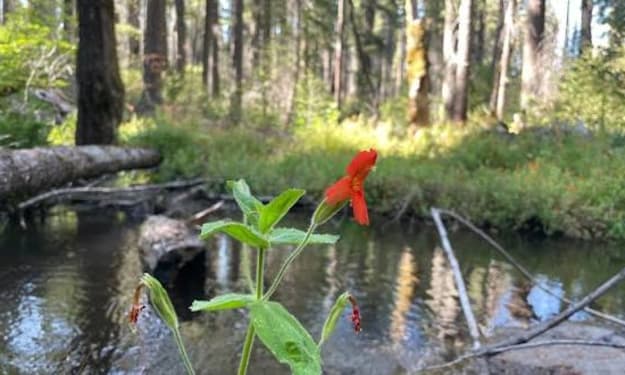
In a remarkable breakthrough for evolutionary biology, researchers studying wildflower populations in California have documented one of the clearest cases yet of rapid genetic evolution occurring in nature. The findings, centered on the bright red scarlet monkeyflower (Mimulus cardinalis), reveal how some plant populations were able to adapt and recover following the region’s most severe drought in over a millennium — providing tangible evidence of an evolutionary process known as evolutionary rescue. The scarlet monkeyflower, a wildflower native to moist areas along streams and springs in California, has long been familiar to botanists and hikers alike for its vivid blooms and distinctive habitat. However, during the early 2010s, California experienced an unprecedented megadrought that lasted several years, killing hundreds of millions of trees and dramatically altering the ecological landscape. While many plant species suffered catastrophic declines, some populations of Mimulus cardinalis showed a surprising resilience. Scientists from multiple institutions undertook a long‑term study to understand how this wildflower weathered such extreme conditions. Over eight years, researchers tracked 55 populations of the monkeyflower across its natural range, closely monitoring their numbers and health. They also conducted whole‑genome sequencing to observe genetic changes over time, looking for evidence that natural selection had acted on specific traits. The results were illuminating. At sites where populations had nearly collapsed — with numbers dropping by as much as 90% — genetic analysis revealed consistent shifts in allele frequencies across the genome. These shifts were not random; they were associated with traits that likely enhanced drought tolerance, enabling some individuals to survive and reproduce where others perished. As these “advantaged” genotypes became more common, the population as a whole began to recover, a hallmark of what biologists call evolutionary rescue. Evolutionary rescue occurs when the genetic variation present within a population allows it to adapt fast enough to avoid extinction under sudden environmental stress. While theoretical models have long predicted such processes, direct evidence in the wild—especially involving plants—has been limited. This study is among the first to document genomic changes in natural plant populations that are clearly linked to a major environmental crisis. For decades, evolutionary biologists have debated how quickly natural selection can operate in real‑world scenarios. Classic case studies like Darwin’s finches in the Galápagos have demonstrated adaptive changes in beak shape over a few generations. But plant studies have often lagged behind, in part because many species have long lifecycles or reproduce clonally, making rapid evolution harder to detect. The California wildflower case breaks new ground by combining long‑term fieldwork with cutting‑edge genomic analysis. Researchers noted that the recovery of the monkeyflower populations did not happen overnight — it took roughly two to three growing seasons for numbers to rebound significantly. Yet in evolutionary terms, this pace is considered rapid. The drought likely imposed intense selective pressure, filtering out less drought‑tolerant genotypes and leaving behind a smaller cohort better suited to the harsh conditions. As these were the individuals contributing more seeds to the next generation, their genetic traits spread through the population. The implications of this research extend beyond wildflowers. As climate change accelerates and extreme weather events become more frequent, scientists are increasingly interested in how species will respond — whether through behavioral changes, migration, or evolutionary adaptation. Cases like Mimulus cardinalis suggest that some species may harbor the genetic diversity necessary to adapt swiftly when environments change dramatically. However, not all species will be so fortunate, and the mechanisms of evolutionary rescue are still not fully understood. “This is one of the clearest cases we've seen where a wild plant species shows genomic evidence of adapting to extreme environmental stress,” said one of the study’s lead authors. “It gives us hope that under certain conditions, natural selection can work fast enough to help populations persist — but it also raises many questions about the limits of such adaptation.” The study’s methods also signal a new era in ecological research. By combining consistent field monitoring with high‑resolution genetic data, scientists can now track evolution as it happens rather than inferring processes from fossils or distant historical records. This “real‑time” view of evolution may become vital for conservation efforts, helping biologists identify which populations are most at risk and which may have the inherent capacity to adapt. For conservationists, the findings underscore both the resilience and vulnerability of natural ecosystems. While some populations like the scarlet monkeyflower demonstrate extraordinary adaptive potential, others with limited genetic diversity may face a greater threat of decline or extinction as climates shift. Understanding the genomic underpinnings of adaptation could therefore inform strategies to protect biodiversity in a warming world. As research progresses, scientists hope to explore similar evolutionary dynamics in other species and regions. The California wildflower study stands as a testament to the power of modern genomics and long‑term ecological research — and a reminder that evolution, far from being a slow, imperceptible force, can sometimes unfold before our eyes.
By Fiaz Ahmed 3 days ago in Longevity



Comments
There are no comments for this story
Be the first to respond and start the conversation.