
Why Handwriting Is Better for Your Memory Than Typing
“Science Shows That Putting Pen to Paper Boosts Memory, Focus, and Creativity in Ways Typing Never Can.”

Rediscovering the Power of Pen and Paper in a Digital Age
In today’s fast-moving digital world, most of us have replaced notebooks with keyboards and pens with touchscreens. Typing feels faster, easier, and more efficient. Yet, new research suggests that while technology has improved our productivity, it may have quietly weakened our ability to remember and understand information deeply. Handwriting, it turns out, is far more powerful for memory, learning, and creativity than typing.
So why does writing by hand stick better in our brains? Let’s explore the science—and the surprising benefits—behind this old-school skill.
---
The Science of Handwriting and Memory
Handwriting engages the brain in ways typing simply doesn’t. When you write something by hand, multiple regions of your brain work together: the motor cortex (controlling hand movement), the visual cortex (recognizing shapes and letters), and the hippocampus (responsible for memory).
Typing, by contrast, relies on repetitive finger movements. Every letter is produced the same way, and your brain doesn’t need to think much about how the letters are formed. Researchers from the University of Norway discovered that people who take notes by hand show stronger brain connectivity in memory-related regions compared to those who type. This means that handwriting not only helps you store information but also strengthens neural connections that support long-term learning.
In simple terms: handwriting forces your brain to slow down, think deeply, and process information more meaningfully.
---
Writing by Hand Helps You Learn and Retain Better
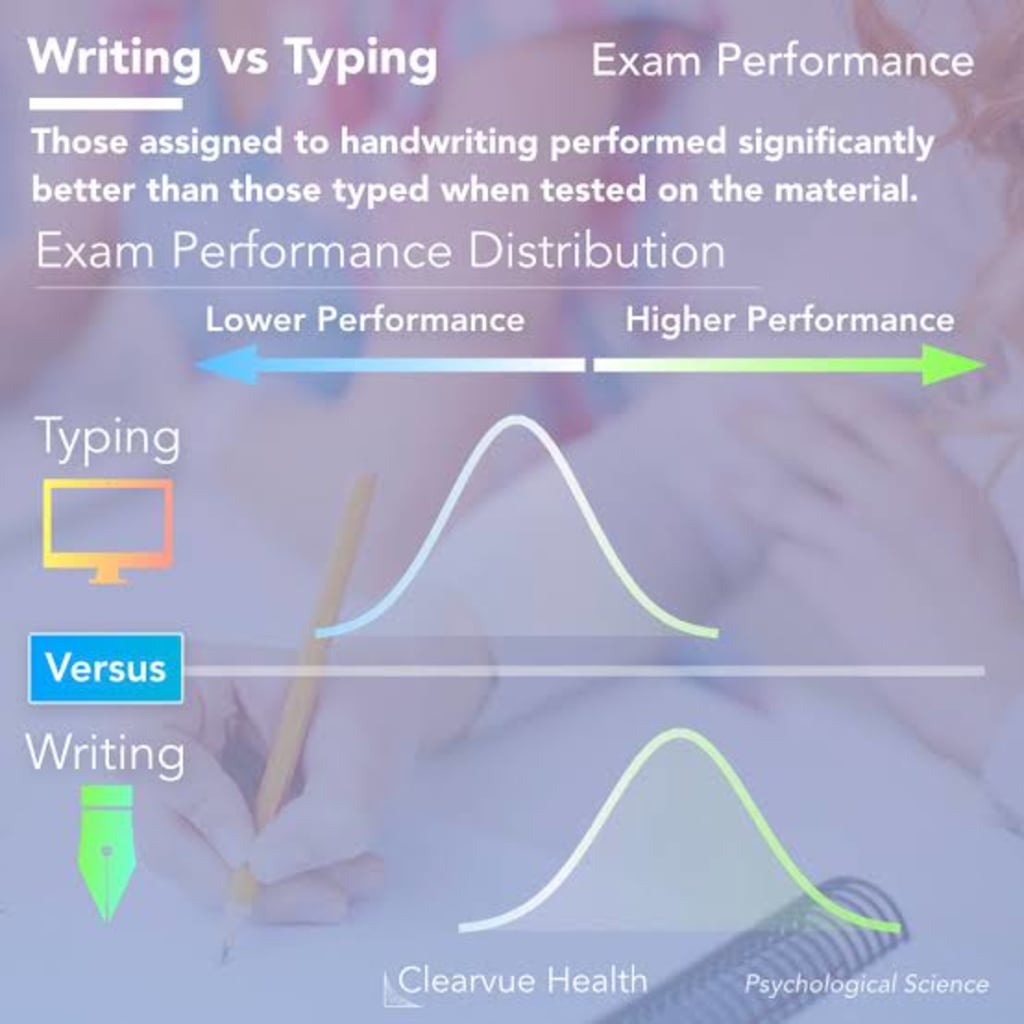
When students take handwritten notes, they remember more—not because they record more words, but because they process the meaning of what they’re writing. A well-known study from Princeton University found that students who typed their lecture notes performed worse on tests than those who wrote by hand. The typists often copied words verbatim without fully understanding them, while the handwriters summarized and rephrased, which improved comprehension.
This is called cognitive encoding: the process by which information is transformed into memory. Handwriting requires you to organize thoughts and prioritize key points, strengthening this encoding process.
If you’ve ever rewritten your notes to study and felt like the material “stuck” afterward, that’s your brain benefiting from the physical and mental engagement of handwriting.
---
Creativity Flows Through the Pen
There’s another hidden advantage of handwriting—it’s linked to creativity. Many writers, artists, and thinkers swear that jotting ideas on paper helps them think more freely. Neuroscientists believe this happens because handwriting is a slower, more deliberate act. The pauses and rhythms of writing allow your subconscious to connect ideas in ways typing often interrupts.
When you type, your brain focuses on speed and efficiency. When you write, it drifts, imagines, and creates. It’s no coincidence that some of history’s most brilliant minds—Leonardo da Vinci, Albert Einstein, and Virginia Woolf—kept detailed handwritten journals and notebooks. The simple act of writing helped them brainstorm and develop new ideas organically.
---
Emotional and Mental Benefits of Handwriting
Handwriting isn’t just good for memory—it’s also good for your mental health. Writing by hand has a calming effect on the mind, similar to meditation. It slows your thoughts, reduces digital distractions, and grounds you in the present moment.
Journaling, for instance, has been proven to help manage stress, process emotions, and improve focus. The tactile connection between pen, paper, and thought gives a sense of control that typing on a glowing screen rarely provides.
In a world dominated by screens, handwriting is a refreshing analog escape—a way to reconnect with your thoughts and emotions authentically.
---
When to Choose Handwriting Over Typing
Of course, typing still has its place—it’s faster and more practical for certain tasks. But when it comes to learning, reflection, or creativity, handwriting is superior.
Here are a few situations where handwriting can make a real difference:
Taking notes in class or meetings: Summarizing key points by hand helps you remember them longer.
Brainstorming ideas or planning projects: Writing freely on paper encourages more creative thinking.
Journaling or self-reflection: Handwriting deepens emotional connection and mindfulness.
Studying for exams: Rewriting material by hand enhances recall and understanding.
Even handwriting short to-do lists can improve your focus—your brain literally visualizes the tasks more vividly.
---
Final Thoughts: Rediscovering the Power of the Pen
In our digital-first world, handwriting might seem outdated—but its cognitive power is timeless. When you pick up a pen, you’re not just forming words; you’re training your brain to think more deeply, remember more effectively, and create more freely.
So next time you’re tempted to type those class notes, a journal entry, or even your goals for the week—try writing them down instead. Your brain will thank you.
Because sometimes, the simplest tools—pen and paper—are still the smartest technologies for your mind.
About the Creator
Fiaz Ahmed
I am Fiaz Ahmed. I am a passionate writer. I love covering trending topics and breaking news. With a sharp eye for what’s happening around the world, and crafts timely and engaging stories that keep readers informed and updated.
Keep reading
More stories from Fiaz Ahmed and writers in Longevity and other communities.
Charlie Dimmock
From Garden Centre to TV Favourite Charlie Dimmock is a familiar face in British gardening and television. Born on 10 August 1966 in West Wellow, Hampshire, England, she developed a love for gardening at a young age—especially spending time with her grandfather in his vegetable patch. She went on to study amenity horticulture, earning a BTEC Diploma and a National Technical Certificate before starting work in a garden centre.
By Fiaz Ahmed 4 months ago in Longevity
The impact of sleep on our mental state
Introduction Sleep is a critical pillar of our daily lives, yet it’s often treated as an afterthought. While comfort and personal preference matter, the idea that we should just sleep “whenever and however” is a trap. To truly function at your peak, you need more than just rest — you need a disciplined strategy. It sounds harsh and at first, if you are used to staying up all night and not paying attention to your mental and physical health, it might seem impossible. However, great things do require some small sacrifices, so let us begin with the three tips.
By Charilaos Spanoudis7 days ago in Longevity
I wanted to title this something different, but worried that my chosen title might cause problems entering the United States in the future so this is the new title. It's the greatest title. No one has ever written a title better than this. (All titles unrelated to content).
Let me be honest. I am finding this difficult. Now, I like a challenge, a stretch, a bit of an obstacle course. “Write about the decline of the British Empire in the form of a narrative poem in which your protagonist is an artichoke” I read, and flex my fingers. “Write a haiku to evoke the sensation of sibilance using only the first half of the alphabet.” “Well”, I think to myself, “this should be fun.” But “write about a system that isn’t working”? A system that isn’t working? Now? In 2026? ONE system? My favourite system that isn’t working? The sexiest system that isn’t working? The one giving me the most angst day to day? The one giving me the most existential dread? I am, as I say, finding this difficult. I will own that I have contemplated writing a thousand words on why the steady “all on” setting on my fairy lights is the EIGHTH of seven options which must be sequentially activated to get there, because that is a system that some fool came up with and it definitely doesn’t work, and now who is paying the price, eh? But how can I write about my fairy lights when…. When…. When….
By Hannah Moore7 days ago in Humans


Comments
There are no comments for this story
Be the first to respond and start the conversation.