
What Are The Benefits Of Static Exercises And Do You Need Them
They can be a real salvation, but they are not suitable for everyone.

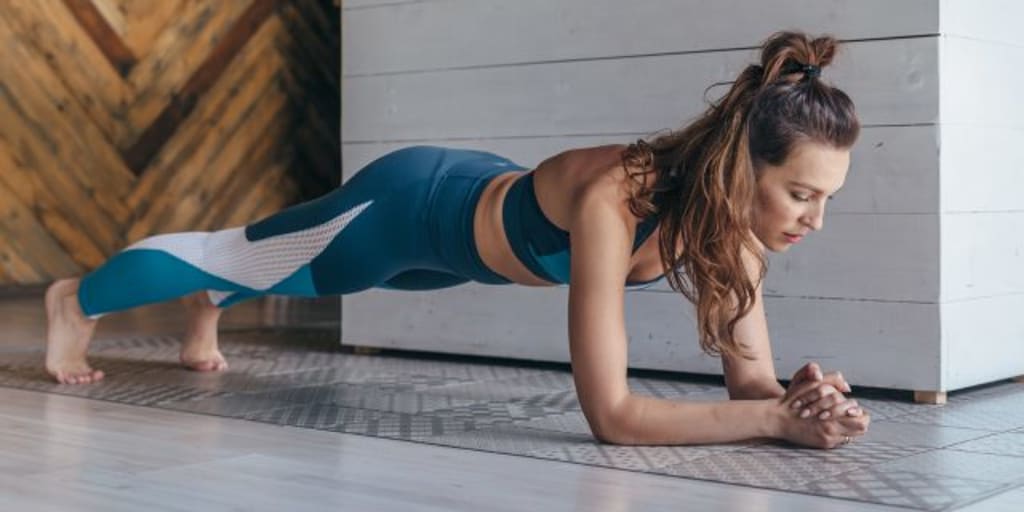
What are static exercises?
Static exercises are movements during which you strain your muscles, but do not change your position. For example, you stand in a plank or freeze in a half-squat and do not move until you have enough strength.
In the process, the muscles tense up, but they do not change their length, do not move the joint and do not relax until the end of the exercise. The second name of these exercises is isometric.
What are the benefits of static exercises?
Reduce the risk of injury
One of the main advantages of static exercises is control over the position of the body.
Working in dynamics, you can choose the wrong trajectory or not hold the correct position. In statics, this is practically impossible, and therefore isometric exercises are as safe as possible.
Effective for muscle building
During static exercises, the muscles have to work without relaxation. In addition, constant tension squeezes the blood vessels, and metabolic products, such as hydrogen ions, accumulate in the working muscles.
All this stimulates protein production after exercise and helps to build muscle mass.
An analysis of nine scientific studies has shown that static exercises increase muscle size by an average of 0.84% per week.
They help to become stronger
A meta-analysis of scientific studies noted that static exercises increase isometric strength by an average of 46%, and half of this increase occurs in the first month of classes.
Who will benefit from static exercises?
Isometric loads will be useful for those who:
- Wants to increase muscle volume. Performing static exercises in addition to dynamic ones, you will be able to "finish off" the muscles and provide them with an additional incentive for growth without overloading the joints.
- He is recovering from an injury and does not want to lose strength. In static, you can choose a position in which you do not experience pain, and safely strain the muscles, maintaining their volume and strength.
- Suffers from arthritis. Isometric exercises will help strengthen muscles without pain, so that you can then move on to other training options.
- Looking for ways to lower blood pressure. A meta-analysis of five scientific papers has shown that only 30-50 minutes of static exercises per week help to reduce systolic pressure by 10 mmHg, diastolic pressure by 7 mmHg. But since an incorrectly chosen load can increase blood pressure during exercise, with hypertension, it is necessary to consult a doctor before starting training.
- Seeks to work out weaknesses. If in some dynamic exercise it is not possible to overcome a dead point - a section of the range in which the projectile seems unaffordable, and the equipment breaks down - static can help. Having strengthened the muscles in this position, you are very likely to finish the repetition with the right weight.
Who doesn't need static exercises
It is not worth wasting time on static for those who:
- Wants to burn more calories. Static exercises do not accelerate the pulse much, and therefore they spend little energy and are not suitable for weight loss.
- Aims to increase the working weight in dynamic exercises. As a result of isometric training, the muscles become stronger, but only in the position in which they were strained. On the rest of the trajectory of movement, the strength of the muscles will not increase, which will not allow you to increase the weight in the exercise.
How to perform static exercises correctly
To get the most out of training, remember the basic rules.
Hold the position longer or strain harder
Scientists have found that muscles increase well in volume if you hold the tension for at least 30 seconds. During this time, the fibers have time to get tired enough to provide a good incentive for growth.
Shorter periods of about 6 seconds may also work, but then you will have to try 100%, straining like the last time.
This approach to static training will not only save time, but also help you become stronger by increasing the stiffness of the tendons.
If possible, choose a position in which the muscles are slightly stretched
In two experiments we found that if you strain slightly stretched muscles, their volume increases by 5-13% more than with the same load in a shortened position.
For example, to pump the quadriceps, it is better to bend your knees at a right or sharp angle, and then strain your hips with all your might. In this position, the rectus femoris muscle will stretch slightly and receive more load than if you were working with straight or slightly bent legs.
This rule can not always be applied in life, especially if you study at home and without additional equipment. For example, for pumping the press, a plank and a boat are often used, in which the abdominal muscles are in a shortened position, but at the same time they receive a good load.
If the exercise allows you to stretch your muscles comfortably and safely, work at a longer length. For example, if you want to load the triceps, first bend your arm at the elbow, and then hold the position.
Which static exercises are worth trying
Almost any strength exercise can be turned into a static one: it is enough to stop at one of the points and hold the position until you get tired.
For example, you can put an unaffordable weight in the leg extension simulator while sitting and press the rollers with maximum force for 45-60 seconds. Or put a barbell on your shoulders, sit down to the parallel of the hips with the floor and freeze in this position.
For those who work out at home, there are also many exercises with their body weight that will allow you to load your muscles well.
The bar
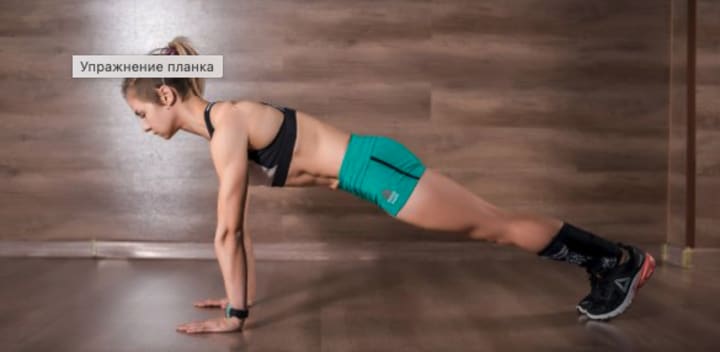
Stand at point-blank range lying down, tighten your abs and buttocks and hold the position, trying to avoid deflection in the lower back.
Side bar
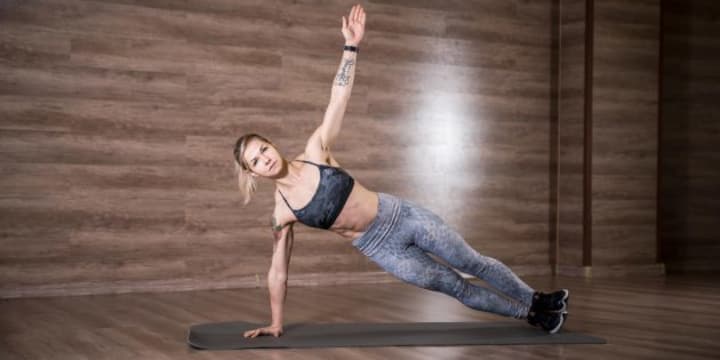
Stand at point-blank range lying down, raise one arm and turn the body to the side so that the chest looks at the wall to the side of you. Try to keep the body in the same plane and not lower the pelvis until the end of the interval. Repeat the same in the other direction.
Static squat against the wall

Stand with your back to the wall and drop into a squat so that your hips are parallel to the floor and the angle at the knees is 90 °. Leaning back against the wall, hold the position. To complicate the movement, you can lift one leg.
Buttock bridge
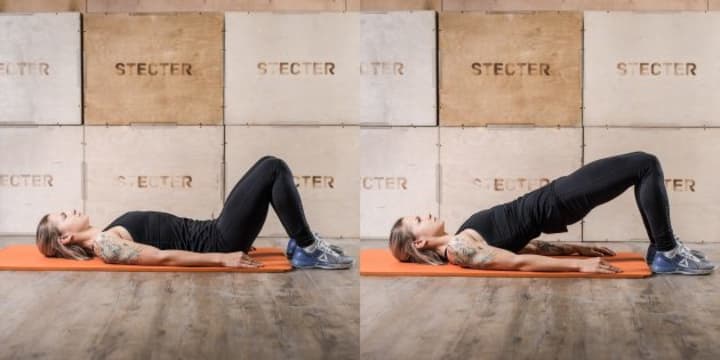
Lie on your back, bend your knees and put your feet on the floor 30-50 cm from the buttocks. Lift the pelvis off the surface, lift it as high as possible and hold this position. The further the feet are from the pelvis, the more difficult it is to perform the exercise.
How to add static Exercises to your workouts
To both pump muscles and increase strength, use static exercises in addition to dynamic ones. After the end of the approach to the target muscle group, tighten them in a static position, if possible in a stretched position, and hold for 30-60 seconds. You can also use a different mode of operation: strain your muscles for 6-10 seconds, but at the same time try your best.
If you have any injuries or diseases of the joints, consult your doctor before performing static exercises. Having received permission to practice, choose a position in which you do not experience pain, and strain your muscles in 4 sets of 30-60 seconds with a rest of 1-2 minutes between them.
About the Creator
Artur Kh.
Writer, doctor and businessman. I blog about self-development, personal growth, health and new ways of making money.
My mother’s best advice: you’re allowed to enjoy nice things
Growing up, my mother always emphasized values like discipline, hard work, and responsibility. But alongside those lessons, she quietly offered me one piece of advice that has shaped the way I view the world: “You’re allowed to enjoy nice things.” At first, I didn’t fully understand what she meant. Life, I thought, was about earning and giving, not indulging. Over time, though, I realized that this simple statement carries profound meaning about self-worth, balance, and the joy of living. The Early Years As a child, I often saw luxury and comfort as something reserved for other people—adults with more money, friends with better opportunities, or strangers on magazine covers. My mother, however, wanted me to understand that pleasure, beauty, and comfort weren’t just frivolous; they were part of life and could be appreciated responsibly. She didn’t mean extravagance for its own sake, but rather a healthy acknowledgment that enjoying life’s little or big pleasures is a form of self-respect. When I was ten, she gave me my first “nice thing”: a leather-bound journal with thick, creamy pages. I didn’t realize it then, but the gift carried a lesson. It wasn’t about owning something expensive; it was about valuing experiences and surroundings that inspire, comfort, or delight. She encouraged me to use it for writing, sketching, and capturing moments, and for the first time, I associated material objects with joy rather than guilt. Learning the Lesson In my teenage years, I began to push myself constantly—academics, extracurriculars, social obligations. Achievements were measured by effort and output, and indulgence felt like a distraction. My mother noticed my tendency to neglect simple pleasures, like a cup of hot chocolate on a rainy day or a quiet afternoon reading. “You’re allowed to enjoy nice things,” she reminded me again. And slowly, I started to understand: enjoying life doesn’t mean being lazy or selfish. It means valuing yourself enough to recognize your needs, your achievements, and your moments of happiness. It’s a form of gratitude, not guilt. Applying It in Adulthood Entering adulthood, the lesson became even more relevant. The workplace can be relentless, financial responsibilities daunting, and the pressures of modern life can make indulgence feel indulgent—or even irresponsible. I found myself hesitating before buying quality shoes, a beautiful coat, or even a small treat like gourmet chocolate. My mother’s advice echoed: enjoyment is not indulgence; it’s a reward for effort and a reinforcement of self-worth. Over the years, I’ve applied this philosophy not just to objects, but to experiences and relationships. Traveling to a new city, attending a concert, or simply savoring a perfectly brewed coffee became acts of self-care rather than guilt-inducing indulgences. Recognizing that I am allowed to enjoy these moments has improved my mental health, strengthened my relationships, and given me a greater sense of purpose. The Deeper Meaning Beyond material comfort, my mother’s advice taught me about boundaries and balance. Life requires hard work, patience, and resilience, but it also requires appreciation. By permitting ourselves to enjoy nice things—whether that’s a well-made handbag, a delicious meal, or a spontaneous weekend getaway—we acknowledge that our happiness matters. It’s a statement of self-worth: we are deserving of care, beauty, and joy. Interestingly, this lesson also translates to generosity. Appreciating what we have allows us to share with others. By enjoying life, we cultivate gratitude and empathy, fostering meaningful connections with those around us. When we respect ourselves, we are more likely to respect and uplift others. Lessons for Others For anyone struggling with guilt over enjoying comfort, my mother’s advice is a reminder that self-care is not selfish. It’s a necessary part of living fully. Recognizing that we are deserving of nice things—whether objects, experiences, or simply moments of peace—creates a foundation for resilience, creativity, and emotional well-being. My mother’s advice may have seemed simple on the surface, but it carries a powerful truth: life is to be lived, savored, and appreciated. We are not merely here to toil endlessly; we are here to experience, enjoy, and grow. Embracing this principle has shaped my approach to work, relationships, and self-care. It’s a lesson I carry every day and hope to pass on to others. In the end, enjoying nice things is not about excess or vanity—it’s about honoring yourself. It’s about saying, I matter. My happiness matters. And that, more than anything, is the best advice my mother ever gave me.
By Fiaz Ahmed a day ago in Longevity



Comments
There are no comments for this story
Be the first to respond and start the conversation.