

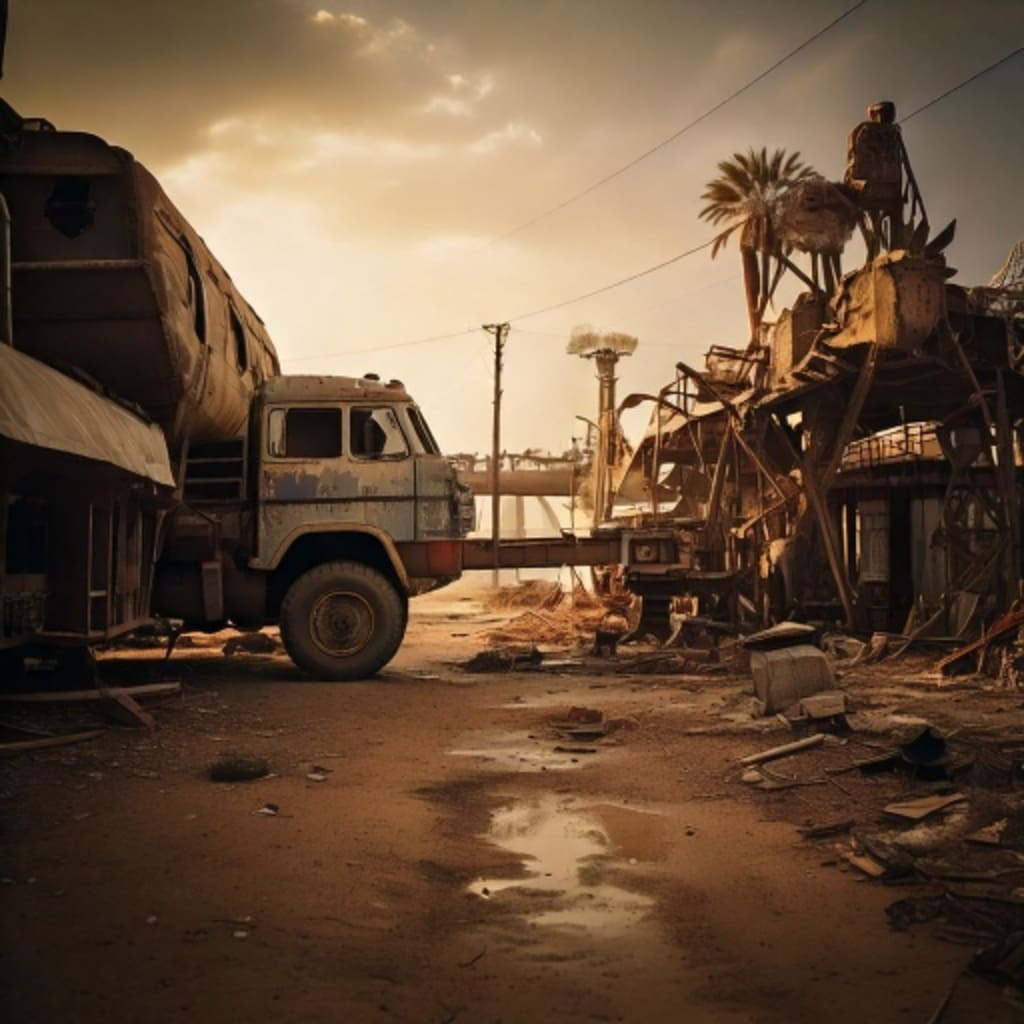
The hubris of human existence is a delicate balance of technological advancements and the impending demise that accompanies them. With each invention, our livelihood is met with growing comfort and complacency, which, within a few years' time, must be addressed as it has become a burden or may directly shorten our lifespan. In 2030, one such technological invention was hailed as the pinnacle of human evolution. Project Genesis, the transfer of consciousness to a machine, was the beginning of our subsequent scheduled downfall. The consciousness of a person could be slowly transferred over the course of a week. Electrical signals, unfelt by the person, extract specific information from memories buried from infancy to how the person prefers their coffee. One by one, the information is transferred to a sophisticated set of drives, chips, and components. A new and revolutionary battery source could maintain the mechanical brain and body for roughly one thousand years. The new body, the price of which was controlled by one company and one company alone, could be completely customizable to the client's wants and desires. This process was very costly but guaranteed to be completely safe and reliable. By 2032, competitors and knock-offs were being forced to yield any production as the ramifications of anything within the process going array, were punishable as high as life in prison without the possibility of parole and even death. For those who could afford it, this procedure was originally intended as the greatest cure for dementia and Alzheimers and the fountain of potential everlasting life. The choice to die was left to the individual, and not by disease, or by mother nature. In the fall of 2035, legislation was passed that lifted the age and condition requirement for consciousness transfer; the only remaining requirement was that the body must be in a state of “uselessness.” At the end of the year 2040, the only requirement needed was the requirement of payment.
In the summer of 2050, resources to maintain the artificial body were now scarce. Too scarce to allocate towards mechanical repairs and upgrades. Alloys and rare earth materials were assigned to other important projects and those who accepted Project Genesis as their future witnessed the beginning destruction of civilization. Not by foreign war, not by internal corruption—although corrupt, it wasn’t their demise; it was Mother Nature who had the final say. Countries had to scramble to find solutions to rising water levels, the hot earth made it difficult to farm, and some of those who chose to live forever now live in a permanent hell.
Among the first “Hu-Mech” to experience bodily shutdown was the very CEO of the company that created Project Genesis. In 2030, his name and creations could be seen from every street corner and even space itself. Within twenty years time, with the inability to shut down his own brain, a safety feature added to prevent “accidental deletion,” he lay propped on a chair, unable to move. A number of features on hu-mech models were designed for maximum profits. Signals would be sent to the manufacturer for repairs, replacements, and upgrades, but now those signals are sent to no one to receive. He lay motionless, not because his battery couldn’t move the artificial limbs but because the small pistons, actuators, and artificial limbs simply stopped working properly, and the world no longer provided the resources for his repairs. With no need to eat, drink, or sleep, his mouth cried for help. He could only hope that a scavenger would have mercy on him. He lay alone in an office overlooking a man-made lake, but with no significant rains, it was now another waste. With potential millennia now in his lonely vision, he stared through the window to wait for the end.
----------------------------------------------------------------------------------------
Located on the corner of College and North St Mary’s Street in downtown San Antonio, Texas, was the Homestead Mary’s. Most religions at this point in the year 2052 have dissolved into smaller groups; the most zealous of the people formed a militant type of following, claiming that the people are suffering at the hands of the sinners who played God, others have found the sanctity of life rather than religion to be the way; more have left God and focused on surviving. The once-thriving Saint Mary’s catholic church still stood majorly undisturbed. However, the parishioners had all left, but only a few remained to ensure that relics were not destroyed. The majority of San Antonio was miraculously spared from the Great Betrayal riots and the continental border wars of 2028. While other cities were not as fortunate, San Antonio became a beacon for those seeking shelter and assistance, while other cities became war-torn.
There was an unspoken rule among the people of the area that no violence or common-sense crimes should be committed. The downtown area became a self-policed area while other locations were still controlled by political means. Homestead Mary’s was established as the central location for guidance. No one elected official rules, but the consensus was that the war veteran Valeo Diaz was considered to be in charge, much to his dismay, but no one else wanted to take the lead. Rumor has it that his name derives from Latin, meaning "to be strong and powerful," but in truth, his name originated from a broken Valero gas station sign.
Within the last days, reports of hostile War-Mechs were following the road from West Commerce Street into the downtown fortified and guarded area under Interstate 35. War-mechs were the unmanned and Artificial Intelligence machines developed by billionaires to provide services to the human species, such as chores, mundane tasks, and, of course, fighting in a war. War-mechs was a term coined after their services were no longer needed, and a system network glitch instructed the mechs to survive under any means necessary. They have been scavenging, looking for parts for repairs; at times, they have resorted to ambushing small human clans for metals, alloys, or anything they could use to repair themselves. These machines have overridden their basic protocols, and disabling them has withered down to the Neanderthal approach of bashing their computer brains in. The standing rule within Homestead Mary’s was that only approved Hu-Mechs with valuable working knowledge were permitted to enter the Homestead. A War-Mech was to be destroyed on site.
With the ever-growing shortage of supplies, those who needed the most help sought aid at Homestead Mary’s. Whatever was available was evenly distributed to those who asked. There was no survey, no questionnaire, and no bureaucracy; those who asked for help did so based on good faith and with the expectation that if anyone falsely received anything under pretense, then they would be asked to leave permanently. There were no immediate issues until the most recent supply caravan was robbed. Homestead Mary’s scouts concluded that a small group of War-Mechs accompanied by two Hu-Mechs and one red blood had robbed the caravan and were last spotted heading to the former plant that once built these machines. Valeo’s decision to send a team to recover the supplies did not come without scrutiny. The Homestead, over the year, had lost three valuable scouts from supply recovery. Valeo knew the importance of this particular caravan—on it—was the monthly supply of medications, water, various foods, and a new solar power source. Valeo couldn’t immediately understand why the Mechs would want this caravan, but only perhaps to barter with others, but he did understand that it was he who must recover them.
The dangers that awaited Valeo and his team were not only limited to the Mechs and red bloods, a term used to describe the normal human; it was considered normal to have a pack of wild cats or dogs attempt to make you their next meal. These animals were never domesticated; they were the generational lucky ones who managed to survive after their humans died. Mad-Mechs, yet another hazard of the world outside of the Homestead, were considered to be one of the cruel twists of a chosen fate. The once Hu-Mechs, who succumbed to severe mental health decay, were considered highly dangerous. The fact that one could live forever through transferred consciousness and have their being slowly slip to a permanent madness is even more frightening than any hell. The Mad-Mechs held no regard for anyone’s well-being. They destroyed for the sake of destroying. It was clear to Valeo that he and his team needed to be sharp and prepared because he now stood at the west gates of Homestead Mary’s. In his vision, the sun bounced off abandoned and discarded vehicles of many varieties. To his northeast, at approximately a hundred and fifty yards away, stood two Mad-Mechs who were currently dissecting a former machine of some type. Valeo calmly reminded his team to stay calm and aim for the head. The Mad-Mechs, with it’s heightened mechanical senses, sharply turned their head to Valeo’s direction and began to sprint towards them.
About the Creator
Anthony Diaz
Writer of Sci-Fi, Fantasy, Horror, and sometimes Poetry.
Keep reading
More stories from Anthony Diaz and writers in Longevity and other communities.
Editing Isn't Fun
When I relit my creative candle, I knew that one of the most dreaded steps in being a writer and content creator (I have recently learned that being a content creator does not include being a writer) was going to be editing. Typically, when I edit my work, it includes approximately an hour of self-hate and intense criticism, so much so that the actual editing process doesn’t start until at least the two-hour mark of my dedicated editing time. This, however, only becomes true if I even get to the two-hour mark of editing. Now that I am a slightly more experienced writer, I can make very small edits on the fly when I’m writing, even when I’m experiencing a writer’s high. Eight years ago, when I was beginning to find a voice and style that I could seriously narrow on, I was still in the experimental stage of finding who I am as a writer. The following is an excerpt from a vocal challenge four years ago:
By Anthony Diaz12 months ago in Critique
The impact of sleep on our mental state
Introduction Sleep is a critical pillar of our daily lives, yet it’s often treated as an afterthought. While comfort and personal preference matter, the idea that we should just sleep “whenever and however” is a trap. To truly function at your peak, you need more than just rest — you need a disciplined strategy. It sounds harsh and at first, if you are used to staying up all night and not paying attention to your mental and physical health, it might seem impossible. However, great things do require some small sacrifices, so let us begin with the three tips.
By Charilaos Spanoudis4 days ago in Longevity
4 Surprising Truths About Nanoparticles In Your Soda
The Unseen World in Your Grocery Cart Imagine grabbing a can of soda or a packaged snack from your pantry. It's a simple, everyday act. Yet, hidden within that familiar fizz and sweetness is a technological frontier most of us never consider: the world of nanomaterials. Current research reveals that many of the foods and drinks we consume may contain engineered or unintentionally formed particles so small they are invisible to the naked eye. This article will explore four of the most surprising and impactful facts we are learning about nanotechnology in our food system, based on current research and analysis.
By The INFORMER5 days ago in Longevity
Pearl
1980 something. we all hung out at Pearl and you and i were nothing special, or so i thought. i mean we all danced, drenched in our own sweat, our own saline solution of fear, too many beers, shots, laughter, tears, fucks in the bathroom and i don't know when we began to be afraid. do you?
By ROCK aka Andrea Polla (Simmons)5 days ago in Fiction


Comments
There are no comments for this story
Be the first to respond and start the conversation.