
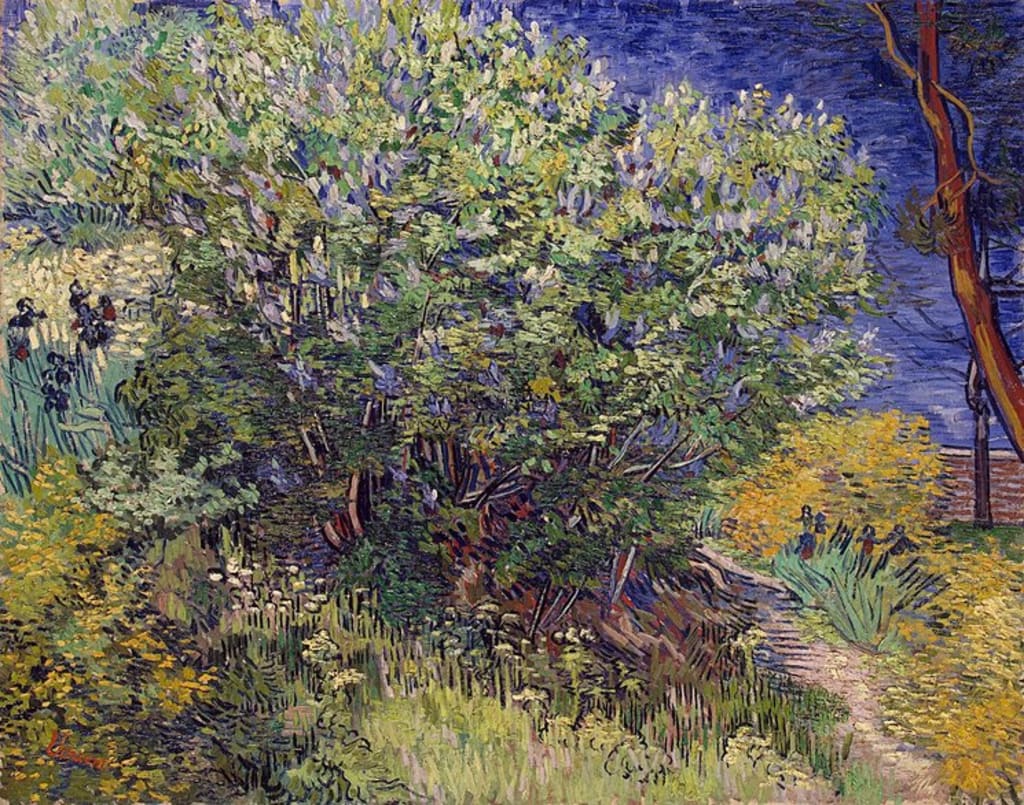
In winter, the sky, cloudless, black, sound of leaves, thin note, thin thread of stars, here and there
here a star
and there
syringa syringa syringa
Brian called on Friday. His voice had changed: slower, softer. He was doing well of course, making his way in pharmaceuticals. A child sang in the background and I imagined a large house with a French door opening to a striped lawn with hydrangea borders. We agreed to meet next month.
Monday. Waiting outside at the back of the house for J. Second night in a row. Can't stand the heat inside (literal and figurative, ha).
"We've sold it," he told me. We sat together in a bar of his choice. The walls were a cheap brick effect, the windows large. One of his fingers was tapping at the side of his glass.
I laughed. "How much?"
He shrugged. "After everything, not a lot. Mum's bought a place near Truro. Debts, funeral. How are you, Joe?"
"But how much more than what you paid her?"
Raining. Found a tent in one of the upstairs cupboards. Sat in it now, watching the trees. Beech, birch, sound of nuthatch, sound of coal tit, squirrel scrabbling. The ground is hard and comforting. I walked for a few hours in no particular direction - cut across stubbly fields. Wanted to think as Clare would, but it's just mud. Forgot the firelighters so spent ages fiddling with matches and twigs.
We lived in a small cottage once tied to a farmhouse. Mum told me it had been rented to a man before she moved in, and apparently he was indigent or crippled; it varied with each telling. They bought the place from my mother. It was dark and small, but we were happy there. They told her it would do her good to get away, when dad left; to move somewhere suburban. They were persuasive and she was weak. The idea of a new start took hold. I woke one morning to find her throwing things out of the windows: china, books, cutlery, bedding. It felt like we were in a sinking ship. I tried to stop her, but she pushed me away.
"It's just a house," she said. "See? And these are only things inside it."
"It's ours though, it's all we have."
"It's ours for now, and before that it belonged to someone else, and after us it will belong to another someone else."
Sometimes at dusk there's a man over by the lane, watching the house. I know he's not unkind. I can feel it. He seems sad. The other day he walked into the pond and swam around it.
"Listen, I know what I did," Brian said. "I don't expect forgiveness or friendship. But I want to do something." He took a slip of paper from his pocket. "It's everything that's left. I wanted to give you more, but Jenny wanted it for Kate. For when she's older."
Spoke to J about what it's like for someone like her here. She wouldn't talk to me for two days. Finally came to find me after maths, asked me to come to her ornithology club at the weekend and pay attention. Afterwards she asked if I noticed anything. I said no, should I have? No, she said. Because you're not black. Told me that on her first day someone congratulated her for 'breaking the mould'.
"I don't want it," I said. "That house, before you took over. It was home. You don't know what it's like, to have to live in a place you love being dismantled like that." Images of skylarks over ploughed fields, hedges grubbed out, the unkind, narrowed countryside.
They're enclosing it. Fence all around. Shrubs pulled out, landscapers in. Lawn squared and striped. Martins' nests knocked from the eaves. Wallpaper gone, carpets out, boards polished, ditch backfilled, home gone.
He took a black book from his bag, slid it across the table. "This was in a box. When they got rid of your stuff I kept it."
"Did you read it?"
"Of course not. It's yours. You were always writing and I knew how much it meant."
"Too scared?"
He drops his head, takes a sip of gin. "Yes, if you want the truth. But I'm prepared to listen."
I flicked through the book, and images come to mind. Brian alone at home, the snow. Locked out, forced to sleep in the shed. Brian's parents, my aunt and uncle, walking up the path and Mum opening the door, the falseness of their smiles. Fourth month, no call. No visit. I didn't write much towards the end. When I started camping away from the house, to get away from what I saw as a monstrous impostor, the writing became unimportant.
"Found my way to the home. Mum not doing well. Hardly talking, doesn't eat. Sometimes glances at me."
"You know that place was best for her."
"No. No, it wasn't. She was all right with me, at home. You just wanted the house and her gone. How many times did you take me to see her? How often did she come? And you, forcing me to help destroy my own home."
"You say it as if I was in charge."
"But you didn't care."
"No. I was thirteen. No, I didn't care about an old house and a mad old woman I hardly knew. All I cared about was getting a bigger bedroom."
"And messing me up."
"Joe, I need to go." He tapped the cheque. "I'm sorry. For all of it. Look at it. Take it. It's yours. I know it's an insult, but it's all I could get."
I lived in the top floor of a Georgian townhouse. It was expensive, and I had no hope of owning a place, but I felt some pride in being there, of having a space in the town that was only mine, and I had worked hard for it. The ceilings were high, the windows large. I had very few belongings, preferring to abide by William Morris' dictum about owning only useful or beautiful things. I slipped the book between others next to my bed, and didn't touch it for days. The less I thought of it, the more it told me, until I was sure I knew what was on every page, could see myself, long-haired, skinny, emulating Edward Thomas, trying to find a chalk path of my own.
Standing at the edge of a copse at dusk, listening to pheasants The sun catches a droplet on a leaf and it shines white The only bright thing, far enough away to be a star, star creating star, starred water the star's star held by leaf, which is itself held by star
I called J. We hadn't spoken for years. She had gone to university, I hadn't. We met once, and she was different. She was dressed up, had jewellery on, wanted a career. I couldn't see her caked in mud, huge binoculars in hand. As soon as I heard her voice I played a YouTube clip down the phone: little bit of bread and no cheeeeese.
"Yellowhammer." I could almost hear her smiling.
Another one: teacher-teacher-teacher.
"Great tit. Good one: appropriate."
"You remember them."
"Of course I remember them. Joe, why the hell did you ghost me? What happened? And before we go any further, will you promise right now not to disappear again?"
"I promise."
"Okay."
"Brian sold the house. He's given me twenty thousand."
"And ... what will you do?"
"I don't think I care about houses much now. I don't know."
Next morning I opened the book. It began with terse descriptions: my mother in bed all day, a humiliating rugby game. By the middle third I had discovered poetry, and the pages were messy with my own attempts: simple, observational, rhyming abandoned as soon as I realised there was more to words than sound. Then the camping, the loneliness, the angry capitals, days spent in fields under trees, days with J who was also needed escape, who taught me the birds. At the back was a pocket I had forgotten about, and it was full of fragments. In the middle of a field at night, feels like being at sea, Mum throwing everything out of the windows. A single scrap of brown, probably from a gift, was all there was left of Mum.
There was a story about a man who lived in the fields and woods around my village. It was a true story, and when I was fifteen, and beginning to camp out more regularly, I went to find him. He was living in the shell of a house half claimed by ivy and saplings, not far from ours. By the front door, now simply a hole, was a small brass plaque with Syringa written on it.
About the Creator
Keep reading
More stories from writers in Longevity and other communities.
Day 4 of Quitting
If this is how sobriety feels, maybe it’s better to go through life a little buzzed… this, along with other hits like, I want to kill myself, I wish I was dead, and I’m going to throw myself off a bridge have been the only thoughts on rotation these past few days. I promise myself that if, in a month, I still feel like this (‘this’ meaning despondent, full of rage, and simultaneously numb) I can go back to smoking. Until mid-February though? Nicotine is off the table.
By sleepy drafts9 days ago in Longevity
Why Minimal Skincare Routines Are Winning in 2026
If you had told me a few years ago that my skincare routine would shrink to just three or four steps, I probably wouldn’t have believed you. Like many of us, I went through the ten-step routine phase, the acid-everything phase, and yes — the “TikTok made me buy this” phase too.
By Veronica Bennetta day ago in Longevity
A Dart at Dusk
Seconds ago, the sullen sun set on the two of us… my exuberant furry companion and me. A fresh breeze embraces us, delivering welcome relief from the day’s oppressive heat. His typical stumbling and staggering along — apace with a sloth — has turned into trip-trapping, high-stepping, almost skipping along.
By Angie the Archivist 📚🪶2 days ago in Petlife


Comments
There are no comments for this story
Be the first to respond and start the conversation.