
Solo year of the Ox
My first year not at the monastery

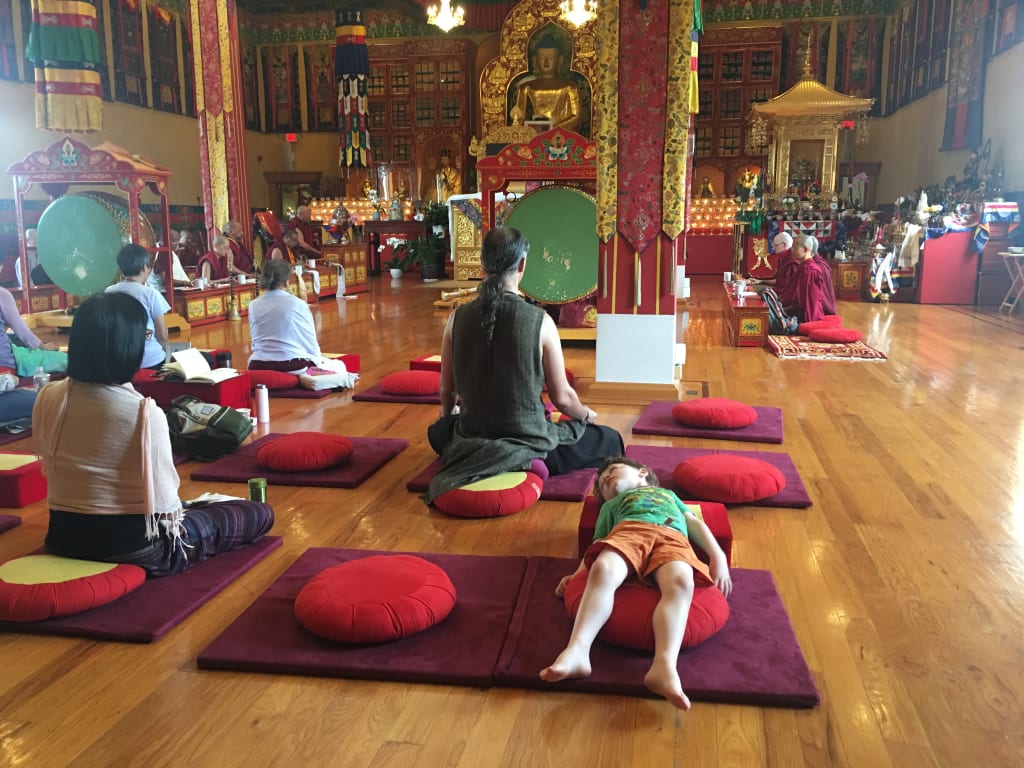
I think it was the thundering drums that reached into my chest and grabbed my heart into Tibetan Buddhism decades ago. The prayers spoke to me before I knew what the words meant. A year after taking refuge with HH Karmapa, the head of the Karma Kagyu lineage, I was granted permission to play the drum for the nightly Mahakala ceremonies.

Mahakala, representing the removal of obstacles, including one's own negative traits, is at the center of the days of prayer and offerings preceding Tibetan New Year, or Losar. On the last day before the New Year, there is a ceremony involving the burning of fragrant branches; the courtyard fills with smoke that lingers beautifully in your clothes, the drums shake the morning and the long horns bleat the sun out from the clouds. You leave feeling purified and aware and clear. Yes, at times there was euphoria, and I guess that's what I was experiencing in that moment above; but more likely immense gratitude, to be part of a community I cared about, people to eat with, woods to walk in, and prayers I believed in. I didn't live there, but I went up the mountain every day to play the drum for Mahakala, and for ten years, I filmed the major events and ceremonies and posted them on social media.
I had training as a journalist--some video, and some photography, but mostly as a writer, for publications ranging from New York Times to Entertainment Weekly, Village Voice and Interview Magazine. It was more daunting to film at the monastery than it was to cover the Democratic National Convention, interview the mayor of Jerusalem-- (we were trapped in an elevator during an earthquake)--or go undercover to investigate a Medicaid scam.
I knew so little about the form of each ceremony, and because it was sacred, and often took place inside quite crowded and small rooms, I was terrified that I would film the wrong things, or step on someone's toes literally or otherwise. For those same reasons, it was equally exhilarating, and as it turned out, part of my spiritual training. You had to be something of a pirate, and face both your own vulnerability and ignorance as well as your innate wisdom. You had to find the sweet spot between having balls and being respectful.
Filming at the monastery not only honed my skills as a videographer and editor, but trained me as a student. My camera was the best window possible for me to see what was really happening. It took a while to realize that the lamas and the Rinpoche were actually thrilled that there was a way to get coverage of the prayers and ceremonies out to students who were thousands of miles away.
Those were the days--(bizarre to think)--before everyone had a cel phone, and even when we did, it took a few years more before it stopped being unthinkable to shoot in a monastery. I dealt with plenty of dirty looks from longtime students who didn't realize I had permission to be kneeling and gliding and hunching about like an elephant.
The first time I filmed the prayer ceremonies leading up to Losar, I was shaky and so was my camera. My eyes were popping out and heart slamming, my camera wildly lighting on every new detail--the tiger print cloth, the skull cups brimming with offering wine, candles--figuring things out as I filmed; each ceremony went on from early in the mornign until five at night with a break for lunch. I knew enough to not film ceaselessly--no way I could have edited or made sense of that vast amount of footage. The most exhilirating part of filming was being in a prayerful state as I did so, feeling as if I had been sewn right into one of the thangkas hanging on the wlal. The ancient ceremonies were vivid and alive; I'd never felt more awake. The drum and the chanting were soothing to me--but not so much hypnotic as enlivening. Every aspect was new, and yet it was also familiar. The prayers and the atmosphere of the monastery awakened a sense of resonance and purpose so deep within me that I could easily believe I had been a Buddhist in previous lifetimes, and perhaps had even come to Woodstock as a child--decades before the monastery was built--because fate meant me to be brought back to this community.
Over time, I developed deep friendships with the teachers and some of the residents. My kids were grown and moved away and my community at the monastery became a second family. I'd longed to be part of something and to have people to pray with and sit down with at a diningroom table and dip delicious fried things into mouth-searing chili sauces.
In the dead of winter there might be only two or three of us eating together, and in the middle of an important teaching in the spring, there might be hundreds, from all over the world. I loved the medicinal smell of the incense, the slightly rancid sweet sting of the air in the torma room in the basement, and the talks I had with my teachers. The first time I saw a ceremony break in the middle and bowls of candy and treats passed out with steaming cups of butter tea, and adults munching happily in silence--I knew I was in the right place. These days I miss even the disgusting taste of Tibetan medicine--talk about bitter little pills, but they cured me more than once.
Out of sensitivity to the violence and extreme suffering in Tibet, the monastery continued having a community lunch on Losar, but otherwise downplayed the fesitivities. Khapse is still offered, but I think this was the last year it was made in the traditional way in our kitchens--with so much gayiety.
Over the years, I did not so much pull away from the monastery, as go with the flow of the tides that swept me in and out. I watched new crops of new generations flow in, and mourned some of the changes and losses. I know this is a bit of a shallow piece I'm writing--my inspiration was to share about my own little New Year celebration in the snow on a hill by my new apartment, ten minutes from the monastery but feeling a continent away...I'm surprised by how much more there is to say, and it's a shock to realize that I've never written about my years at the monastery.
Everything I ever wanted to say I said with video, and those videos were in service to something bigger. I made about 50 videos over the years, and the contain the best of me without using the word I...
if only, if only I could write like that, live like that, offer that special quality that the entire lineage first offered to me.
I lit a stick in the icy wind and set into flames a piece of paper where I'd scrawled a few things that I wished to offer to the fire and the smoke and the mountains that were all around me, including the mountain directly in front of me, with the shape I know better than the shape of my own body.
The air was fine and sharp; I could hear drums. No obstacles.
About the Creator
Dakota Lane
Author four YA novels, ALA winner, journalist for NY Times, Village Voice. Indie movie producer. New music, woodland forests, fairytale, street fashion, neurodiversity, trauma recovery,healing, creative spaces, street fashion. Yaddo grant.
Keep reading
More stories from Dakota Lane and writers in Longevity and other communities.
Amazon Savings Secrets for Disabled & Chronically Ill Shoppers
Disabled and chronically ill people often pay more for basic life: delivery fees, specialty items, replacements for things that break faster, and the constant “convenience tax” of needing things shipped because stores aren’t accessible.
By Tracy Stine2 days ago in Longevity
Tatt~Master
— Assembly Line Tatt Machine ~ Impressions to Impress — As I begin to understand more about the Tattoo Phenomenon. I've written silly, yet verbatim, dating site anecdotes in 'Frazzled.' So let me ask you: Would you be More attracted to someone slathered with tattoos, or Less?
By Jay Kantor5 days ago in Humor


Comments
There are no comments for this story
Be the first to respond and start the conversation.