
I have tennis rackets stuck under my feet. I continuously underestimate how high and far I need to hoist my leg up before taking my next step. Snowshoes are not sneakers, I remind myself. Snow is deceiving. A white, glittery blanket, yet hard and frozen. The snow crunches beneath me with every step.
I’m breathing harder and moving slowly, as if I’m trudging through molasses. In the crisp, cold air hangs a perfect silence so loud that every bit of noise I hear is stemming from myself. When I come to a halt, the stillness of the atmosphere is impossible to ignore. The dark brown trees are intimidatingly tall, looming over the entire forest. Snow sits upon their sturdy branches, like a parrot on a pirate’s shoulder. There is no wind to sway the branches, no creatures to ruffle the fallen dry leaves.
While nearing the edge of one of the creeks, I learn that water is deceptive, too, because it isn’t fully stationary. Only by careful analysis do I find the top layer of water is frozen solid, while the running water underneath is persistent, slithering like a snake around the rocks. I come to realize that the Earth itself is playing tricks on me; it is spinning on its axis, rotating around the sun, the same sun that I can clearly see beaming proudly through the gray sky. The nature of the universe precludes anything from being motionless. I take a mental snapshot of this moment, freezing it in time.
I am inferior to the forest, vastly out of my element, and everything I see is a reminder of that. I look down, and notice a branch growing around an old cable wire and back to its original course, escaping death, and just trying its best to survive. Nature is smart, smarter than I give it credit for. I am comfortable with the idea that we are the most advanced, intelligent species that is known to exist. I catch myself continuously dismissing progress in nature as “instinct”. But now, as I stare at this branch and cable, I admire its strength to stay alive, and realize that far more often, humans put themselves in life-threatening situations daily. Perhaps we should take notes from this clever plant.
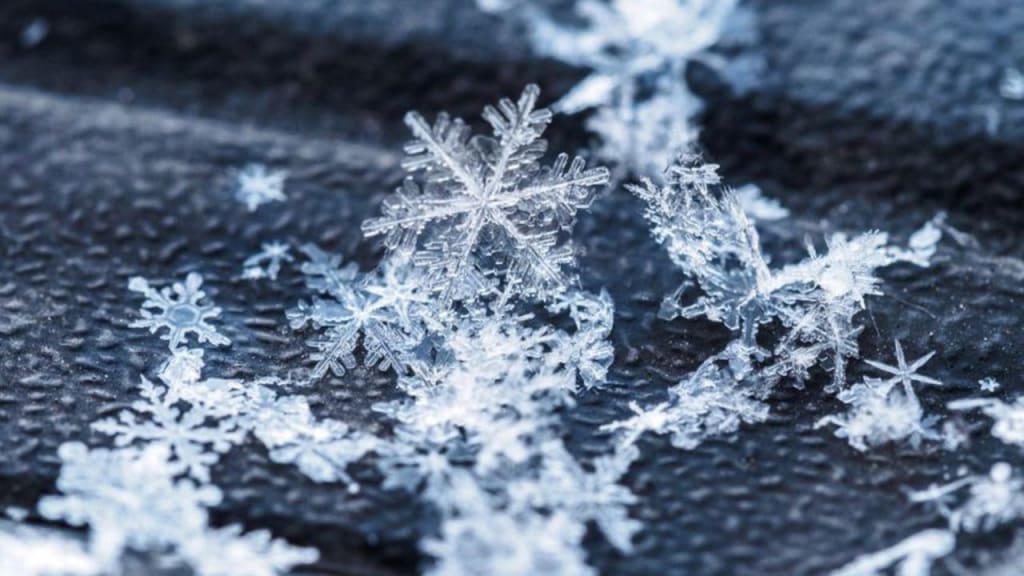
Snow begins to fall, and passes through the silhouette of the sun. In this moment, every tiny, unique snowflake can be seen with the naked eye. I cock my head backwards, so that the snow looks as if it were falling in unison, slowly moving toward my face. I think about taking another snapshot in mind. Cue the epiphany.
If I were able to stop time, and in that frozen snapshot, analyze every single physical, chemical, biological, and other associated aspects of this snowstorm, I could predict with perfect certainty where every single snowflake would land. All of these factors that affect the snowstorm and individual snowflake’s positions are measurements of the size, density, chemical composition, and number of atoms within the snowflake, as well as the friction imposed from atmospheric conditions such as air temperature, air pressure, wind speed, wind direction, pressure gradients, humidity, dew point, etc. All of these factors are dependent on each and every snowflake, and ultimately, where that snowflake lands. For humans, it’s unimaginable. We are unable to gather and process all of that information, and therefore, we deem it as being “random”.
Our inability to freeze time and process this experience is irrelevant, because regardless, it still happens. When our universe was created, physical laws were set in place. Four fundamental forces of nature, being gravity, electromagnetism, the weak force, and the strong force, were established and prescribed a certain strength and function, all of which have not changed. Every bit of matter is created by and acted upon by these forces. It brings me back in time to the mantra we all memorized in 7th grade science class: “matter cannot be created or destroyed”. Applying these concepts, you begin to realize that the snowflakes’ positions are predetermined. Matter will behave in an absolute predictable manner, we as humans are just unable to process this.
If you apply this concept to all matter, you come to the conclusion that, in this regard, inanimate objects are no different from animate ones. Matter is matter. Whether or not it can send electrical signals through nerve pathways propagated by sensual experience is irrelevant to whether or not is being acted upon by these forces. Thus, it implies that it is still a pre-determinable entity. Every decision made by you has come about from a previous decision. Your internal genetic makeup, chemical configuration, and interactions with the environment have caused you to be who you are, behave how you behave, and think how you think. Your next decision will be based on the neural pathways in your brain, which have been strengthened, and formed by what has already happened. Your choices are predetermined.
We make decisions every day, such as what we eat for breakfast or what we watch on television before bed. But we don’t have free will – what we have is perceived free will. Humans are not a mature enough species to handle such autonomy. To live in such a world where humans had total freedom would not only be complete chaos, but completely impossible.
Thinking back to the creation of the universe as we know it, the atoms and molecules that we are currently composed of has always existed and always will exist, just altered into different forms over time. What does this imply when you feel drawn to someone? Not only to feel a lightning connection that you cannot describe into words, but also to crave someone’s presence. We as humans describe that we feel that we belong to someone, or when we are with them, it just feels “right”. We have soulmates. As aforementioned, the atoms that we are made up of have always existed. In a capacity we are all incapable of understanding, the atoms and molecules I am made up of could essentially coexist in someone else. Perhaps this is why we can feel so deeply connected to someone and yearn for their presence. We think, feel, and behave similarly to someone because of the predetermined neural pathways our brain.
About the Creator
Keep reading
More stories from writers in Longevity and other communities.
Day 4 of Quitting
If this is how sobriety feels, maybe it’s better to go through life a little buzzed… this, along with other hits like, I want to kill myself, I wish I was dead, and I’m going to throw myself off a bridge have been the only thoughts on rotation these past few days. I promise myself that if, in a month, I still feel like this (‘this’ meaning despondent, full of rage, and simultaneously numb) I can go back to smoking. Until mid-February though? Nicotine is off the table.
By sleepy drafts13 days ago in Longevity
The Six Things I Refuse to Sacrifice When It Comes to Health
I've watched people negotiate with their health for years. They don't call it that, of course. They call it being busy. Or realistic. Or flexible. Or "in a season." But what they're actually doing is trading long-term function for short-term convenience and hoping it doesn't catch up to them.
By Destiny S. Harris2 days ago in Longevity


Comments
There are no comments for this story
Be the first to respond and start the conversation.