
Price per Pound
My Journey with Food

I don't have any medical or scientific expertise. This is my own story: mine, and my father's and his father's. I want to tell it, because it has been an important part of my life, and I know that others have struggled and struggle too.
As a child, I watched my father fight through a series of diets, seven I think, each one claiming that the previous diet had been completely wrong-headed and this new diet was the Holy Grail. He respected doctors. With one exception, every diet was medically recommended. Many of you have, I suspect, had a similar experience.
The plug was pulled on each of these diets a few months after he started them. At one point fat was the enemy and carbohydrates were fine. Then there was the Atkins diet, high animal protein. I visited the doctor six months after he started Atkins and there was a warning sign posted that the Atkins diet came with risk of heart attack, and patients were to get off it. Great! It's probably not necessary for me to report that every time he went off a diet he regained all of the weight he had lost and more.
Television programs, magazine articles, and more trumpeted the dangers of obesity, and discussed it in terms of will power. Yes my father also took amphetamines for a time, and we all know what a danger they turned out to be.
It was not long before I started to follow the same pattern. I remember at age 8, when I had my tonsils out, the 8-year old boy in the next bed weighed 48 pounds and I weighed 84 pounds. And I remember that soon after the tonsillectomy I gained weight rapidly.
What elements are in the etiology of human weight gain and loss? Like most serious questions there is a constellation of factors. If we were mice, a single gene would be responsible for obesity. But we are not mice.
There can be factors of family trauma. My father's aunt was anorexic. She was admitted to the psychiatric hospital in Brockville Ontario. I don't imagine the treatments were very advanced in those days (my father was born in 1925). I do imagine that, when she died by suicide, the family made an effort to see that everyone ate enough and more than enough. I and all of my cousins on my father's side are obese.
There are biological factors, one of the biggest being insulin resistance. It is part of diabetes. I have been a type-2 diabetic for over 30 years. The short version is that if the body does not produce enough insulin, it cannot handle the sugar, which includes starches and alcohol that break down into sugar.
Figuratively, the sugar then rides along on blood molecules, which makes them heavier, and they pit the arteries. The pits are then filled in with cholestorol. When I attended rehab classes for heart attack patients, the majority of attendees were diabetics.
Insulin resistance. In 1971 my family was moving to another city. While packing up one of the cupboards, I came across an old, unopened bottle of Sucaryl, an artificial sweetener from the late 1950s. I asked my parents what it was doing there. They told me that my pediatrician had admonished them, "Never let this boy have sugar." My heart stopped. At that time, age 15, I weighed 220 pounds and was perhaps 40 pounds overweight. I asked them why they hadn't told me. Their answer was lame. They didn't believe in artificial sweeteners.
I'm not saying that Sucaryl would have saved the day--it clearly had its side effects. I am saying that I would have preferred to know that sugar and things that turn into sugar were dangers to me.
I tried the medically approved diets of the day. Like my father, I lost and gained. Finally the news came. I remember the day. My old piano professor was visiting my university. She was lecturing on the artistic-literary principle of "lightness." I had an excessive workload at the time. I had a medical appointment that day and the doctor told me I was a type-2 diabetic.
I think it is an odd diagnosis to get used to because the symptoms are not overt. I really didn't feel it. And I wondered if there had been a mistake, but as I mulled this over, the elevator in my department opened and one of the students from that lecture was there. He asked me, "Professor, what was the name of that literary principle?" I answered lightness. It was also the answer to my own question.
I started the South Beach diet immediately. The first phase has no starches or sugars. At the end of a month I felt better. At the end of six months I had lost weight, and my doctor said that the diabetic symptoms were no longer evident. He also explained that it was not a reversal, that I would always have the disease and it would progress, which it did.
I managed to control my blood sugar at first with diet alone, then I needed Metformin to keep it in check. It is an old drug, effective and safe.
And then I became a widower. I did not check my sugars during my wife's four-month terminal illness, nor for three months afterwards. Finally my doctor made me do a blood test. The desired range of blood sugar is between 4 and 7. Up to 10 can happen and is not necessarily dangerous. I scored a 20.
My diligent, determined, excellent doctor tried me on various combinations of classes of medications until one finally worked. Still, two years later I had a heart attack. Actually I found my major heart attack had been preceeded by two major, silent heart attacks. Causes? Grief? Grief which caused high blood sugar, which caused the arteries to fill with cholesterol?
I survived the attacks and the surgery, asking Providence to extend my life because there were people depending on me. "I have a daughter," I said to the surgeon. "I have promises to keep." He assured me that his team would help me keep those promises, and they were as good as his word.
And now the disease has progressed another notch or two, and I have also experienced the first symptoms of arthritis, so time to be lighter on my feet (back to that lecture on lightness again). My doctor determined that I need insulin, so I inject it nightly, and with it I have received a glucometer. And here is where my story turns more optimistic, or at least usefully informative, I hope.
The meter, a disk stuck into the fatty tissue of my arm, records my blood sugar every three minutes. It then relays the readings to my cell phone, and software records it on a line graph. There is a green range (good), a yellow range (too high), and a range that is much too high. An alarm goes off when the sugar is too high or too low. The default setting is for the green range to be from 4 to 10. I have left my meter on that setting. A variety of graphs can be displayed. The one my doctor likes best is the "Time in range." What percentage of the time was my sugar in the green range, the yellow range, and the much too high range?
I have been making a big effort, essentially following the South Beach Diet Phase 1, which is very much like the Keto diet. This week I have eaten no starches or sugars, no fruit, with two small exceptions which I will name below. Here is the chart of my "Time in Range:"
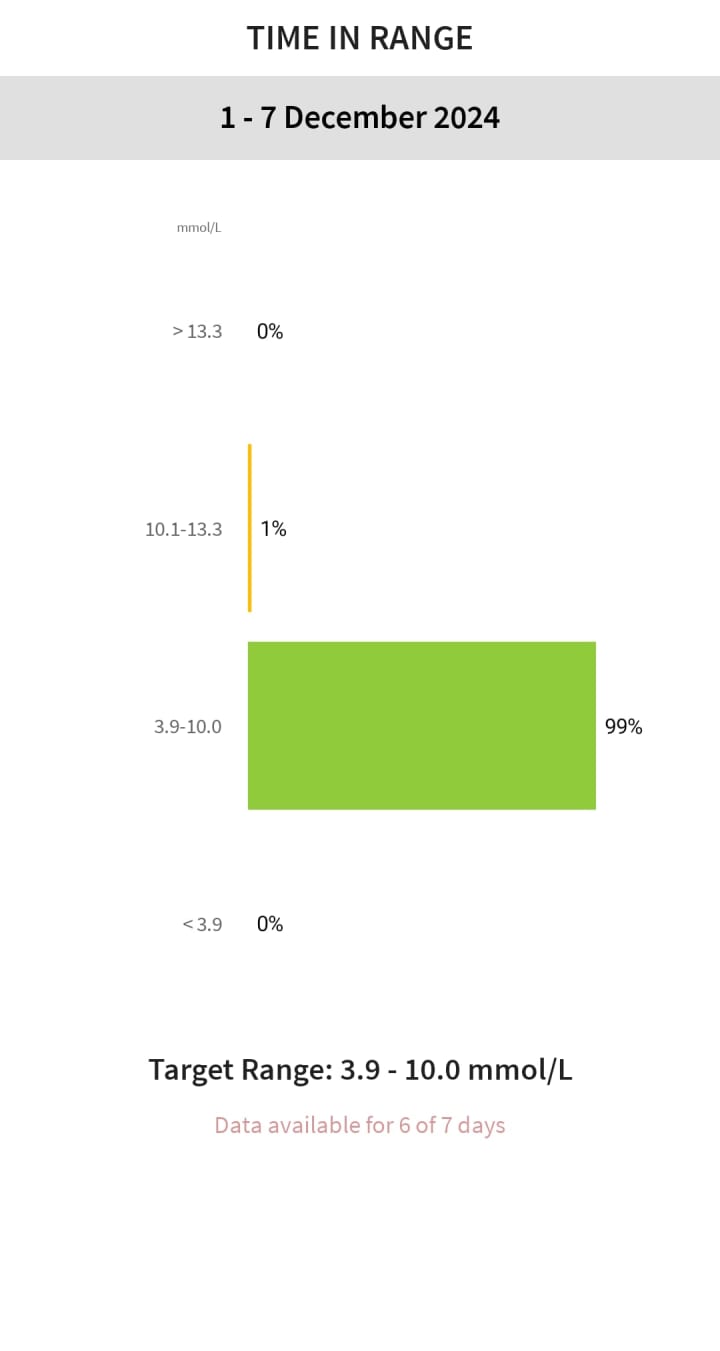
So between eating very carefully and taking my medications I have succeeded this week, almost all of the time with my blood sugar in the green range. As an experienced dieter (serially, like my father) I am wary of "pushback," the way the organism, if it feels it has been deprived, puts a kind of choke hold on the dieter and presses them to eat the foods that have been left out.
For this reason I do things to satisfy myself fully and make sure I do not give myself the impression of being on an unsustainable austerity drive. For one thing, I enjoy food, I enjoy cooking, and I always make myself one really great weekend meal. I'm going to describe it.
The appetizers suit my particular taste (maybe not yours, I don't know). I have a friend just over 90, sharp as a tack, whose daily treat is peanut butter and horse radish on crackers. He served them to me and I adopted it right away. But my peanut butter is sugar free (you can see some of the grocery store brands that say "Just peanuts" or something similar) and crackers are obviously out so I use slices of English cucumber, which I call "the South Beach cracker." In the past I might have used slices of fruit, but my fruit eating is greatly reduced (see below).
Since I am missing my fruit, and love that flavour, I use a sugar-free fruit beverage, like this one:

I have consumed it liberally and it does not spike my glucometer.
Pasta, I think, must have come directly from God. I would hate to do without it. But starch, you say? Well yes, so I use a substitute. To me altering one's diet is all about good substitutions. For that reason I don't listen to people who are dead set against artificial sweeteners. If I undid all my substitutions I would not be able to follow the diet I have chosen.
For pasta I use one of the brands of Japanese Konjen root. It has no carbohydrate, and various brands cut it in the shape of pasta. My grocery store has two brands. I like the substitute Fettucine. They also make a rice substitute out of Konjen. The preparation is very simple. Rinse and heat to evaporate the water.
So I decided on my fettucine tonight. I added a primavera sauce, and also some leftover rotisserie chicken. I don't add salt to anything (heart attack), so at the end I sprinkled a lemon spice mix (readily available) of the top. I also added grated cheese. None of these elements increases my blood sugar much. Every meal will make a bit of a bump on the graph of course, but this one not a significant increase. Before the meal I had a 6.4 reading, afterwards 7.2, and it has now levelled off. Bottom line I am satisfied and in range with one of my favourite meals:

And since this is special meal night, I have added one more thing: two beef sliders. Protein yes, fat yes, carbohydrates and sugars no.

It's a big meal, but then I am a large man. Have I conformed to the framework of this diet? Absolutely. Do I feel in any way deprived of my favorite foods? Not at all. And my blood sugar is in the range!
I am still exploring with my glucometer, which I love. I think that any diabetic who can get one would benefit from it. For one thing the results are individual. Certain things my send my numbers soaring, but maybe not yours. So each person can test for themselves. Some of my discoveries for myself:
Sushi: I love it, but it is not a good idea. The rice makes my sugar spike. I am looking around for some sashimi to try instead.
Coffee or tea with milk and artificial sweetener is okay, hardly moves the needle for me.
Eggs, which I did not eat for years on the low-fat diet, are just fine. I make omelets for breakfast--I add vegetables, mushrooms, and cheese and stay in range.
No potatoes in that omelet, though, actually no potatoes at all, a bit of a shock for someone whose grandmother lectured that "It's not a meal without potatoes," so I substitute Konjen root pasta and Konjen root rice. By the way Konjen pasta, an egg, turkey bacon (another staple), and grated cheese make a wonderful carbonara (see the photo at the top of this article), and they do not take me out of range.
I do miss fruit. I have tried eating 25 blueberries, and they did not make the meter spike.
Legumes: a well meaning dietitian told me to eat legumes every day to satisfy my appetite. I tried kidney beans and they spiked my blood sugar. They are, after all, starchy.
As I'm sure you know there are alcohol sugars. I tried an alcohol sugar ice cream bar, and it too did not change the meter. There is the caveat with alcohol sugar that it sometimes causes digestive problems. Also, if you are looking for a cookie substitute, read the label. Your cookies may not have added sugar, but they almost certainly have carbs. And your meter will tell you soon enough.
So I am saying that, with the meter and careful planning (everything starts with grocery shopping), creative cooking, and eating, my blood sugar is very well controlled. And I hope some bit of this story is interesting or helpful to you. Thank you for reading.
About the Creator
Paul A. Merkley
Mental traveller. Idealist. Try to be low-key but sometimes hothead. Curious George. "Ardent desire is the squire of the heart." Love Tolkien, Cinephile. Awards ASCAP, Royal Society. Music as Brain Fitness: www.musicandmemoryjunction.com
Keep reading
More stories from Paul A. Merkley and writers in Longevity and other communities.
Bridge: a Bridge to Rich Retirement
What a great subject this challenge is! Full disclosure: I am a co-founder of Seniors Junction (www.seniorsjunction.com), a startup that advocates, researches, and delivers serious or purposeful leisure activities to prevent seniors isolation and to help those of us who are seniors to live richer, more rewarding, autonomous lives of purpose and social connectedness. As a retired widower, I am (or was) at high risk for social isolation and the consequences of it, known to be more dangerous to health than obesity or smoking. Add grief to the mix and look out! I’m a good example--after my wife died I had chronically high blood sugar and three major heart attacks, the third one almost fatal.
By Paul A. Merkley5 years ago in Longevity
You’re Probably Shortening Your Life Without Realizing It (Here’s the Simple Fix Nobody Talks About)
Most people don’t think they’re making choices that shorten their life. They assume that serious health problems come from obvious risks—smoking, extreme stress, or poor genetics. But the reality is far more subtle. The biggest impact on longevity often comes from small, repeated habits that feel harmless in the moment.
By Lukáš Hrdlička3 days ago in Longevity
Sightings of One of the UK’s Rarest Insects Triple
A remarkable increase in sightings of one of the United Kingdom’s rarest insects has delighted conservationists and nature lovers across the country, offering a rare piece of good news in an era of widespread insect declines. The insect in question, the green forest hoverfly (Caliprobola speciosa), has seen recorded observations treble in recent years, prompting hope that dedicated conservation work and habitat protection measures may be paying off. The green forest hoverfly is a striking species, known for its metallic green and golden body adorned with bright orange wings and legs. It is extremely uncommon and has historically only been reliably recorded in two parts of southern England: the New Forest in Hampshire and Windsor Great Park in Berkshire. Soaring Sightings: What the Data Shows According to a four‑year study supported by Forestry England, sightings of the green forest hoverfly have increased from around 150 recorded observations before 2022 to more than 450 in recent counts — a threefold jump in documented appearances. Volunteers dedicated thousands of hours to data collection, using standardized survey methods to track individual hoverflies across the hoverfly’s short spring flight period. The insect emerges for only a few weeks each spring and is highly dependent on specific habitat features. Ancient beech trees and decaying stumps provide essential breeding sites where females lay their eggs, and the larvae develop in the decomposing wood. These microhabitats are increasingly rare across much of the UK due to forest fragmentation and historical woodland management practices that removed deadwood from managed forests. Despite its rarity, the species has long fascinated naturalists because of its striking appearance and elusive behaviour. Its distinctive green sheen makes it unmistakable to trained observers, but its overall scarcity has made population trends difficult to monitor consistently until volunteer survey efforts were established. Conservation in Action The rise in sightings has not happened by accident. Conservation groups have been working for years to protect and manage suitable habitats, particularly in the New Forest — one of the UK’s most biodiverse woodland landscapes. Forestry England has used data from hoverfly surveys to adjust habitat management plans, including removing excessive holly and undergrowth that can shade out deadwood resources and disrupt the fine ecological balance required by these insects. Leanne Sargeant, a senior ecologist with Forestry England, described the New Forest as a “haven for nature,” emphasizing that the recent findings illustrate how targeted conservation and community involvement can make a difference for even the most cryptic species. Sargeant said the survey results have helped improve understanding of the hoverfly’s distribution and habitat needs, allowing managers to fine‑tune practices that encourage biodiversity rather than suppress it. For example, some areas previously cleared for visitor access or aesthetic reasons are now being managed to retain deadwood and older trees, which are vital for insect life cycles. Volunteers and Citizen Science Play a Key Role The surge in sightings would not have been possible without the dedication of volunteer naturalists. These citizen scientists conducted more than 2,700 hours of field observations, recording not only green forest hoverflies but also a range of other rare and scarce insects that benefit from improved woodland habitats. Their observations contribute to long‑term species databases used by conservation bodies across the UK. One survey volunteer, Andy Murdock, noted that the renewed understanding of the hoverfly’s presence has helped highlight the importance of protecting ancient woodland features that many casual visitors might overlook. “With the right habitat, this species can continue to thrive,” he said, reflecting the optimism among enthusiasts. AOL Why It Matters The green forest hoverfly’s rebound is particularly significant in the context of broader declines in insect populations worldwide. Recent global studies have shown that insect abundance and diversity are under threat due to habitat loss, climate change, pesticides, and land‑use change — making any sign of recovery noteworthy. For the UK, where many insect species are in long‑term decline, the hoverfly’s success demonstrates that focused conservation action, supported by scientific data and public involvement, can yield measurable improvements. It also serves as a reminder that protecting biodiversity requires preserving the natural processes and habitats that underpin complex ecological webs. Looking Ahead Researchers and volunteers plan to continue monitoring the green forest hoverfly in coming years to determine whether the upward trend is sustained. They also hope that similar efforts in other parts of the UK can shed light on the status of other rare insects, helping to ensure that these small but vital species are not lost to future generations.
By Fiaz Ahmed 7 days ago in Longevity



Comments (2)
Paul I can only imagine the help you have been to people that don't do or understand the research.
So pleased that you're working heroically at staying alive, well,and happy. We all want to see more of your wonderful writing. Could I add that it's best to eat your veg first and protein second before any carbs or fruit? Also, it's advisable to do some exercise within 90 minutes of any meal…a brisk walk will do, but the Theraband or simple weight- lifting will counteract the blood sugar rise too.