
Our Best Diet Tip for Fast and Durable Body Fat Loss
Discover a little known science-based practical diet tip for body fat loss

"What do you recommend for weight loss?" is undoubtedly the question we get asked the most as fitness and wellbeing consultants.
And what most people mean when they talk about weight loss actually pertains to body fat loss —as opposed to muscle mass loss, for instance.
On top of this misguided —yet very common— denomination, there's just so much information and debate on this topic that it's really quite easy to feel lost, confused, and even downright frustrated when looking for straight answers.
And with so much interest from so many people, there's also a lot of money, products, marketing, and clickbait involved.
The two of us have had an interest in the subject of body fat loss for years, both personally and professionally —initially as a personal trainer for Cyril and now as fitness and wellbeing consultants for both of us.
And during that time we've been able to experience quite a lot of different things when it comes to losing body fat.
But one behavior has stood out particularly, through its simplicity and effectiveness: a diet adjustment we've stuck with to this day.
Now, just to be clear, we're not looking to alienate or body-shame anyone, by labeling some levels of body fat as more desirable or better than others. As far as we're concerned, to each their own.
And so today, we'd like to share this diet adjustment with you, so you can — if you want — take it for a spin and, in a matter of days, be empowered by the results we're betting you'll experience, just like us, and many of the people who've tried and adopted it as well.
It all comes down to a simple approach involving the key distinction between carbs and fats, that we've personally come to call fuel selection.
We'll also aim to keep it practical and straightforward, without getting overly technical or mired in moot points.
So let's get started!

It Starts with 2 Simple Shifts
We've mentioned the misguided denomination of body fat loss as weight loss.
Well, on top of this lexical shift, there's another significant one from how most people approach the matter of weight loss altogether.
Indeed, when it comes to losing body fat, the first thing one may want to figure out is how to stop storing it in the first place.
Yet, strangely enough, most people don't think about it this way. They don't stop to ask the question: "How did I come to store the fat I want to get rid of, in the first place? And how can I stop doing so, starting now?"
A typical case of treating the symptoms instead of the cause, reinforced by massive and often misleading marketing, as well as widespread, and often erroneous, preconceived notions.
And yet, in our experience, asking these questions is definitely the best place to start, for not only fast, but also durable, body fat loss.
The Storage Process
There's a lot of debate surrounding nutritional and even physiological science, and, as any scientific enterprise, they both stand as works in progress.
Therefore, we ourselves exercise caution and humility in how we approach their associated theorizations and tend to recommend others do the same.
That being said, the diet adjustment we want to share today is based on the following notions and theoretical perspectives.
Our bodies constantly aim to maintain a certain amount of sugar in our blood, to provide us with continuous energy, a process called glucose homeostasis.
This process is a core part of metabolism, so it's influenced by pretty much everything that happens with our bodies, from our physical activity to what we eat, to whether we're awake or asleep.
When our blood sugar gets too high, after a meal, for instance, a hormone called insulin is released into our bloodstream, to trigger the storage of some of the sugar away from our blood, as glycogen, in order to get back to healthy levels of blood sugar.
This makes insulin an anabolic hormone, meaning it triggers a storage response in our bodies: it is part of the metabolic process of molecule construction called anabolism.
But when this storage response is triggered, sugar may not be the only thing stored away.
Indeed, as an anabolic hormone, findings suggest that insulin also promotes the creation of fat cells, or adipocytes, through a process called adipogenesis.
These cells form the adipose tissue — our body fat.
This means that with the insulin release triggered by sugar blood spikes, the fats in our blood get stored as well, as triglycerides, in our fat cells, the adipocytes.
And so the resulting theory of insulin-induced fat storage points us in the following direction: that the simultaneous presence of significant amounts of both sugar and fats in our blood could directly promote the triggering of fat storage, via insulin release.
This means that by avoiding higher levels of both sugar and fats in our blood at the same time, we could effectively prevent the insulin release that triggers the unwanted fat storage process:
- no high levels of fats in our blood means that there won't be any fat to store in the case of sugar-induced insulin release;
- no high levels of sugar in our blood means no blood sugar spike and no significant insulin release, which means no storage, regardless of the potential presence of fats in our blood.
And so, from this perspective, we realize that mindful body fat management could pretty much boil down to understanding:
- What behavior makes for the presence of fats in our blood.
- What behavior makes for the occurrence of storage-triggering sugar spikes in our blood.
Because making sense of these two aspects is how we may get a practical understanding of the anabolic aspect of fat metabolism, and precisely act to prevent undesired fat storage.
Stopping Unwanted Fat Storage thanks to Fuel Selection
So what makes for the presence of fats in our blood? Well, fats from our food, mostly.
And what makes for the presence of storage-triggering sugar spikes in our blood? Much the same way, the carbs —short for carbohydrates — from our food, for the most part. They directly increase our blood sugar, leading to insulin release to regulate it with the associated triggering of the anabolic response: storage.
And so, whether or not the theory of insulin-induced fat storage holds true, it has led us to implement the following diet adjustment, which has worked wonders for us and the people we've shared it with over the years, in preventing unwanted fat storage: not having significant amounts of both carbs and fats in the same meal.
Based on the results we've got from this adjustment, a more simple and practical way to look at the storage mechanism is that, when presented with significant amounts of both carbs and fats, our bodies would rather burn the carbs as fuel and store the fats for potential later use.
A later use which, when most meals contain both carbs and fats, never really comes, thus leading to body fat gain.
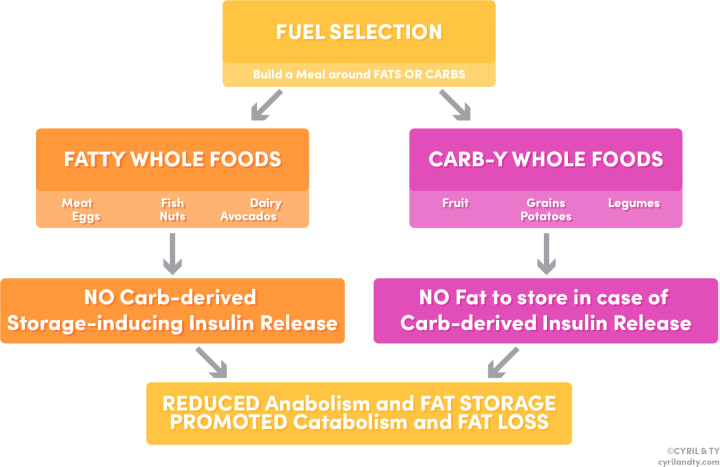
So by having meals that contain EITHER carbs OR fats, our bodies are able to focus on burning that one kind of fuel, instead of ending up burning the carbs while storing the fats.
And so the simple and practical bottom line of this approach to stopping the unwanted storage of body fat is what we now call fuel selection: it means having either carbs or fats in a given meal, as a single type of fuel, instead of having both, i.e. combining them.
And it so happens that, as we stop storing body fat thanks to fuel selection, instead of fuel combination, our bodies compensate for this dietary shift by triggering significant fat loss as well.
To put it in terms of metabolic processes: by reducing the anabolic response in our bodies, i.e. the storage of carbs and fats, a catabolic response is promoted instead —the degradation into energy of the carbs and fats we eat as well as those already stored, thus directly promoting fat loss.
Let's Get Practical
Not mixing carbs and fats in our meals has worked wonders for us over the years and still does today.
So here are several practical pointers to implement this adjustment, prevent unwanted fat storage and directly promote fat loss.
Reading the labels on food products to identify fuel types. This is easily done thanks to what we call the 5% rule: if a specific food contains more than 5% of carbs and/or fats, then you can assimilate this food to that specific fuel type. So if a food has more than 5% of both carbs AND fats, that's a no-no! The funny thing is, you'll notice that unprocessed whole foods almost always contain only one fuel type, whereas processed foods nearly systematically contain both carbs AND fats.
Avoiding combinations of identified fuel types. As part of fuel selection, we recommend trying to avoid having carb-y foods like sweets, fruit, grains, legumes, and potatoes, together with fatty foods like meat, fish, dairy, eggs, nuts, avocados, olives, and oils, among others. Of course, just as we mentioned the notion of carb and fat content for a given food type with the 5% rule, the quantity we end up ingesting makes a difference too: a teaspoon of something isn't the same as a plateful of it. That being said, we do recommend trying to avoid having both carb-y and fatty foods within the same meal, regardless of the quantities, to maximize the effectiveness of fuel selection and its results.
Leaving sufficient time between meals. So as not to mix carbs and fats during the same meal, we need to agree on what a meal is. In our experience, it depends on the type and amount of food ingested but, as a general rule, after eating a meal based on one fuel type –carbs or fats– we tend to keep a window of 2 to 3 hours before eating a meal based on the other fuel type, to keep away from any unwanted fuel combination.
Being wary of processed foods. We'd really recommend reducing the consumption of processed foods in general due to their content in processed carbs and fats. Indeed, not only do many processed foods combine both carbs and fats, but, in our experience, many of them also have high glycemic indexes and glycemic loads, as well as low contents of fiber and water. This means many processed foods tend to have relatively imbalanced ratios of caloric load over the satiety they provide us with. In other words, through processed foods, it's easy to ingest too many calories, as well as notably upset our blood sugar levels. So we'd at least advise trying to:
- Reduce the consumption of processed sweets, which often contain significant amounts of both carbs and fats: ice-cream, cookies, cakes, etc.
- Avoid sweet desserts, which contain carbs, right after savory meals that contain fats.
- Reduce the consumption of liquid carbs from juices, sodas, and alcoholic drinks, and try to avoid them altogether around meals that contain fats.
Distinguishing between simple carbs and complex carbs. Finally, we want to mention the distinction between:
- simple carbs/sugars, which can be naturally occurring, such as those found in whole fruit, or processed, such as beet or cane sugar;
- complex carbs/starches, found in starchy foods such as grains, potatoes, and legumes.
According to common nutrition theory, complex carbs tend to be harder for our bodies to metabolize, which means they have a lower glycemic index and trigger less of a steep blood sugar increase than simple carbs —though this varies depending on whether these complex carbs come from processed or whole foods. But they still affect our blood sugar levels and can ultimately lead to insulin release and the storage response. So complex carbs not only trigger the storage response but also keep our blood sugar elevated for longer periods, due to the rate at which our bodies metabolize them. This is not what we're looking for with a fat loss goal, as we want our bodies to have the opportunity to metabolize the fat already stored in order to get rid of it, something that continuously high blood sugar tends to prevent. So when it comes to promoting fat loss, we generally advise, on top of not combining carbs and fats, to reduce the consumption of complex carbs, and really build meals around either simple carbs —such as with ripe whole fruit— or fats. Except when on a vegan diet, in which case, meals built around complex carbs from grains, potatoes, or legumes can be easier to implement than meals based solely on fats.
Your Choice, Your Results
Our bodies are constantly trying to optimize themselves according to how we use them, as with the process of glucose homeostasis —or blood sugar regulation— that we discussed.
And so results will likely start happening from the first meal you implement a change. And by paying close attention to your body, you can expect to experience noticeable structural differences within only 2 to 3 days when it comes to body fat distribution, based on how comprehensive you've been in your implementation.
Experiencing fast and tangible results in turn makes it easier to stick to the changes you introduce, letting you access an empowering inertia with your diet. In other words, it progressively gets easier and more effective.
So here's our last practical pointer for giving fuel selection a try:
Introducing changes progressively. Don't blame yourself should you forget about the fuel content of some foods or make combinations without realizing it. The desire to be mindful about it is the first step towards fast, tangible, and durable results. In fact, resorting to what we call buffer meals to relieve cravings by indulging in foods containing both carbs and fats, in all mindfulness, can even allow you to:
- re-experience the downsides of this fuel combination;
- help you carry on with the changes you're implementing;
- down the line, strengthen your resolve and your results.
Like a booster shot of sorts!
So anywhere from not trying it, to aiming to reduce carbs and fats combinations, to putting a stop to these combinations outright, as always, the choice is yours.
____________________________________________________
There's a lot of debate about carbs and fats each being responsible for weight gain, and therefore standing as obstacles to fat loss.
But, in our experience, it's not about the notion that one should be had rather than the other, or that both should be avoided completely.
It's about the difference between having them at the same time and separately, as we've discussed quite extensively.
All in all, we'll say that several behaviors and behavior adjustments can directly promote fat loss, in connection to diet, physical activity, and other lifestyle aspects.
But fuel selection remains the most effective one we've encountered and a tremendously empowering baseline behavior when it comes to body fat management, way beyond calorie-counting, portion control, and other restrictive or abstract approaches.
It's one we ourselves have been following for years with undeniable results and still do today.
So we hope you found value and inspiration in what we shared in this article, and we want to thank you for reading.
And until next time, stay safe and stay happy.
Cyril & Ty
____________________________________________________
If you've found value in what we shared through this article, feel free to like it and share it with someone you know who might enjoy it as well.
Tips are greatly appreciated and support our present and future work.
Thanks again for reading!
About the Creator
Cyril & Ty
We’re all about enjoying happier bodies, minds, and lives!
Discover our many articles to take your fitness & wellbeing to the next level for FREE today at https://cyrilandty.com.
Keep reading
More stories from writers in Longevity and other communities.
10 DIY Medicinal Herbs (Very Effective)
There's something deeply satisfying about growing your own medicinal herbs. For centuries, our ancestors relied on backyard gardens not just for food, but for natural remedies that supported their health and well-being.
By Edward Smith4 days ago in Longevity
TUS NUA - ch 53
TUS NUA – ch 53 New Beginnings – Mia and Midnight (*)(*)(*) Finola knew Ali’s brother-in-law needed to put his mind at rest. She fed her arm through his and led him outside. “We’ll sit here. If you like, I can put a block around us so our conversation will be private.”
By Margaret Brennan3 days ago in Fiction



Comments
There are no comments for this story
Be the first to respond and start the conversation.