
Next Generation Sequencing Market Size & Forecast 2025–2033
Precision Genomics Enters a High-Growth Era as NGS Redefines Medicine, Research, and Diagnostics

Introduction
Next Generation Sequencing (NGS) has become one of the most transformative technologies in modern biology and medicine. What once required years of painstaking laboratory work can now be accomplished in hours with unprecedented accuracy and depth. From decoding human genomes to tracking infectious disease outbreaks and guiding targeted cancer therapies, NGS is fundamentally reshaping how science understands life at the molecular level.
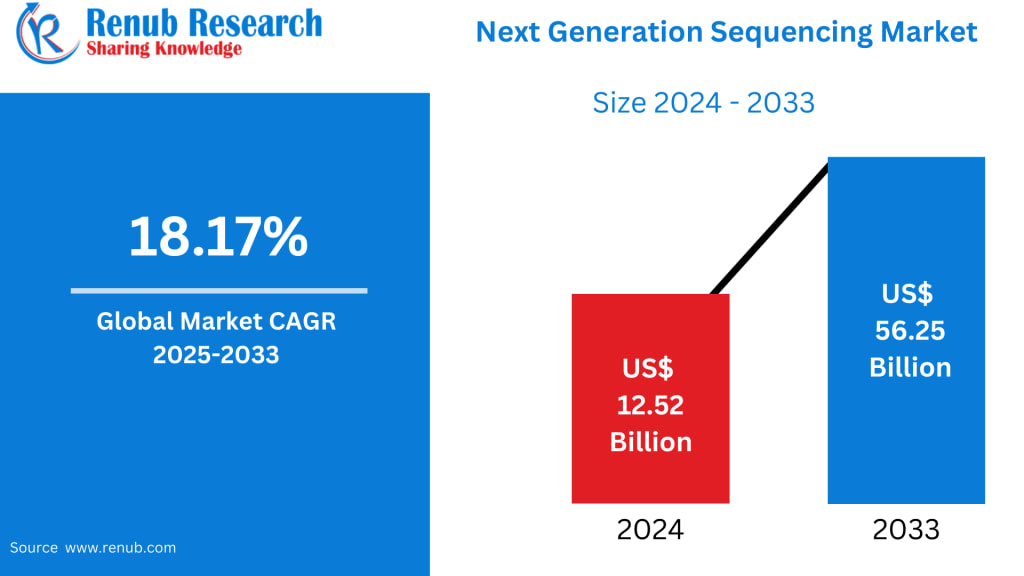
According to Renub Research, the global Next Generation Sequencing market is projected to expand from US$ 12.52 billion in 2024 to US$ 56.25 billion by 2033, registering a strong CAGR of 18.17% during 2025–2033. This remarkable growth reflects accelerating adoption across clinical diagnostics, pharmaceutical R&D, agricultural genomics, and population-scale research initiatives. As sequencing becomes faster, more affordable, and more data-rich, NGS is moving from specialized research centers into mainstream healthcare systems worldwide.
Next Generation Sequencing Market Outlook
Next Generation Sequencing refers to a suite of high-throughput technologies capable of sequencing millions of DNA or RNA fragments simultaneously. Unlike traditional Sanger sequencing, which processes limited sequences at a time, NGS enables parallel sequencing on a massive scale. This leap in efficiency dramatically reduces cost per base, shortens turnaround times, and unlocks deeper insights into complex biological systems.
The growing importance of personalized medicine is one of the most powerful drivers of market expansion. NGS allows clinicians to identify genetic mutations, biomarkers, and disease-specific signatures, enabling therapies to be tailored to individual patients. In oncology, for example, sequencing technologies guide precision treatments by revealing actionable mutations that determine drug responsiveness. In infectious diseases, NGS supports rapid pathogen identification, outbreak tracking, and antimicrobial resistance surveillance.
Meanwhile, decreasing sequencing costs, cloud-based bioinformatics platforms, and AI-driven data analytics are lowering barriers to adoption. Academic laboratories, hospitals, and even smaller biotech startups can now integrate sequencing into routine workflows. As a result, NGS has become a cornerstone of genomics, transcriptomics, epigenomics, and metagenomics research—creating a powerful ecosystem of innovation that will define life science research over the next decade.
Market Size and Forecast: 2025–2033
Renub Research estimates that the NGS market will grow from US$ 12.52 billion in 2024 to US$ 56.25 billion by 2033, reflecting a CAGR of 18.17%. This trajectory highlights the transition of NGS from a niche research tool into a core infrastructure for modern healthcare and biotechnology.
Several forces are shaping this growth:
Technological Advancements: Innovations in long-read sequencing, single-cell genomics, and spatial biology are expanding the depth and scope of genomic analysis.
Clinical Integration: Hospitals and diagnostic laboratories are increasingly using NGS for cancer profiling, rare disease diagnosis, prenatal screening, and pharmacogenomics.
Biopharmaceutical R&D: Drug discovery, vaccine development, and biomarker identification rely heavily on high-resolution genomic data.
Public Health and Agriculture: Genomic surveillance, crop improvement, and livestock breeding are accelerating adoption beyond healthcare.
As these applications converge, the NGS market is evolving into a multi-sector platform industry, supporting innovation across medicine, environmental science, and industrial biotechnology.
Competitive Landscape: Top Players Shaping the NGS Market
1. Thermo Fisher Scientific
Founded: 2006 | Headquarters: United States
Thermo Fisher Scientific is a global leader in analytical instruments, diagnostics, and life sciences solutions. Through brands such as Thermo Scientific and Applied Biosystems, the company delivers comprehensive NGS platforms, reagents, and laboratory automation tools. Its strong global distribution network and deep integration across research, clinical, and pharmaceutical markets position Thermo Fisher as a cornerstone of the NGS ecosystem.
2. Pacific Biosciences (PacBio)
Founded: 2004 | Headquarters: United States
PacBio is recognized for its Single Molecule, Real-Time (SMRT) sequencing technology, which delivers long-read sequencing with high accuracy. These capabilities are critical for applications requiring structural variant detection, de novo genome assembly, and complex transcriptome analysis. PacBio’s systems are widely used in human genomics, plant and animal sciences, and oncology research.
3. Illumina Inc.
Founded: 1998 | Headquarters: San Diego, California
Illumina remains one of the most influential companies in the NGS market, offering integrated sequencing platforms and bioinformatics solutions used across academic, pharmaceutical, and clinical environments. Strategic initiatives, including regional manufacturing partnerships, have strengthened its global footprint. Illumina’s continuous investment in speed, accuracy, and cost-efficiency reinforces its leadership in large-scale genomic projects.
4. Roche Ltd.
Founded: 1896 | Headquarters: Basel, Switzerland
Roche operates at the intersection of pharmaceuticals and diagnostics, giving it a unique position in clinical genomics. Through innovative diagnostic platforms and personalized healthcare strategies, Roche integrates NGS into oncology, infectious disease testing, and companion diagnostics—bridging research insights with patient-centered care.
Product Innovation and Launches in NGS
Bio-Rad Laboratories, Inc.
In June 2024, Bio-Rad launched the ddSEQ Single-Cell 3′ RNA-Seq Kit alongside Omnition v1.1 analysis software. Designed for droplet-based workflows, the system enables efficient creation of high-quality RNA-Seq libraries, empowering researchers to explore gene expression at single-cell resolution with enhanced accuracy.
Takara Bio Inc.
In October 2025, Takara Bio introduced the Trekker™ Single-Cell Spatial Mapping Kits, optimized for FFPE samples. These kits expand access to spatial single-cell analysis and integrate seamlessly with third-party platforms such as 10x Genomics, BD Biosciences, Parse Biosciences, and Illumina—supporting multi-modal research workflows.
SWOT Perspectives: Selected NGS Ecosystem Contributors
Hamilton Company
Strength: Precision Automation and Liquid Handling
Hamilton’s advanced robotic platforms and liquid-handling systems ensure reproducibility, accuracy, and throughput across NGS workflows—from sample preparation to library construction. By minimizing manual errors and streamlining laboratory processes, Hamilton enhances data quality while accelerating discovery. Its reputation for engineering excellence and customization makes it a trusted partner for genomic laboratories worldwide.
Geneious
Strength: Intuitive Bioinformatics Platform
Geneious offers a comprehensive bioinformatics suite that integrates powerful genomic analysis with a user-friendly interface. Supporting multiple sequencing technologies and data formats, the platform enables researchers of varying expertise levels to manage, assemble, and interpret complex datasets efficiently. Its modular design and automation features position Geneious as a leading solution for data-driven genomics.
Recent Developments in the NGS Market
bioMérieux SA
In June 2025, bioMérieux announced the acquisition of Day Zero Diagnostics, a U.S.-based company specializing in genome-based infectious disease diagnostics using machine learning. This strategic move strengthens bioMérieux’s capabilities in rapid pathogen detection and antimicrobial stewardship, reinforcing the role of NGS in public health.
Agilent Technologies, Inc.
Agilent’s acquisition of e-MSion in March 2023 enhanced its analytical portfolio with advanced electron capture dissociation (ExD) technology. While traditionally aligned with mass spectrometry, the integration supports biomolecular characterization, complementing genomic workflows and accelerating biotherapeutic development.
Sustainability in the NGS Industry
PerkinElmer, Inc.
PerkinElmer has committed to ambitious environmental and social goals, including net carbon neutrality by 2040, 100% renewable electricity by 2030, and significant reductions in waste and water usage. The company integrates sustainability into product design, operational efficiency, and responsible sourcing, while also promoting diversity and ethical governance.
10x Genomics, Inc.
10x Genomics embeds sustainability into its innovation strategy through energy-efficient manufacturing, reduced laboratory waste, and ethical supply chain transparency. The company also prioritizes social equity through workplace diversity and community engagement, setting new standards for responsible growth in genomic technologies.
Market Segmentation Overview
The global NGS market can be segmented across multiple dimensions:
By Product Type: Sequencing platforms, consumables (reagents, kits), and bioinformatics solutions
By Technology: Sequencing by synthesis, single-molecule sequencing, nanopore sequencing, and hybrid approaches
By Application: Oncology, reproductive health, genetic disease diagnosis, infectious disease surveillance, agriculture, and population genomics
By End User: Academic institutions, clinical laboratories, pharmaceutical and biotechnology companies, and government research centers
Each segment reflects different growth drivers, with clinical diagnostics and pharmaceutical R&D emerging as the fastest-growing application areas.
Strategic Company Profiles: Industry-Wide Coverage
The following organizations play pivotal roles in shaping the NGS market landscape:
Illumina
Thermo Fisher Scientific
Pacific Biosciences
QIAGEN N.V.
Roche
Bio-Rad Laboratories, Inc.
Takara Bio Inc.
Hamilton Company
Geneious
bioMérieux SA
Agilent Technologies, Inc.
PerkinElmer, Inc.
Oxford Nanopore Technologies plc
BGI Group
10x Genomics, Inc.
Each company contributes through technology innovation, strategic partnerships, acquisitions, and sustainability initiatives. Together, they form a highly dynamic ecosystem driving the evolution of sequencing technologies.
Strategic Assessment: Industry Trends
Strengths
Rapid technological innovation and declining sequencing costs
Broad application base across healthcare, research, and agriculture
Increasing integration with AI and cloud-based analytics
Weaknesses
High initial investment for advanced platforms
Data management challenges and need for specialized bioinformatics expertise
Opportunities
Expansion of personalized medicine and companion diagnostics
Growth in emerging markets and population genomics programs
Development of point-of-care and decentralized sequencing solutions
Threats
Regulatory complexity in clinical genomics
Data privacy and cybersecurity risks
Intensifying competition and price pressures
Final Thoughts
The Next Generation Sequencing market is entering a defining decade. With Renub Research projecting growth from US$ 12.52 billion in 2024 to US$ 56.25 billion by 2033 at a CAGR of 18.17%, NGS is no longer just a research tool—it is a foundational technology for modern healthcare, biotechnology, and life science innovation.
As sequencing becomes faster, cheaper, and more integrated with digital analytics, its influence will expand across diagnostics, drug development, agriculture, and public health. Companies that combine technological excellence with sustainability, data intelligence, and strategic partnerships will shape the future of genomics.
In an era where understanding DNA is key to solving humanity’s most complex challenges, Next Generation Sequencing stands at the forefront—unlocking the code of life and transforming how the world approaches medicine, science, and innovation.
About the Creator
jaiklin Fanandish
Jaiklin Fanandish, a passionate storyteller with 10 years of experience, crafts engaging narratives that blend creativity, emotion, and imagination to inspire and connect with readers worldwide.
Keep reading
More stories from jaiklin Fanandish and writers in Longevity and other communities.
United States Prostate Cancer Biomarkers Market Size and Forecast (2025–2033)
United States Prostate Cancer Biomarkers Market Overview The United States Prostate Cancer Biomarkers Market is witnessing strong and sustained growth, reflecting a broader transformation in oncology diagnostics and personalized medicine. According to Renub Research, the market is expected to reach US$ 3.54 billion by 2033, rising from US$ 1.48 billion in 2024, registering an impressive CAGR of 10.16% from 2025 to 2033.
By jaiklin Fanandish6 days ago in Longevity
Day 4 of Quitting
If this is how sobriety feels, maybe it’s better to go through life a little buzzed… this, along with other hits like, I want to kill myself, I wish I was dead, and I’m going to throw myself off a bridge have been the only thoughts on rotation these past few days. I promise myself that if, in a month, I still feel like this (‘this’ meaning despondent, full of rage, and simultaneously numb) I can go back to smoking. Until mid-February though? Nicotine is off the table.
By sleepy drafts8 days ago in Longevity
13 Reasons to Stop Using Cardio to Compensate for a Weak Foundation
Fitness doesn't fall apart because effort is missing. It falls apart because the strategy quietly works against the body. Cardio got sold as suffering. Breathless. Burning. Punitive. Somewhere along the way, discomfort became proof of effectiveness.
By Destiny S. Harris5 days ago in Longevity


Comments
There are no comments for this story
Be the first to respond and start the conversation.