
Metaverse Could Reshape The Healthcare Sector— Here's How
Metaverse is an emerging technology that holds lucrative opportunities where people can use different devices to move and communicate in a virtual environment. The metaverse world is a digital space that is made more lifelike through the usage of virtual reality (VR), augmented reality (AR), and artificial intelligence (AI).

The healthcare industry started using the technology for patient education, surgery, mental health, medical marketing, and treatment, which will change the way medical service is delivered. The healthcare transition into the metaverse is driven by people trusting the emerging technology as well as the pandemic effect as it pushed the general public to adopt certain technologies, according to Jack Latus, CEO of online healthcare provider Latus Health.
Here are three ways healthcare is transforming due to the emergence of the metaverse.
1. Telepresence
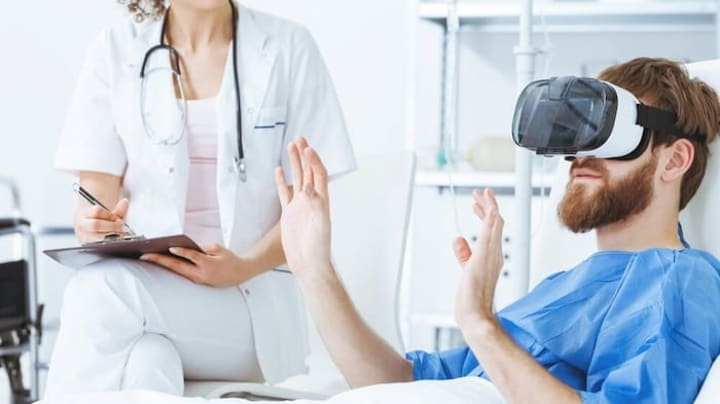
Medical telepresence, which helps people feel present in a remote location, can provide a level of visual and audio clarity that is very realistic. The technology has allowed the creation of robotics that can assist patients out of hospitals, assist doctors and nurses, and are controllable from any location through computers or smartphones.
Telepresence robots can enable specialized physicians to consult with patients without being physically present as the distance is not an obstacle in the metaverse, according to IFR. Besides, it can allow consultations from any location in the world just by using a VR headset. An AR headset can provide vital real-time patient data such as heart rate, body temperature, and blood pressure, while mixed reality can also provide superimpose 3D views of pre-operative images like MRI and CT scans.
The telepresence robot technology was introduced to the healthcare world years ago, but it was heavily used during the pandemic outbreak. Robots were able to sterilize patients’ rooms and deliver medication and supplies to lower the risk of infection.
In 2020 in the Chinese city of Wuhan, six types of robots have been brought in to help with basic tasks for the patients. Dignity Health, a California-based firm, started using robots to quickly diagnose stroke patients in 2013.
In 2016, UAE’s specialized healthcare provider Amana Healthcare introduced a telepresence robot service to patients and staff through a partnership with VGo Communications, a US company that develops markets and visual communication solutions for healthcare. Telepresence robots will allow patients, family members, and health professionals to drive the robot and interact through the built-in video and audio.
The market size of medical telepresence robots was estimated at $39.38 million in 2020, and the worldwide medical telepresence robots market is expected to grow at a compound annual growth rate (CAGR) of 18.5% from 2021 to 2028, according to Grand View Research.
2. Digital twin modeling
Digital twin technology is a digital copy of tools, people, and systems in healthcare. The technology develops digital representations of healthcare data, including hospital environment, human physiology, and lab results through computer models.
Digital twins are used to modeling body organs, physiological characteristics, and individuals' genetics to create personalized medicine and treatment plans.
As many as 66% of healthcare executives, who were surveyed by Accenture in 2022, said that their organizations' investment in digital twin technology would increase over the next three years.
NUREA, a France-based startup that develops AI-based digital twin imaging software for cardiovascular surgeons, has developed a technology that enables automated 3D reconstruction of the patient-specific digital vascular twins from CT angiograms. Surgeons use this technology to envision the progression of the aortic aneurysm using geometrical data.
Predictiv is an American startup that projects the occurrences of genetic disorders in a person using DNA-based digital twins through an individual’s fingernails to extract DNA and develop digital twins. The company provides a genetic risk report and preventive, personalized healthcare plans based on DNA results.
In 2020, Tommaso Mansi and his Siemens Healthineers research team had created a digital twin of the heart, which is a computer-based computational representation of a patient's heart. The idea is to allow doctors to employ the digital twin's prognostic advice in real-time during procedures, potentially boosting the number of patients who can benefit from the treatment.
3. Customer care
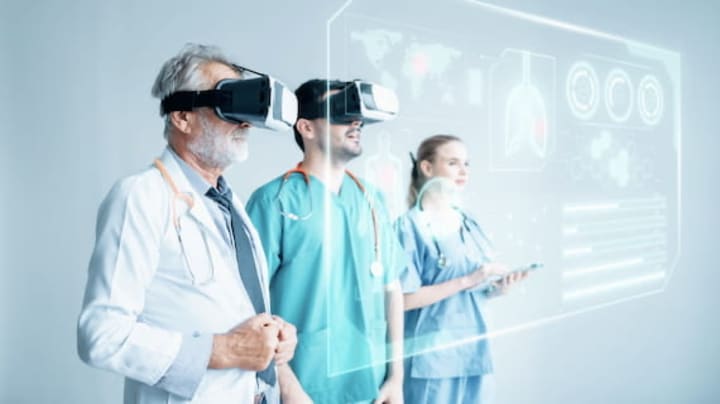
As part of the UAE government's digitization initiative, the Ministry of Health and Prevention (MOHAP) has launched its first metaverse customer service center at the Arab Health 2022, which was held between January 24 and 27.
MOHAP said that the service aims to support people when they can not change their locations for a transaction service. Customers can request information, submit documents, and pay fees in their real faces, displayed in the virtual room instead of avatars through the new service.
Healthcare services worldwide, including Aimedis (a company that operates in the Netherlands, Dubai, and the Philippines) are adopting the metaverse technology. The company provides hospital chains with the metaverse for the first time in the Middle East. The virtual hospital ecosystem includes therapies, consultations, rehabilitation courses, and education. Aimedis was at Arab Health 2022 exhibition, where people tried its metaverse healthcare service demonstration.
To maintain the decentralized structure of the system, the blockchain is at the heart of the metaverse's architecture. Blockchain will ensure that all decentralized data, databases, and computations are completely trustworthy and that only inhabitants of the metaverse control everything in the virtual world.
About the Creator
Day 4 of Quitting
If this is how sobriety feels, maybe it’s better to go through life a little buzzed… this, along with other hits like, I want to kill myself, I wish I was dead, and I’m going to throw myself off a bridge have been the only thoughts on rotation these past few days. I promise myself that if, in a month, I still feel like this (‘this’ meaning despondent, full of rage, and simultaneously numb) I can go back to smoking. Until mid-February though? Nicotine is off the table.
By sleepy drafts12 days ago in Longevity
The Muscle Paradox: Why Training Harder Is Making You Weaker
I watch it happen every week. Someone walks into the gym with fire in their eyes, ready to transform. Six months later, they're frustrated, confused, and barely any different than when they started. Same weights. Same physique. Same excuses.
By Destiny S. Harris6 days ago in Longevity




Comments
There are no comments for this story
Be the first to respond and start the conversation.