
Magic! While sun exposure stimulates appetite and leads to weight gain in men, it does not affect women
It is well known that there are obvious differences between men and women

It is well known that there are stark differences between men and women, both physically and mentally, as well as in health and behaviour. Even more surprising, there were differences in how men and women responded to the sun.
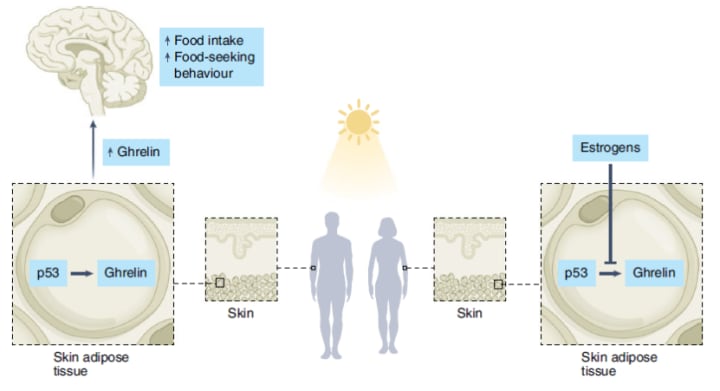
11 July 2022, A team led by Carmit Levy of the Department of Human Genetics and Biochemistry at the Sackler School of Medicine at Tel Aviv University published a study on Nature Metabolism entitled Food-seeking behavior is triggered by skin In males, ultraviolet exposure in males and females has different effects on males and females, and sunlight exposure stimulates foraging behavior of males but not females, through the mechanism of Ghrelin, which is dependent on skin fat cells. A hormone that stimulates food intake.

The research background
Sunbathing is a double-edged sword. Overexposure to the sun can cause skin burns, which can lead to skin cancer. In contrast, moderate exposure to the sun supplements vitamin D, increases liver metabolism, protects organs from hepatocyte lipid toxicity and metabolic diseases, and protects against cardiovascular disease and other causes of death. However, whether men and women respond differently to environmental factors such as UV radiation remains to be studied.
The research content
Sun exposure increases energy intake and metabolic status in men compared with women
To start, the researchers analyzed data from a three-year National Nutrition Survey of about 3,000 people and found that men's energy intake varied seasonally, with peaks in summer. There was no corresponding change for women. Summer is the season when solar radiation is strongest, so they wondered if uv exposure could be affecting appetite.
To further explore differences in how men and women respond to sunlight, researchers asked volunteers (five men and five women; Ages 18-55) exposed to bright sunlight for about 25 minutes. A mass spectrometry analysis of blood samples taken before and after sunlight showed that lipid and steroid metabolism increased in men and decreased in women under sunlight exposure.

UVB radiation enhances foraging behavior in males
To further investigate the gender-specific effects of UVB exposure, the researchers exposed mice (12 males and 12 females) to daily UVB radiation (50mJ/cm2) for 10 weeks, equivalent to about 20 to 30 minutes of midday Florida sun exposure in the summer. The results showed that male mice exposed to UVB showed increased food intake and were more motivated to find food. Female mice were not affected.

UVB radiation induces ghrelin production and secretion in skin adipose cells
Further analysis of the plasma of mice exposed to UVB found significant increases in ghrelin levels in males, both in total and active form (acylghrelin), but not in females.
Stomach is the main source of ghrelin, and previous studies have reported that white fat in subcutaneous tissue is involved in the regulation of foraging behavior. Therefore, the researchers further explored whether stomach or skin tissue is the potential producer of appetite related hormones during UVB exposure.
Somewhat unexpectedly, the uVB-induced secretion of ghrelin in males came not from the stomach, but from the fatty tissue of the skin. UVB radiation induces the production and secretion of ghrelin by male skin adipocytes, and ghrelin mediates the foraging behavior of UVB in male mice.

P53 regulates UVB - induced ghrelin expression
Subsequent studies further demonstrated that UVB radiation upregulates p53 (a transcription factor that inhibits tumor growth by regulating many target genes) in the skin (epidermis, dermis, and subcutaneous tissue), thereby activating the Ghrelin promoter. These results were confirmed in skin adipocyte specific deletion of p53 mice (p53-CKO). Male p53-CKo mice did not eat more when exposed to UVB and were not motivated to find food.
In fact, p53 expression in adipose tissue has previously been shown to be associated with the development of insulin resistance and increased production of pro-inflammatory cytokines, but its association with ghrelin production is an interesting new finding that still needs to be further explored.

So why aren't women affected by sun exposure in a similar way to men?
The researchers found that estrogen blocked transcriptional activation of p53 in ghrelin. Thus, ovariectomized female mice with low levels of estrogen showed the same increase in appetite as males when exposed to UVB.
Solar radiation increases appetite and ghrelin levels in human males
To learn more about how exposure to solar radiation alters appetite in humans, researchers questioned and analyzed blood samples from volunteers (13 men and 14 women) who were exposed to the sun for about 25 minutes. The results found that men felt significantly hungrier than normal hunger levels, while women reported no significant difference in hunger levels.
In addition, total ghrelin levels and the active form of ghrelin were significantly increased in the UVB exposed men compared to the day before the experiment. Ghrelin levels were higher in women than men before sun exposure, but there was no change in women's ghrelin levels after sun exposure, and significantly higher in men.
conclusion
This exciting study shows that sun exposure enhances foraging behavior in men through p53-dependent ghrelin activation in skin fat cells. In women, this mechanism is disrupted by estrogen, which explains why the sexes show different changes in appetite in response to sun exposure.
This work identified skin fat as a potential mediator of feeding behavior through exposure to sunlight, and thus it is possible to consider the role of a new adipose tissue subtype based on the original energy balance formula. In an accompanying opinion article, Carlos Dieguez and Ruben Nogueiras stress that "this work will certainly pave the way for further research into the role of skin in energy and metabolic homeostatic, and may lead to gender-based therapies for endocrine-related diseases".
Follow me here and star 👇
Popular Science in this issue
About the Creator
Keep reading
More stories from writers in Longevity and other communities.
Day 4 of Quitting
If this is how sobriety feels, maybe it’s better to go through life a little buzzed… this, along with other hits like, I want to kill myself, I wish I was dead, and I’m going to throw myself off a bridge have been the only thoughts on rotation these past few days. I promise myself that if, in a month, I still feel like this (‘this’ meaning despondent, full of rage, and simultaneously numb) I can go back to smoking. Until mid-February though? Nicotine is off the table.
By sleepy drafts16 days ago in Longevity
Global Dialysis Market Size and Forecast 2025–2033: Lifeline Technology in a World Facing a Kidney Health Crisis
Introduction: Dialysis at the Center of a Growing Global Health Emergency The global healthcare system is facing a silent but rapidly escalating crisis: the rising burden of chronic kidney disease (CKD) and end-stage renal disease (ESRD). As diabetes, hypertension, aging, and lifestyle-related disorders increase worldwide, dialysis has become a life-sustaining necessity for millions of patients.
By Sushant. Renub Research2 days ago in Longevity
How to Succeed at the Benson Directory®
Congratulations and welcome to the Benson Directory® employee #22391! As our newest call handler, you will have the privilege of speaking with dozens of unique and interesting people on a daily basis as well as the opportunity to earn bonuses for high performance. Contained within this handbook you will find a set of ease to follow instructions designed to help you settle in to your new role and begin paving the way to success.
By S. A. Crawford6 days ago in Fiction




Comments
There are no comments for this story
Be the first to respond and start the conversation.