
Japan Dishwasher Market Value & Growth Forecast 2025–2033
How Smart Kitchens, Urban Lifestyles, and Hygiene Awareness Are Powering Steady Market Expansion

Japan Dishwasher Market Overview
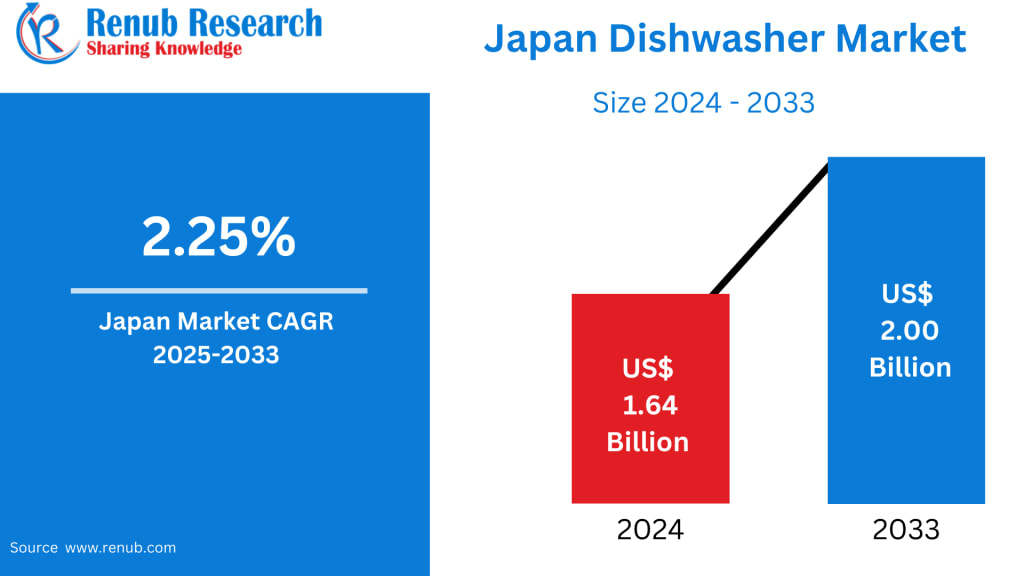
The Japan dishwasher market is entering a phase of stable yet meaningful growth as modern lifestyles reshape household priorities across the country. According to Renub Research, the Japanese dishwasher market is projected to grow from US$ 1.64 billion in 2024 to US$ 2.00 billion by 2033, registering a Compound Annual Growth Rate (CAGR) of 2.25% during 2025–2033.
This expansion is not driven by mass adoption alone but by a gradual shift in consumer behavior. Japanese households are increasingly valuing convenience, hygiene, and efficient use of time, particularly in urban environments where space and time are limited. Dishwashers, once considered a luxury or unnecessary appliance, are now being recognized as essential kitchen tools aligned with modern living.
Rising awareness of sanitation standards, technological advancements in compact appliances, and growing demand from both residential and commercial sectors are steadily increasing dishwasher penetration across Japan.
Japan Dishwasher Market Outlook
A dishwasher is an automated kitchen appliance designed to clean dishes, cookware, and utensils using controlled water pressure, detergent, and high temperatures. Compared to manual washing, dishwashers offer improved sanitation, reduced water consumption, and significant time savings.
In Japan, dishwashers are increasingly tailored to meet unique household requirements. Compact kitchens, smaller family units, and apartment-style living have encouraged manufacturers to introduce space-saving designs without compromising cleaning efficiency. From countertop models to built-in systems integrated within cabinetry, the Japanese market reflects innovation focused on practicality.
As consumers continue to prioritize cleanliness, convenience, and smart technology, dishwashers are becoming a symbol of efficient urban living rather than a discretionary purchase.
Key Growth Drivers in the Japan Dishwasher Market
Urbanization and Demand for Convenience
Japan is one of the most urbanized countries globally, with over 92% of its population residing in cities. Urban households, especially in metropolitan areas, face long working hours and limited leisure time. Dishwashers offer a practical solution by reducing daily household chores.
The growing prevalence of dual-income families has further accelerated demand. With fewer hours available for domestic work, consumers increasingly prefer appliances that automate repetitive tasks. Compact dishwashers specifically designed for smaller Japanese kitchens are gaining strong traction, particularly in apartments and condominiums.
Technological Innovation and Smart Features
Japanese consumers are highly receptive to advanced technology, especially when it improves efficiency and sustainability. Dishwasher manufacturers are responding by launching models equipped with:
Energy-efficient wash cycles
Water-saving systems
Noise reduction technology
Smart sensors and AI-driven programs
These innovations appeal to environmentally conscious buyers and tech-savvy households. A notable development occurred in July 2023, when Hoshizaki Corporation introduced its smallest-ever compact commercial dishwasher, highlighting the industry’s shift toward space-efficient designs.
Rising Hygiene and Health Awareness
Public health consciousness has increased significantly in Japan, particularly following the COVID-19 pandemic. Dishwashers provide high-temperature washing that effectively eliminates bacteria and germs, offering superior sanitation compared to manual washing.
This benefit is especially valued by households with children and elderly members. As of September 2024, Japan’s elderly population reached 36.25 million people, accounting for nearly one-third of the total population. The emphasis on hygiene, combined with demographic aging, continues to support dishwasher adoption across both residential and commercial sectors.
Challenges in the Japan Dishwasher Market
High Initial Costs and Consumer Price Sensitivity
Despite long-term efficiency benefits, the high upfront cost of dishwashers remains a significant barrier. Many middle-income households hesitate to invest due to budget constraints, particularly when handwashing is still viewed as economical.
Price sensitivity is more pronounced in rural areas, where space constraints are less severe but traditional habits persist. While financing options and entry-level models are expanding, affordability remains a key challenge for broader market penetration.
Limited Kitchen Space in Traditional Homes
Japan’s compact housing designs pose a structural challenge for dishwasher adoption. Older residences often lack adequate kitchen space or plumbing infrastructure to accommodate full-sized units.
Although manufacturers are introducing portable and countertop models, limited kitchen layouts continue to restrict widespread adoption. Consumers often prioritize essential appliances such as refrigerators and washing machines over dishwashers, slowing market growth in space-constrained households.
Japan Built-In Dishwasher Market
Built-in dishwashers are gaining popularity in newly constructed apartments and renovated homes. These models integrate seamlessly into kitchen cabinetry, offering a minimalist and space-efficient solution.
Demand is strongest among high-income households and urban professionals seeking premium kitchen aesthetics. Built-in models typically feature advanced energy-saving functions, quiet operation, and larger capacities. However, adoption remains limited in older housing stock, where structural constraints hinder installation.
Japan Residential Dishwasher Market
The residential segment represents the largest share of the Japanese dishwasher market. Rising disposable incomes, changing lifestyles, and increased health awareness are encouraging households to adopt dishwashers.
Compact, portable, and countertop dishwashers are particularly popular due to affordability and ease of installation. Eco-friendly models that reduce water and electricity usage are also gaining momentum among environmentally conscious consumers.
As convenience-driven lifestyles continue to shape purchasing decisions, the residential segment is expected to maintain steady growth throughout the forecast period.
Japan Commercial Dishwasher Market
Commercial dishwashers are essential in Japan’s hospitality and foodservice industries, where strict hygiene regulations are enforced. Restaurants, cafes, hotels, and catering services rely heavily on automated dishwashing solutions to maintain sanitation standards.
Labor shortages in the hospitality sector further boost demand, as dishwashers reduce dependency on manual labor. Compact under-counter units serve small eateries, while conveyor and hood-type systems are widely used in hotels and large dining facilities.
Distribution Channel Analysis
Offline Dishwasher Market
Offline retail remains the dominant distribution channel in Japan. Consumers prefer purchasing appliances from electronics stores and specialty retailers where they can receive demonstrations, expert advice, and after-sales support.
In-store promotions, extended warranties, and installment payment options continue to strengthen offline sales, particularly for high-value appliances.
Online Dishwasher Market
E-commerce channels are expanding rapidly as digital adoption increases. Online platforms offer competitive pricing, broader product selections, and convenient home delivery.
Compact dishwashers are especially popular online due to simpler logistics. Product reviews and detailed comparisons help consumers make informed decisions, contributing to rising online sales momentum.
Regional Market Insights
Tokyo Dishwasher Market
Tokyo is the largest and most developed dishwasher market in Japan. Dense urban housing, busy lifestyles, and high disposable incomes drive strong demand for compact and built-in dishwashers.
Tokyo’s thriving restaurant and hospitality sectors further contribute to robust commercial dishwasher sales.
Saitama Dishwasher Market
Located near Tokyo, Saitama benefits from rising residential development and a growing middle-class population. Affordable countertop models are especially popular among young families and first-time buyers.
Aichi Dishwasher Market
Aichi, home to major industrial hubs including Nagoya, exhibits balanced demand across residential and commercial segments. Urban growth and industrial activity make it one of Japan’s most promising regional markets.
Market Segmentation
By Product
Freestanding
Built-in
By Application
Residential
Commercial
By Distribution Channel
Offline
Online
Top Cities Covered
Tokyo, Kansai, Aichi, Kanagawa, Saitama, Hyogo, Chiba, Hokkaido, Fukuoka, Shizuoka
Key Players Analysis
Leading companies operating in the Japan dishwasher market include:
Electrolux AB
Panasonic
Whirlpool
Robert Bosch GmbH
Samsung
Siemens
LG Electronics
Haier
Each company is evaluated across five viewpoints: Overview, Key Person, Recent Developments, SWOT Analysis, and Revenue Performance.
Final Thoughts
The Japan dishwasher market is evolving steadily as changing lifestyles, urban density, and hygiene awareness redefine household priorities. While space constraints and upfront costs remain challenges, continuous innovation in compact and smart dishwasher designs is unlocking new growth opportunities.
With a projected market value of US$ 2.00 billion by 2033, Japan’s dishwasher industry reflects a broader transition toward efficient, technology-driven living. As consumers increasingly value time savings and sanitation, dishwashers are poised to become a mainstream appliance across Japanese households and commercial establishments alike.
About the Creator
Keep reading
More stories from Aaina Oberoi and writers in Longevity and other communities.
United States Dialysis Market Size & Forecast 2025–2033
United States Dialysis Market Overview The United States Dialysis Market is entering a phase of sustained and resilient growth as the country grapples with a rising burden of kidney-related disorders and an aging population requiring long-term renal care. According to Renub Research, the market is projected to expand from US$ 1.35 Billion in 2024 to US$ 1.96 Billion by 2033, registering a Compound Annual Growth Rate (CAGR) of 4.25% during 2025–2033.
By Aaina Oberoi10 days ago in Longevity
Day 4 of Quitting
If this is how sobriety feels, maybe it’s better to go through life a little buzzed… this, along with other hits like, I want to kill myself, I wish I was dead, and I’m going to throw myself off a bridge have been the only thoughts on rotation these past few days. I promise myself that if, in a month, I still feel like this (‘this’ meaning despondent, full of rage, and simultaneously numb) I can go back to smoking. Until mid-February though? Nicotine is off the table.
By sleepy drafts4 days ago in Longevity
Bruce Lee and The God of War: Kuan Ti
It starts with love.. The Power to the God Of War and Wealth Walk into a Chinese restaurant (even in Oklahoma, USA), a Chinese police station, a kung fu martial arts studio or even a Chinese temple and you often see a red faced warrior holding a heavy quan-do (spear like weapon).
By WILD WAYNE : The Dragon King4 days ago in Chapters


Comments
There are no comments for this story
Be the first to respond and start the conversation.