
How I Learned to Love My 600 Square Foot Apartment (And Make It Work!)
Small Urban Apartment
When "Cozy" Really Means "Tiny"
When I first moved into my urban apartment three years ago, I stood in the middle of my 600 square feet and had a minor panic attack. Where would everything go? How could I fit a living room, bedroom, office, and dining area into what felt like a glorified closet?
Fast forward to today, and I genuinely love my small space. It's taught me more about intentional living than any minimalism podcast ever could. If you're struggling with limited square footage, I've learned some game-changing strategies that transformed my cramped quarters into a home I'm actually proud of.
The Mind Game of Small Spaces
Here's something fascinating I discovered: how big a space feels has less to do with actual square footage than you'd think. When I learned this, everything changed.
I used to think I needed more space. Turns out, I just needed smarter space. The way you arrange furniture, use color, and manage lighting creates a psychological perception of openness that's honestly kind of magical. Research shows that visual openness affects how we perceive space more than the actual measurements do.
Once I understood this, I stopped feeling defeated by my apartment's size and started getting creative with what I had.
Going Up When You Can't Go Out
The Wall Revelation
My biggest breakthrough? Looking up. I had been so focused on my limited floor space that I completely ignored the massive vertical real estate I was wasting.
I installed floor-to-ceiling shelving in my living area, and it was like adding another room. Suddenly I had space for books, plants, picture frames, and storage baskets. The best part? It made my ceilings look higher, which made everything feel more spacious.
In my kitchen, I ditched the bulky cabinets and went with open shelving that goes all the way up. Not only did I gain about 40% more storage, but the open design keeps things feeling airy instead of boxed in.
Getting Stuff Off the Floor
This was my second major revelation: anything you can mount on a wall frees up precious floor space and makes rooms feel less cluttered.
I mounted my TV, installed a floating desk that folds up when I'm not working, added wall-mounted nightstands in my bedroom area, and even found a fold-down dining table that disappears completely when I'm not eating. When I do yoga or have friends over, I can fold it up and suddenly have a wide-open space.
The psychological difference is huge. When your floors are clear, your brain registers the space as bigger and more organized.
Furniture That Earns Its Keep
The Futon is Dead, Long Live Convertible Furniture
Remember those horrible futons from college that were uncomfortable as both a couch AND a bed? Yeah, multifunctional furniture has come a long way since then.
I invested in a sofa bed with an actual memory foam mattress. When friends visit from out of town, it converts into a legitimate guest bed, not a medieval torture device. The rest of the time, it's just my regular, comfortable couch.
My coffee table? It has hidden storage inside where I keep throw blankets, board games, and extra chargers. My dining table expands when I'm hosting dinner parties and shrinks back down for everyday use. Every piece of furniture in my apartment has to justify its existence by serving multiple purposes.
The market for this type of furniture has exploded because so many of us are living in smaller urban spaces. I wish I'd known about these options when I first moved in instead of struggling with traditional furniture that wasn't designed for apartment living.
The Magic of Nesting
Nesting tables were my solution to the "where do I put drinks when friends come over" problem. Most of the time, they're stacked neatly in the corner. When I'm entertaining, I pull them out and suddenly have surface space for everyone.
Same with my dining chairs. I have stackable ones that look intentional and modern, not like cafeteria furniture. Two are always out, and the other four stack in my closet until I need them.
Color and Light: The Optical Illusion
Keeping It Light and Bright
I'll be honest, when I first heard "paint everything white," I thought it sounded boring and sterile. But I was desperate, so I tried it.
The difference was shocking. My apartment immediately felt 20% bigger (yes, there's actually research on this). Light colors reflect more light, which creates the illusion of space.
But here's the thing—I didn't want to live in a hospital. So I used what designers call the 60/30/10 rule:
60% of my space is soft, neutral tones (whites, light grays, warm beiges)
30% is a secondary color (I went with soft sage green)
10% is accent colors through pillows, artwork, and small decorative items (I love burnt orange and deep teal)
This gives you visual interest and personality without making the space feel smaller or overwhelming.
Lighting Layers
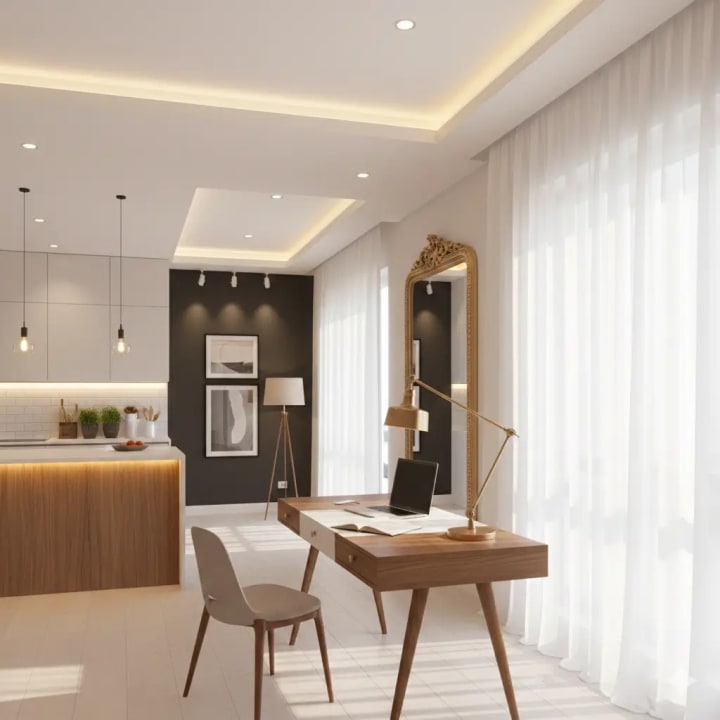
Natural light became my obsession. I replaced my heavy curtains with sheer ones that give me privacy while letting in maximum daylight. I also positioned a large mirror directly across from my window, which essentially doubles the natural light in the room.
For artificial lighting, I learned to layer it:
Overhead ambient lighting for general illumination
Task lighting like my desk lamp and under-cabinet kitchen lights
Accent lighting to highlight artwork and create mood
Having multiple light sources at different heights adds depth and makes the space feel more dynamic and larger than it is.
Creating Rooms Without Walls
Defining Zones in Open Space
In a studio apartment, you can't just have everything blend together, or it feels chaotic. But adding walls would make it feel like a prison cell.
I use area rugs to define different zones. There's one under my dining table, another under my couch, and a small one next to my bed. It's subtle, but your brain recognizes these as different functional areas, which helps with both organization and mental clarity.
I also positioned a tall bookshelf perpendicular to the wall to separate my sleeping area from my living space. It provides visual separation without blocking light or making either area feel cramped. The bookshelf itself is useful storage, so it's pulling double duty.
Transparent Dividers
For my home office area, I wanted some separation but didn't want to lose the open feeling. I found a glass partition that creates a boundary without blocking sightlines or light. During work calls, I have a defined space, but it doesn't make my apartment feel chopped up.
Decluttering: The Never-Ending Battle
The One-In-One-Out Rule
This rule has saved my sanity: every time I buy something new, I get rid of something old.
It sounds simple, but it forces you to think critically about every purchase. Do I love this new throw pillow enough to get rid of one I already have? Usually, the answer is no, which saves me money and space.
I learned from a UCLA study that clutter directly correlates with stress levels, especially for women. Once I started keeping my space cleaner and more organized, I genuinely felt calmer. It's not just aesthetic—it's mental health.
Hidden Storage Everywhere
I became obsessed with finding hidden storage opportunities:
My bed has massive drawers underneath for off-season clothes
My ottoman opens up to store blankets and magazines
My entryway bench has a lift-up seat for shoes
I use decorative baskets on shelves to hide clutter while looking intentional
The key is making storage look good. If it's ugly, you won't use it, and then you're back to clutter.
Mirrors and Reflective Surfaces
The Classic Trick That Actually Works
I was skeptical about the whole "mirrors make rooms look bigger" thing until I tried it. I hung a large mirror on my biggest wall, and it legitimately feels like I doubled my living room.
The trick is positioning it strategically—ideally across from a window so it reflects natural light and the view outside.
I also incorporated reflective surfaces through metallic picture frames, a glass coffee table, and glossy kitchen backsplash tiles. These catch and bounce light around, adding dimension.
One warning though: too many reflective surfaces can feel cold and overwhelming. I learned this the hard way and had to dial it back.
Bringing Life Inside
The Power of Plants
I never considered myself a plant person, but adding greenery to my apartment was transformative. Plants improve air quality, add color and texture, and create a connection to nature that makes the space feel less like a box.
I have a tall fiddle leaf fig in the corner that draws eyes upward, hanging pothos on wall-mounted planters, and small succulents on my windowsill. They make the space feel alive and less confined.
Plus, taking care of them gives me a routine and purpose, which is weirdly grounding when you live alone in a small space.
Smart Tech for Small Spaces
Cutting the Cord (Literally)
Technology has been a surprising ally in my small-space journey. I mounted my TV on the wall, which eliminated the need for a bulky entertainment center. I use wireless speakers instead of a sound system with tangled cables everywhere.
My smart home setup lets me control lights, temperature, and even my door lock from my phone, which means fewer physical switches, thermostats, and control panels cluttering up my walls.
Furniture with Built-In Charging
One of my favorite recent finds is furniture with built-in USB ports and wireless charging pads. My nightstand and coffee table both have them, which means I can charge devices without needing accessible outlets or dealing with cord clutter.
In older urban apartments (like mine), outlets are never where you need them. This has been a game-changer.
Flexibility is Everything
Furniture That Moves
I used to push all my furniture against the walls because I thought it made the room bigger. Actually, floating furniture away from walls creates better flow and makes spaces feel more open.
I also prioritized lightweight or wheeled furniture. My coffee table has casters, so I can easily move it aside for yoga or exercise. My dining chairs are light enough to rearrange quickly depending on whether I'm working, eating, or entertaining.
This flexibility means my apartment can transform based on what I'm doing, which is essential when one room has to serve multiple functions.
Less is More (No, Really)
Curating Instead of Collecting
In a small space, you can't display everything. I had to get ruthless about what I kept visible.
Instead of covering every surface with souvenirs and photos, I selected a few meaningful pieces and displayed them intentionally. I rotate seasonal artwork and decorative objects, which keeps things fresh without adding more stuff.
I also created a gallery wall with a cohesive color palette rather than random framed items scattered everywhere. One concentrated visual impact makes a stronger statement than bits and pieces throughout the space.
Getting the Scale Right
This was a costly lesson: I bought a dining table that was too big, and it made my entire apartment feel cramped. I ended up selling it at a loss and getting a smaller one.
Now I measure obsessively before buying anything. I even use painter's tape on the floor to visualize the footprint of furniture before purchasing. It sounds excessive, but it prevents expensive mistakes.
Furniture needs to be proportional to the space. Too big, and you feel trapped. Too small, and it looks disconnected and odd.
What I Wish I'd Known From Day One
Living in a small urban apartment isn't about sacrifice—it's about intention. Every decision matters when you have limited space, so you're forced to be thoughtful about what you bring in and how you use it.
The principles that transformed my space are pretty straightforward:
Use vertical space aggressively
Invest in quality multifunctional furniture
Stick with light, cohesive color palettes
Create zones without building walls
Declutter ruthlessly and regularly
Every choice should serve both form and function. When it does, small spaces stop feeling limiting and start feeling liberating.
Urban living has created a whole industry of innovative solutions for apartment dwellers. Companies are designing specifically for how we actually live in cities now—in smaller, more efficient spaces that require creativity.
Whether you're downsizing, moving to your first studio, or just trying to make your current space work better, these strategies can help you create a home that feels organized, intentional, and uniquely yours.
Living small isn't a compromise. It's about creating a functional, beautiful sanctuary that gives you refuge from the chaos of city life outside your door. And honestly? Once you figure it out, there's something incredibly satisfying about a perfectly optimized small space.
It might sound cliché, but less really can be more—if you're strategic about it.
About the Creator
Beyond Exhaustion: What Happens to Your Body and Brain After 72 Hours Without Sleep?
We've all experienced the grogginess of a poor night's sleep or the heavy eyelids that follow an all-nighter. But what happens when you push the human body to its absolute limits? Staying awake for 72 hours—three full days and nights—is a severe shock to your system. It shifts from a simple matter of feeling tired to a profound physical and psychological crisis. Here is a chronological breakdown of what happens to your mind and body when you stop sleeping.
By Mohammad Hamid3 days ago in Longevity
How to Whiten Teeth Naturally: What Actually Works (and What to Avoid)
A bright smile has always been associated with confidence. Whether you’re leading a boardroom meeting or just laughing at a joke with friends, your teeth are the first thing people notice. But over time, your teeth start losing their natural brightness. The daily cup of chai or coffee, colourful Indian spices, smoking, or simply aging can slowly leave behind stains. How to whiten teeth naturally? In many Indian houses, home remedies, or ‘Nuskhas‘, are passed down like heirlooms. You may hear, ‘Hey, try brushing with baking soda’ or ‘rub a lemon on your teeth.’ Social media is full of such “natural whitening hacks”, promising quick results without a visit to the dentist. So, do these remedies actually work? And more importantly, are they safe for your teeth?
By Good health to everyonea day ago in Longevity
📢 Raise Your Voice Thread: 03/05/2026
Our “Raise Your Voice Threads” are hosted most alternating Thursdays at 12PM ET to offer creators more avenues to uncover exceptional stories on Vocal. As we are continuously searching for fresh creators and inspiring stories, this thread provides an opportunity to exchange and discuss the stories that have moved and motivated us on Vocal.
By Raise Your Voice by Vocal7 days ago in Resources



Comments
There are no comments for this story
Be the first to respond and start the conversation.