
Global Bionic Devices Market Size & Forecast 2025–2033
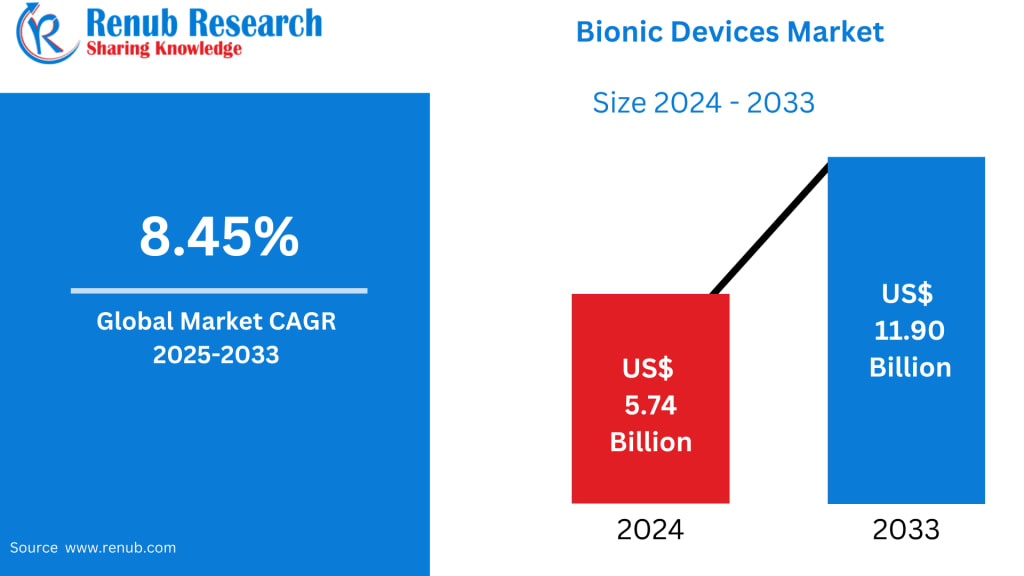
AI-driven prosthetics, smart implants, and wearable robotics are redefining human mobility as the market advances toward a US$ 11.90 billion future.

Introduction: Where Biology Meets Engineering
The global healthcare landscape is undergoing a profound transformation as technology increasingly integrates with the human body. At the forefront of this evolution is the bionic devices market, a sector dedicated to restoring, enhancing, or replacing biological functions through advanced engineering, robotics, and artificial intelligence. From intelligent prosthetic limbs and exoskeletons to cochlear and retinal implants, bionic devices are no longer experimental—they are rapidly becoming essential tools in rehabilitation, mobility support, and sensory restoration.
According to Renub Research, the Global Bionic Devices Market is expected to expand from US$ 5.74 billion in 2024 to approximately US$ 11.90 billion by 2033, registering a CAGR of 8.45% during 2025–2033. This remarkable growth reflects a convergence of factors: rising prevalence of chronic illnesses and disabilities, rapid technological breakthroughs in wearable robotics and materials science, growing healthcare expenditure, and a global push toward personalized, minimally invasive medical solutions.
As nations invest in advanced healthcare infrastructure and patients increasingly seek solutions that enhance independence and quality of life, bionics stands at the intersection of medicine, engineering, and human aspiration.
Understanding Bionic Devices: Beyond Prosthetics
Bionic devices are engineered systems designed to replicate or augment the functions of natural body parts. Unlike conventional medical devices, bionics integrate robotics, sensors, software, and AI to create adaptive, responsive systems that interact directly with the human body.
Common categories include:
Prosthetic limbs that mimic natural movement and respond to muscle or neural signals
Cochlear implants that restore hearing by bypassing damaged auditory structures
Retinal implants and bionic vision systems for visual impairment
Exoskeletons that assist individuals with mobility challenges to stand and walk
Neuromodulation and cardiac devices that regulate internal organ function
What differentiates modern bionics from earlier mechanical aids is intelligence. Today’s systems are lighter, more precise, and increasingly capable of learning from the user’s movement patterns. With AI-based motion control, sensor fusion, and digital connectivity, bionic devices are becoming more intuitive, enabling smoother integration with the human body.
Key Market Drivers
1. Rising Incidence of Disabilities and Chronic Conditions
The growing prevalence of diabetes, vascular diseases, trauma injuries, and neurological disorders is increasing the need for prosthetics, mobility aids, and assistive devices. Aging populations in developed nations further amplify demand for hearing implants, joint support technologies, and neurostimulation systems.
2. Rapid Technological Advancements
Breakthroughs in artificial intelligence, machine learning, robotics, and materials engineering have dramatically improved device performance. Smart sensors, 3D printing, and lightweight composites allow for highly customized prosthetics, while AI enables real-time adaptation to user movement.
3. Demand for Personalized and Non-Invasive Solutions
Patients increasingly prefer devices that are tailored to their physiology and lifestyle. Modern bionic systems are designed for comfort, precision, and minimal invasiveness, aligning with broader healthcare trends toward personalized medicine.
4. Increasing Healthcare Expenditure
Public and private investment in medical technology is accelerating across North America, Europe, and Asia-Pacific. Government programs supporting rehabilitation, veteran care, and disability inclusion are also contributing to wider adoption.
Regional Landscape: Innovation Across Continents
North America remains the largest market, driven by advanced healthcare infrastructure, strong reimbursement systems, and leading innovators such as Abbott Laboratories, Boston Scientific, Medtronic, and Abiomed.
Europe benefits from robust research ecosystems in Germany, the UK, and France, along with increasing adoption of prosthetics and neurostimulation technologies.
Asia-Pacific is emerging as a high-growth region due to rising healthcare investment, large patient populations, and expanding medical manufacturing capabilities in Japan, China, and South Korea.
Countries such as the United States, Germany, and Japan have been instrumental in setting global standards for rehabilitation technologies, exoskeletons, and implantable devices, driving both clinical outcomes and commercial growth.
Competitive Landscape: Top Players Shaping the Market
Abbott Laboratories (USA)
A global healthcare leader, Abbott operates across diagnostics, medical devices, nutrition, and pharmaceuticals. Its portfolio spans cardiovascular, neuromodulation, and rhythm management systems, making it a key contributor to bionic technologies that regulate biological functions and improve quality of life.
Abiomed (USA)
Specializing in cardiac assist devices, Abiomed’s Impella heart pump systems provide life-saving hemodynamic support for patients with severe heart failure. Its innovations in temporary circulatory support place it at the forefront of functional organ replacement technologies.
Edwards Lifesciences (USA)
A leader in structural heart and hemodynamic monitoring, Edwards Lifesciences develops transcatheter valves and surgical monitoring systems. Its devices are integral to minimally invasive cardiac procedures, blending precision engineering with life-sustaining functionality.
ReWalk Robotics (Israel)
Now operating as Lifeward Inc., ReWalk is renowned for its wearable exoskeletons that enable individuals with lower-limb disabilities to walk again. Its rehabilitation and personal mobility systems highlight the market’s focus on restoring independence and mobility.
Boston Scientific (USA)
Boston Scientific offers advanced interventional devices across cardiology, neurology, urology, and pain management. Its neuromodulation and implantable technologies play a critical role in managing chronic conditions through bioelectronic solutions.
Together, these companies demonstrate the breadth of the bionic ecosystem—from cardiac support and neurostimulation to exoskeletons and smart implants.
Product Launches: Innovation in Action
Pixium Vision SA (March 2023)
Pixium Vision received FDA Breakthrough Device Designation for its Prima System, a photovoltaic retinal implant designed for patients with dry age-related macular degeneration. By combining central prosthetic vision with peripheral natural sight, the technology represents a milestone in bionic vision restoration.
Cochlear Limited (July 2025)
Cochlear introduced the Nucleus® Nexa™ System, the world’s first smart cochlear implant with upgradeable implant firmware. This innovation allows recipients to benefit from future technological advancements without replacing the implant, setting a new standard for long-term hearing solutions.
These launches underscore the industry’s shift toward software-enabled, future-proof medical devices that evolve alongside technological progress.
Strategic Insights: SWOT Highlights
EKSO Bionics Holdings Inc.
Strength: Leadership in wearable exoskeleton technology
Ekso’s expertise in robotics and biomechanics has enabled the development of advanced exoskeletons such as EksoNR and EksoVest, used in rehabilitation, industrial safety, and defense. Strategic partnerships with hospitals and research institutions reinforce its role as a pioneer in human mobility augmentation.
Ottobock SE & Co. KGaA
Strength: Global leadership in prosthetics and orthotics
With a legacy spanning over a century, Ottobock’s innovations—such as the C-Leg, Genium X3, and Michelangelo Hand—set benchmarks in functional precision and user comfort. Its integration of AI-based motion control and personalized fitting services positions it as a cornerstone of patient-centric bionic design.
Recent Developments: Expanding the Frontier
Medtronic Plc (February 2025)
Medtronic achieved FDA approval for the world’s first closed-loop adaptive deep brain stimulation (aDBS) system for Parkinson’s disease. By automatically adjusting stimulation based on real-time brain activity, this breakthrough redefines neurostimulation and highlights the growing role of AI in implantable medical devices.
William Demant Holdings A/S (2025)
Demant announced the acquisition of Germany’s KIND Group for €700 million, strengthening its presence in the European hearing care market. This strategic move expands access to hearing solutions and underscores consolidation trends in the bionic hearing segment.
Sustainability in Bionics: Innovation with Responsibility
Sonova Holding AG
Sonova integrates environmental and social responsibility into its innovation strategy. Its sustainability goals include reducing carbon emissions, increasing renewable energy use, and designing durable, recyclable hearing solutions. Through its Hear the World Foundation, Sonova promotes global access to hearing care, aligning technological progress with social impact.
Bionik Laboratories Corp.
Bionik focuses on creating long-lasting, resource-efficient robotic rehabilitation systems. By emphasizing responsible sourcing, lean manufacturing, and ethical labor practices, the company aims to reduce environmental impact while improving patient mobility and neurological recovery outcomes.
Sustainability is emerging as a competitive differentiator, with companies increasingly designing devices that balance technological sophistication with environmental stewardship.
Market Segmentation and Competitive Analysis
The bionic devices market can be segmented by product type (prosthetics, implants, exoskeletons, neuromodulation devices), application (orthopedic, neurological, cardiac, sensory), and end-user (hospitals, rehabilitation centers, home care). Among these, prosthetics and hearing implants currently dominate, while exoskeletons and neurostimulation systems are among the fastest-growing segments.
Leading companies—including Abbott, Abiomed, Edwards Lifesciences, ReWalk, Boston Scientific, Baxter International, Cochlear, Medtronic, William Demant, Ekso Bionics, Ottobock, Sonova, Bionik Laboratories, Pixium Vision, Open Bionics, Cyberdyne, and Myomo—compete through:
Product innovation and R&D investment
Strategic partnerships and acquisitions
Sustainability initiatives
Global distribution networks and personalized patient services
Future Outlook: Toward a More Human-Centered Technology
The next decade will redefine what it means to live with a disability. With continued advancements in AI, machine-brain interfaces, sensor technology, and biomaterials, bionic devices will become increasingly responsive, adaptive, and accessible. Integration with digital health platforms will enable remote monitoring, predictive maintenance, and continuous performance optimization.
Emerging economies will also play a growing role as healthcare infrastructure expands and costs decline. Combined with rising awareness and supportive government policies, the addressable market for bionic devices is set to broaden significantly.
By 2033, as the market approaches US$ 11.90 billion, bionics will no longer be viewed merely as assistive technology—it will be recognized as a transformative force that empowers individuals to reclaim mobility, restore senses, and enhance human capability.
Final Thoughts
The global bionic devices market stands at the threshold of a new era—one where human limitations are no longer fixed boundaries but challenges to be engineered away. With strong growth projections from Renub Research, rapid technological innovation, and an expanding ecosystem of global players, the industry is redefining healthcare outcomes and patient independence.
From intelligent prosthetics and smart cochlear implants to AI-driven neurostimulation and wearable robotics, bionic technologies are reshaping the relationship between humans and machines. As investment, sustainability, and personalization converge, the future of bionics promises not just better devices—but better lives.
About the Creator
Keep reading
More stories from Aaina Oberoi and writers in Longevity and other communities.
Saudi Arabia Medical Ceramic Market Size and Forecast 2025–2033
The Saudi Arabia Medical Ceramic Market is expected to reach US$ 340.42 million by 2033, up from US$ 188.15 million in 2024, expanding at a CAGR of 6.81% during 2025–2033. This strong growth trajectory reflects rising healthcare expenditures, an aging population, increasing demand for complex surgical procedures, and rapid developments in biocompatible materials for orthopedic and dental applications. As Saudi Arabia continues to transform its healthcare ecosystem under Vision 2030, medical ceramics are emerging as a foundational material supporting advanced diagnostics, minimally invasive surgery, and long-term implant solutions.
By Aaina Oberoiabout 6 hours ago in Longevity
Day 4 of Quitting
If this is how sobriety feels, maybe it’s better to go through life a little buzzed… this, along with other hits like, I want to kill myself, I wish I was dead, and I’m going to throw myself off a bridge have been the only thoughts on rotation these past few days. I promise myself that if, in a month, I still feel like this (‘this’ meaning despondent, full of rage, and simultaneously numb) I can go back to smoking. Until mid-February though? Nicotine is off the table.
By sleepy drafts7 days ago in Longevity
United States Stoma or Ostomy Care Market Size & Forecast 2025–2033
United States Stoma or Ostomy Care Market Overview The United States Stoma or Ostomy Care Market is projected to experience steady and resilient growth over the forecast period, expanding from US$ 896.98 million in 2024 to US$ 1,380.81 million by 2033. This upward trajectory reflects a Compound Annual Growth Rate (CAGR) of 4.91% from 2025 to 2033, as estimated by Renub Research.
By jaiklin Fanandish6 days ago in Longevity


Comments
There are no comments for this story
Be the first to respond and start the conversation.