
Fat Acceptance VS Weight Loss Culture
How I found a middle ground and lost 100 pounds


Fat.
What does the word mean to you? Is it something you could call yourself without flinching? If you use it to describe others, do you usually do so with the intent to praise, wound, warn, or merely describe?
I’ve been bigger than average since I was in fifth grade. I wasn’t morbidly obese back then, but I was big enough that the kids on the school bus composed a song about my round butt and double chin to serenade me with every morning.
In 2011, I made the decision to cast off my sense of shame and be radically unapologetically fat.
In 2019, the consequences of that decision started to weigh too heavily upon me, and I had to backtrack.
Currently, I’m straddling the awkward position of being somewhat pro Fat Acceptance, while also deliberately and aggressively trying to lose weight.
So, what is Fat Acceptance?
Fat Acceptance is an online movement which encourages large-bodied people to spit in the face of societal norms and embrace their girth. The exact tenets of this movement vary depending on who you ask, but they usually involve eating without shame, rejecting the notion food as equal to morality, shunning diet culture, speaking out against stereotypes, and breaking fashion rules. The movement is closely intertwined with #Body Positivity (which focuses on loving your body no matter what it looks like) and #Health at Every Size (which preaches the idea that people of any weight can lead a healthy life).
These days, Fat Acceptance influencers can be found on social media apps ranging from Instagram, to YouTube, to Facebook. Apparently it’s rampant on TikTok, not that I’d know much, having never used that particular platform. I’m old enough that I discovered it back on ye olde LiveJournal, a now more or less defunct blogging website.
I needed Fat Acceptance when I found it. I was twenty-six, with a well-cultivated lack of self-esteem. I was also an American living in China, teaching at an elementary school by day, and studying Mandarin by night.

I’d always assumed, even in college when fat jokes were rare, that everybody who looked at me was disgusted by my flabby arms and the way my stomach was easily three times the size of my boobs. In China, my obviously foreign features meant that people were comfortable having animated discussions about my body right in front of me. My improving ability to understand Chinese meant I knew exactly what they were saying. It was like having all of my worst fears confirmed.
Although Chinese people come in all shapes and sizes, the obesity rate in China hovers between five and six percent of the population. In my home state of Maine, the obesity rate is 31.7 percent. In Maine I was kind of normal, at least insofar as I could assume everybody I met was used to encountering people my size and bigger on a daily basis. In China, I was a freakish outlier.
I weighed two-hundred and twenty pounds when I first arrived in the Chinese city of Wuhan, and three hundred pounds by the time I left. For most people I encountered, I was the fattest person they’d ever seen.

So people talked.
Polite people whispered about how I was “pang”, a Mandarin word for fat that has a neutral connotation. “Pang” is the word somebody would use to describe a chubby baby or a lazy but beloved twenty-five pound lump of house cat.
More disapproving people would exclaim at how “fei” I was. “Fei” also means fat, but with a negative connotation. The bigger I got, the more people remarked on my fei-ness.
Parents who saw me walking down the street would point me out to their children, and use me as a parable for why they should eat their vegetables. “You see?” one mother said to her little girl. “Next time you cry at your grandmother’s bitter melon, remember that big fattie! Your loving grandma just wants to keep you from looking like that!”
Other people would have animated discussions about how somebody as big of me could possibly remain capable of walking.
It wasn’t unusual for taxi drivers to ask me to sit in the middle of the backseat, for fear that I’d throw their car off balance if I sat too far to one side. One time I tried to explain that the taxi could carry five people and their luggage, so surely I wasn’t going to break it. The taxi driver turned his head thoughtfully, and asked whether I weighed more or less than five hundred kilos (1102.31 pounds). However large I was in reality, I was so outside the norm that people would assign me impossibly high weights at random.
One night, coming out of the bathroom at a bar, I almost collided with a pair of young women. One of the women screamed as if she’d encountered a monster. As I walked away, I overheard her telling her friend that if she ever got as fat as me, she’d kill herself. I might have considered taking that path if I hadn’t already begun to immerse myself in Fat Acceptance ideology. It was what kept me afloat.
When I got home from the bar that night, I posted a photo of myself in a gorgeous blue dress on the Fatshionista LiveJournal community and shared what had happened. I was flooded with messages from other fat women telling me how pretty and smart I was.

I wouldn’t say that I ever joined the ranks of Fat Acceptance influencers, but I was definitely involved in those circles. I started a plus size fashion blog on Tumblr that got some attention. At one point, I was interviewed by the plus-sized fashion brand Eloquii. I also wrote an article about being a fat foreigner in China, which was picked up by the online women’s magazine XO Jane.
Writing my XO Jane article helped me put my treatment in China into perspective. I loved China and didn’t want to write negatively about the country, so I tried to put a positive spin on my article, which in turn helped me see my situation more clearly. I had lots of Chinese friends, who treated me like a person. I worked at a school that recognized the effort I put into my job, with students who judged me on my teaching rather than my looks. I even won an award that recognized me as one of the top foreign teachers in Wuhan. After the award ceremony, a Chinese co-worker of mine confided to me that when we’d first met, she’d assumed somebody as fat as me must be lazy, but after getting to know me she’d learned it wasn’t true. For every hurtful comment I received, it seemed I always met dozens of people who were willing to give me a chance and learn there was more to me than just a mountain of blubber. I experienced so much kindness in China, and I’ll always be grateful for my time there.
The people streets who made comments about me were strangers, who were surprised to see something unusual in their daily life. In my XO Jane article, I compared their exclamations of “pang” and “fei” to how a New Yorker might, without malice, blurt out the first thing that came to mind if they randomly encountered a giraffe walking down the streets of Manhattan. The most hurtful comments I’d heard tended to be from people who were afraid that they or their loved ones would become fat, a worry which was their burden to bear rather than mine.
I gradually reached a point where I didn’t care at all what people said about my body. I was almost deliriously happy. My skin is the thickest part of me, and I have fat acceptance to thank for that.
Even so, I had my doubts about the movement. It’s common for big names in Fat Acceptance circles to make extreme claims about how being fat is always healthier than losing weight, to insinuate that any doctor who advocates weight loss is a fatphobic monster, and to even compare a parent putting a child on a diet to sexual abuse. Some members of the Fat Acceptance movement exhibit a cult-like mob mentality, going after members of the movement who chose to lose weight.
To be fair to Fat Acceptance people, the nature of the internet is that divisive hot takes go viral, while more nuanced views attract far less notice. Still, I was constantly seeing really young and vulnerable people parroting inflammatory and potentially dangerous Fat Acceptance mantras.
As a teacher, I began to think about whether or not Fat Acceptance ideology was something I’d want my students exposed to. I had a few students who were bigger and got made fun of for it. That’s not what I wanted for them. However, I also didn’t want them to do anything that could negatively influence their health. Most big names in Fat Acceptance claim that being obese is, in fact, totally healthy. In my heart, even when I was deep into Fat Acceptance, something always told me that wasn’t true.
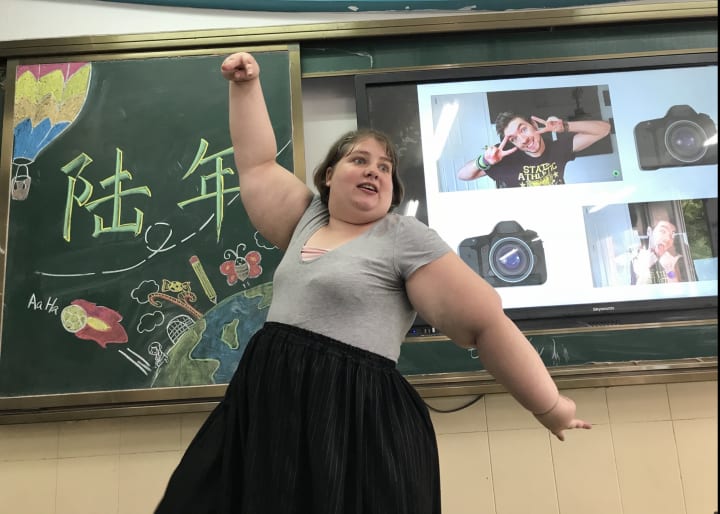
I deleted my fatshion tumblr, but I still continued to blithely allow myself to get bigger and bigger.
The health problems came slowly and gradually. I was like a frog being boiled in water, only the water was my own ever increasing adipose tissue.
I noticed how my heart would pound when I climbed the stairs to get to my classes. I ignored it, but as I grew, I started to have honest to god heart palpitations. My heart would squelch in my chest whenever I moved around too much, with a burbling sensation like it was farting my blood into my veins. I had to leave for class fifteen minutes early, so I could find a place in the hallway to hide and catch my breath, to keep the children from seeing and worrying about me.
My asthma became worse and worse. I had to take my rescue inhaler almost every hour, overdosing to the point where I was shaky and my esophagus burned, and I still was constantly out of breath.
I left China in 2019, and switched to teaching English online. This job was totally sedentary, and adjusting to living in the USA after living a third of my life abroad was hard. I’d always been enthusiastic about food and prone to turning to it in times of stress. I did that more than ever. One of the few things I liked about being back in America was that I could easily obtain certain snacks that were rare in Wuhan— Donuts, Reece’s Cups, Twix Bars, Pumpkin Spice Lattes, and more. I was cut off from my social circle, and I treated candy as my new best friend (… well, except for the part where I ate the candy).
I reached 315 pounds. One day I realized that washing my hair in the shower made my arm ache from its own heaviness. On another, I found that I couldn’t walk to the end of my driveway without feeling like I was going to collapse. Another, I was trying to cook myself some lunch, but my stomach was hanging low enough to hurt my skin, and I had to sit down. This all could have been the proverbial nail in my coffin.
In the final chapter of her book, Two Whole Cakes, fat activist Lesley Kinzel compares successful weight loss to searching for a unicorn. It’s a fantasy that gets sold to little girls, but it’s impossible in the real world. Lesley was one of my favorite writers in the movement, and to this day I find most of her writing to be meaningful and eminently sensible. However, whether she intended it or not, one of my biggest takeaways from her work was that weight loss was impossible. I assumed that I’d just always be fat no matter what I did, so I concentrated on enjoying my life, and didn’t try to make changes.
During the summer of 2020, I came to the conclusion that the best way to be able to move around again, would be to find some movement I could do and work at it. I started swimming every day with the goal of regaining my mobility, but I assumed I’d stay the same weight, or perhaps even get bigger. Instead, I dropped fifteen pounds in a matter of days. It was like that weight wasn’t meant to be there, and it was ready to come off at the slightest provocation. I felt physically better.

Seeing that I could lose weight, and that it felt good, I started to experiment with deliberate weight loss. There were days here and there where I tried methods that were unsustainable and unpleasant for me, like cutting out all carbs and ridiculous fasting, but through trial and error I was able to settle on methods that worked well with my lifestyle. These days, I track my calories to make sure I’m at a deficit, make sure to eat mostly nutritionally dense food, and take a three mile walk every afternoon. I go to the gym twice a week. On days when I’m really feeling it, I can go for up to thirty minutes on the stair machine. On days when I’m just not in the mood, I watch Star Trek while peddling half-heartedly on the stationary bike. Even my “bad” workout days are still better for me than sitting around all the time.
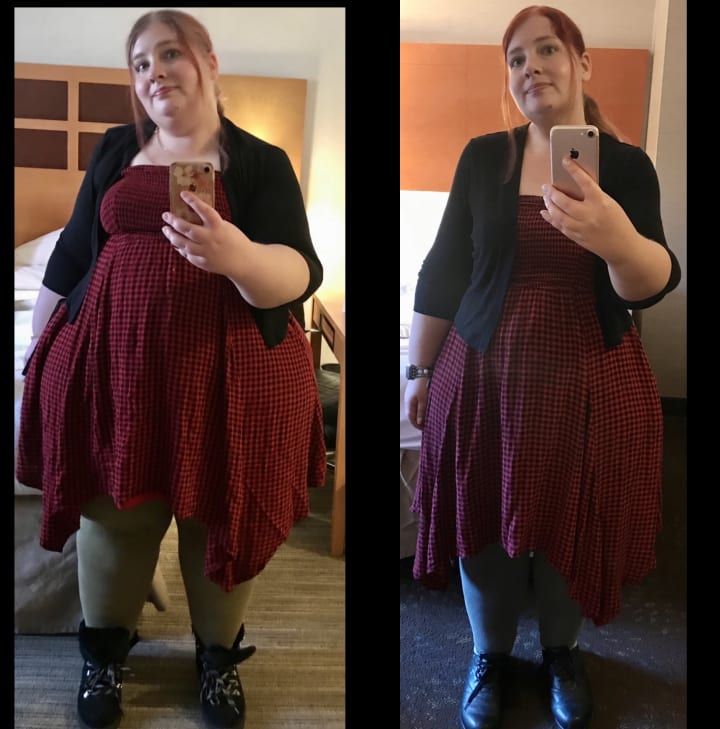
I’ve lost over one hundred pounds in the last year and a half, and I feel healthier than I ever have in my adult life.
In November of 2019, I dragged my 315 pound self to New York City to see a Broadway show. I couldn’t walk around the city and I couldn’t properly fit into the theatre seat. It was awful. Two weeks ago (October 2021), I went to New York City again to see another Broadway show. I walked fifteen to twenty-five miles every day that I was there, and I fit into my theatre seat with room to spare. I’m flying to England at the end of this month, and even though I’m still fat, I’m not afraid of how I’ll squeeze myself onto the airplane, or of holding my travel partner back as we explore London.
These days, my feelings about Fat Acceptance are mixed. I was so used to feeling sick all the time, that not feeling sick is borderline euphoric. My desire for other people to feel as good as I do leaves me tempted to get evangelical about the healing powers of weight loss. But I don’t. Not everybody’s life and health improves with with a slimmer waistline, and I don’t want to contribute to a narrative that touts weight-loss as a cure for anything and everything. Just because I was miserable at three hundred pounds doesn’t mean that everybody is, and I don’t get to make assumptions about anybody else’s relationship with their own body.
I often think of the girl in the bathroom in China who said she’d rather die than get fat like me. That girl was facing societal pressures that made her feel like her life would be worthless if she gained too much weight. A movement that seeks to divorce a person’s weight from their worthiness as a person is a good thing. Nobody should have to feel that being fat would erase all the good things about them, or like they’d be better off dead than obese.
I remember being a fifth grader being made fun of on the school bus. Before discovering Fat Acceptance, I’d always felt like my bullies were right and I was the problem. Fat children shouldn’t grow up feeling like they put on this earth to be bullied or like cruelty is righteous, as long as it’s directed at them.
People deserve bodily autonomy, and that includes the right to maintain their body at whatever weight best facilitates their happiness and comfort.
People don’t deserve to be lied to or dragged into an echo chamber.
My advice for fat people reading this would be to make your own decisions about what parts of the Fat Acceptance movement do and don’t serve you. Pay attention to your body and your mental health, and figure out what you need. If you decide that losing weight is the best course of action, don’t feel like you’re betraying anybody. You can keep speaking out against the stigma fat people face while still taking care of yourself.
Fat acceptance can be like fire. If you learn a little bit and use it carefully, it can improve your life. If you have too much of it, or don’t exercise caution and common sense, it can be a destructive force.
Fat.
I taught that word to a group of Chinese six year olds once, as part of a list of English adjectives. The list included “thin”, “tall”, “short”, “old”, and “young”. The kids asked my Chinese co-teacher whether the word translated as “fei” or “pang”. After my co-teacher told them it meant “pang”, the kids started calling me fat all the time, innocently unaware of how insulting that word could be to native English speakers.
Ironically, the Fat Acceptance movement has helped me lose weight. It got me past the cultural baggage associated with being called fat. Being filled with despair and self-loathing does nothing to promote healthy choices. Making peace with what other people think about my weight has given me the clarity to make an informed decision about what I think of it.
To me, the word fat has come to conjure up the way my body felt at its unhealthiest, but it’s not an insult. It doesn’t mean that a person is bad and ugly. In my case, and for my body, it’s a problem that needs to be fixed.
If you enjoyed reading this, consider sharing it with a friend or over social media.<3
Read more about my experiences in China here.
About the Creator
Rose
This is just a hobby.
The impact of sleep on our mental state
Introduction Sleep is a critical pillar of our daily lives, yet it’s often treated as an afterthought. While comfort and personal preference matter, the idea that we should just sleep “whenever and however” is a trap. To truly function at your peak, you need more than just rest — you need a disciplined strategy. It sounds harsh and at first, if you are used to staying up all night and not paying attention to your mental and physical health, it might seem impossible. However, great things do require some small sacrifices, so let us begin with the three tips.
By Charilaos Spanoudis6 days ago in Longevity
Met Office Forecasts Dry Weather for Sindh
The Pakistan Meteorological Department has issued a forecast indicating that Sindh province is expected to experience a prolonged period of dry weather over the coming weeks. Meteorologists say the region will see little to no rainfall, with temperatures remaining above seasonal averages, raising concerns about agriculture, water resources, and public health. According to the Met Office, a high-pressure system over the Arabian Sea and the Indian subcontinent is likely to dominate weather patterns in Sindh for the next fortnight. This atmospheric configuration inhibits cloud formation, leading to clear skies and minimal precipitation. Forecasts predict daytime temperatures in major cities, including Karachi and Hyderabad, to hover between 28°C and 34°C, slightly above the long-term average for this period. Nighttime temperatures are expected to remain mild, ranging from 18°C to 22°C. The dry spell comes at a critical time for the agricultural sector. Sindh is a major contributor to Pakistan’s wheat, sugarcane, and rice production. Farmers are being advised to monitor soil moisture levels carefully and consider supplemental irrigation for crops at sensitive growth stages. Prolonged dry conditions can affect germination, yield, and quality, particularly for wheat crops that rely on moderate rainfall in the final stages before harvest. Water resource management is also expected to become a key challenge. Reservoirs and canals in Sindh, which depend on upstream flows from the Indus River system, are already operating at variable levels due to reduced inflows and increased water demand. Local authorities are monitoring water distribution closely, emphasizing conservation measures and urging residents to avoid excessive usage. In some districts, water rationing plans may be activated if the dry period persists. Public health officials have cautioned about potential heat-related risks. Although the current temperatures are not extreme, prolonged dry conditions can exacerbate health issues, particularly for vulnerable populations such as the elderly, children, and people with preexisting medical conditions. Heat stress, dehydration, and respiratory issues may become more common if residents do not take appropriate precautions. Health authorities recommend staying hydrated, avoiding prolonged exposure to the sun during peak hours, and ensuring access to cool environments. The Met Office also noted that dust storms and haze could occur in some areas due to the dry conditions combined with occasional strong winds. These phenomena can reduce visibility and impact road traffic, aviation, and outdoor activities. Residents are advised to take safety precautions, particularly when traveling, and to follow local advisories regarding dust and air quality. Economists have warned that the dry spell could have indirect effects on local markets. Reduced crop output may drive up food prices, especially for wheat, rice, and vegetables, affecting household budgets and contributing to inflationary pressures. Traders and suppliers are being advised to monitor market conditions and plan accordingly to avoid shortages or sudden price hikes. Despite the dry weather, meteorologists have noted that this pattern is part of a natural seasonal variation. Sindh typically experiences dry periods during the pre-monsoon and post-winter seasons, and occasional heat waves are not unusual. However, experts also emphasize that climate change may be altering rainfall patterns, leading to longer dry spells and more unpredictable weather events. Continuous monitoring and early warning systems are essential to mitigate risks to agriculture, water supplies, and public health. Authorities in Sindh have urged residents and local businesses to remain vigilant. Farmers should adopt efficient irrigation practices, municipal agencies should ensure water distribution networks function effectively, and the public should take measures to protect health and safety. Collaboration between government departments, meteorological agencies, and the community will be crucial in managing the impacts of this dry period. Looking ahead, the Met Office expects the dry spell to continue into late March, with little relief from rainfall until the onset of the pre-monsoon showers. While temperatures are likely to remain moderate, the persistence of dry weather underscores the need for careful planning and resource management in Sindh. Residents are encouraged to stay updated with official forecasts and advisories to minimize the effects of prolonged dry conditions on daily life and livelihoods.
By Fiaz Ahmed 2 days ago in Longevity
"Scream 7" (2026): Running out of Fresh Screams
This is the seventh time we’ve had a Ghostface crisis. Scream 7 is the latest edition of the Scream franchise. Sydney Prescott and her family are under attack by another anonymous killer dressed in a Ghostface costume. While having issues with her daughter, Tatum, they run from the bloody murders, trying to determine who is behind it all.
By Marielle Sabbag3 days ago in Horror



Comments
There are no comments for this story
Be the first to respond and start the conversation.