
Eternal Youth, Eternal Regrets: How We Broke Mortality (and Ourselves)
The invention that promised eternal life but made us question what it truly means to be human

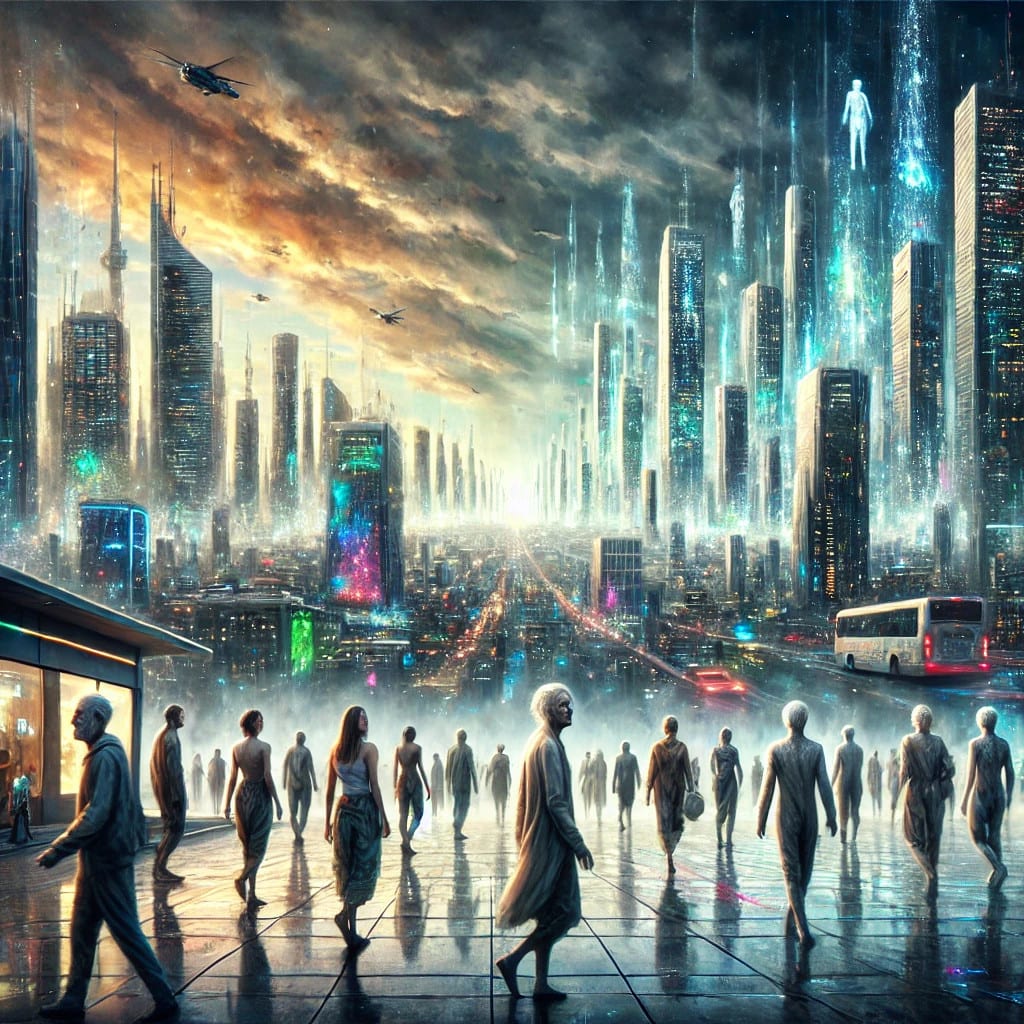
The Death of Death
I remember the day they announced it—the cure for aging. Not a temporary hack or a fountain-of-youth scam, but real, irreversible science. They called it ChronoGenesis, a breakthrough that stopped cellular degradation, erased genetic mutations, and reset biological clocks indefinitely. The world changed overnight. People lined up to become eternal, but no one could predict what would come next.
We had conquered death. But had we doomed ourselves in the process?
The Science of Immortality
The core of ChronoGenesis was built on telomere rejuvenation and quantum-regenerative stem cells, effectively eliminating the body's natural aging process. These remarkable stem cells, programmed to regenerate tissue and repair DNA at the quantum level, acted like biological time machines. Telomeres, those tiny protective caps on the ends of chromosomes, were lengthened and fortified, preventing them from fraying with age. Combined with nanotechnological self-repair mechanisms, the treatment meant that humans no longer suffered from disease, cellular decay, or even physical trauma—wounds healed almost instantly, and organs began to function as if they were new.
Death, as we knew it, had been rendered obsolete.
At first, the benefits seemed infinite. The elderly could regain youth, the sick could be cured, and the greatest minds of every generation could work indefinitely. The first few years felt like an unalloyed utopia. Humanity, it seemed, was finally on the brink of achieving perfection. But it didn’t take long before the first cracks in our seemingly flawless society began to show.
Scientists started noticing irregularities in brain function over extended periods. While the body remained perfect, the brain wasn’t immune to the consequences of eternal life. Neurons, while biologically perfect, began accumulating excess information. Memories, once vivid and fleeting, began to blur. Cognitive overload became a phenomenon that no one had anticipated. People reported an eerie sense of déjà vu, fragmented memories, and a creeping loss of identity. The brain, it seemed, was never meant to store centuries of experience.
Even worse, governments and corporations sought to control the process. ChronoGenesis was not available to all—only the wealthy elite could afford the full rejuvenation cycles, leaving the poor to wither away as mortality became a new form of class warfare. Immortality wasn’t just about living forever; it became the ultimate status symbol, the final division between the privileged and the expendable. Those who could afford it were granted eternal life, while the others were left to decay, abandoned in a world where they no longer fit.
When the World Stopped Turning
With death gone, so too was urgency. No deadlines. No last chances. No reason to strive. At first, people marveled at their newfound time, but soon, boredom settled in. It began with the artists—those who once poured their soul into creating, seeking meaning in their work. But now, with eternity stretching before them, their once-burning passion flickered and faded. The notion of "a fleeting moment" was gone, replaced with the numbing certainty that time was no longer their enemy. They could always start tomorrow, or the next year, or the next century.
Entrepreneurs, too, abandoned their ambitions. With no pressure to build or create for the future, entire industries stagnated. Relationships, once vibrant and fragile, began to wither. Love that had once been precious, fleeting, and intense became a casual routine, as people found themselves drifting through relationships, secure in the knowledge that they could always start over. Marriages lost their sacredness, and friendships became nothing more than arrangements with no expiration date.
Without an expiration date, every decision lost its weight. "I’ll do it later" became the new mantra of civilization. Human desire to innovate, explore, and push boundaries—the very things that had propelled society forward—began to fade into stagnation. Humanity entered a global lethargy, a kind of societal paralysis. Why rush when you have eternity?
The economy spiraled into chaos. Retirement was meaningless, but jobs couldn’t sustain an endless workforce. Universities became obsolete—why rush to learn when you had forever to do it? Entire fields of study collapsed, and the hunger for discovery faded into complacency. Education systems that had once served to propel the young into the future were now irrelevant. A sense of purpose, of moving toward something greater, dissipated in the face of eternity.
Then came the psychological breakdowns. Without the fear of death, people began to take extreme risks. Sports turned into death-defying spectacles, with competitors throwing themselves into increasingly dangerous feats, hoping to rekindle the adrenaline rush that had once driven them. But no matter how extreme the challenge, there was always the guarantee of survival, and so the meaninglessness of it all grew. Some even attempted self-destruction, only to be revived moments later, stuck in a cycle of reckless abandon.
Human ambition, once driven by the fleeting nature of existence, began to wither. The excitement of new beginnings, the exhilaration of the unknown, was gone. Everything was a never-ending loop.
The Population Paradox
Governments soon faced an impossible dilemma—how do you sustain an ever-growing population when no one dies? Laws were introduced to restrict reproduction, leading to mass sterilization policies. Love became conditional, relationships had contractual expiration dates, and parenthood was a privilege granted by lottery. But even then, overpopulation became an increasingly difficult problem to manage. Without death to clear space for new generations, the world became overcrowded, its resources stretched thin.
Entire industries collapsed. The funeral business ceased to exist, and life insurance became obsolete. Space colonization, once considered the ultimate escape plan for humanity, proved inefficient compared to the exponential growth of an undying society. The dream of expanding into the cosmos fell apart as the Earth grew ever more crowded and strained under the weight of its immortal inhabitants.
Meanwhile, the rich hoarded their immortality, pricing ChronoGenesis out of reach for the common citizen. Those who couldn’t afford the treatment aged and died as relics of a bygone era, creating a new class divide: the "Eternals" versus the "Ephemerals." The wealthy, now truly immortal, amassed power like never before. They controlled not just their own destinies, but the future of all humanity. And those who couldn’t afford the treatments became increasingly marginalized, fighting for scraps in a world where immortality had become a commodity.
In some countries, uprisings broke out. The "Ephemerals" turned against the elites, waging wars over the right to exist indefinitely. Governments cracked down, and entire societies were reshaped around the ethics of eternity. There were calls for a new world order, where immortality would be available to all. But those in power—those who had secured their eternal lives—had little interest in such changes. They had become gods in a world that no longer needed a reason to die.
The Soul Dilemma
Religions collapsed overnight. What happens to faith when there’s no afterlife to prepare for? The once widespread belief in heaven, hell, reincarnation, and eternal reward or punishment lost its meaning. What did it matter if you were good or bad, if there was no judgment awaiting you in the afterlife? Some clung to the hope that immortality was a test, a trial to prove the worth of human existence. Others, disillusioned, abandoned spirituality altogether.
Suicide cults emerged, claiming that true transcendence required rejecting artificial eternity. These groups believed that immortality was a prison, a distortion of what life was meant to be. They sought to embrace death, not as an enemy, but as a necessary and natural part of the cycle of existence.
More disturbingly, those who had lived for centuries began to report losing their sense of self. Memories blurred, identities eroded, and the human mind, never designed for an infinite lifespan, began to deteriorate. The oldest Eternals spoke of an unshakable emptiness, a longing for an ending they could never have. Some wandered aimlessly, unable to remember who they once were, while others sought to erase their own memories, choosing selective amnesia over the crushing burden of eternity.
The Unforeseen End
After centuries of stagnation, something changed. The first Eternal died. Not from violence, nor accident, but from what scientists called existential collapse—a phenomenon where the human consciousness, unable to sustain itself indefinitely, simply shut down. No warning. No pain. Just... gone.
It started happening more frequently. Minds that had lived for centuries suddenly ceased functioning. Some believed it was a defense mechanism, the brain’s way of forcing an end when existence became too much. Others saw it as proof that even eternity had a limit—that we were never meant to last forever.
The shockwave rippled across the world. If immortality was meant to be a gift, what did it mean if it could be taken away? Perhaps, in some twisted way, the ultimate answer was that even life itself could be too much. The first "true death" in centuries began to unravel the illusion of eternal life.
The Rebirth of Humanity
As the centuries passed, a new philosophy emerged. Humanity had seen both extremes—the terror of mortality and the horror of immortality. The lesson was clear: balance was key. Scientists refined a new version of ChronoGenesis, one that allowed controlled longevity without the burden of infinite existence. People could live longer, but the process would no longer be indefinite. Time limits were placed on extended lifespans, ensuring that people could choose when to age again. Death was no longer an inevitability, but a conscious decision—an option to embrace when life felt complete.
This new understanding of life and death began to restore purpose. People no longer feared aging. Instead, they began to cherish each year, knowing it was a gift. Mortality, once seen as a curse, was now understood as part of what made life meaningful.
The Last Generation
A group of rebels emerged—humans who refused the gift of longevity. They called themselves The Last Generation and dedicated themselves to restoring mortality as a cultural cornerstone. They believed that only through death could life retain its beauty, its urgency, and its meaning. Their movement gained traction, spreading across the world. Soon, entire civilizations chose to abandon eternal life altogether, understanding that to embrace death was to truly live.
Rituals were created to celebrate natural endings, and mortality became a conscious choice rather than a curse. People could now live to old age and choose when to step off the stage of life, content in the knowledge that they had made the most of their time.
A World Reimagined
The Earth transformed. With immortality no longer the default, societies learned to cherish each moment again. Art, music, and philosophy flourished as people rediscovered the beauty of fleeting experiences. No longer were they prisoners of their own eternity, but masters of their own time. Some still chose longevity, but most embraced the natural cycle of life and death. The world found meaning in its impermanence once more.
The Final Question
Looking back, we ask ourselves: was it all a mistake? Perhaps not. Perhaps we needed to glimpse eternity to understand the value of time. We thought we were escaping death, but in the end, we were only running from ourselves.
Conclusion: The Cost of Playing God
We sought eternity. Instead, we found our limits.
And maybe, just maybe, that’s what being human is all about.
About the Creator
Alain SUPPINI
I’m Alain — a French critical care anesthesiologist who writes to keep memory alive. Between past and present, medicine and words, I search for what endures.
Keep reading
More stories from Alain SUPPINI and writers in Longevity and other communities.
Mastering French Without Losing Your Sanity: A Realistic Guide for Beginners
Learning French can feel like solving a Rubik’s Cube blindfolded. The tricky pronunciation, the never-ending grammar rules, and the surprising exceptions make it seem impossible. But don’t worry—equipping yourself with key expressions and effective strategies can turn frustration into fluency. Let’s simplify French and make learning enjoyable.
By Alain SUPPINIExclusive • 11 months ago
Day 4 of Quitting
If this is how sobriety feels, maybe it’s better to go through life a little buzzed… this, along with other hits like, I want to kill myself, I wish I was dead, and I’m going to throw myself off a bridge have been the only thoughts on rotation these past few days. I promise myself that if, in a month, I still feel like this (‘this’ meaning despondent, full of rage, and simultaneously numb) I can go back to smoking. Until mid-February though? Nicotine is off the table.
By sleepy drafts10 days ago in Longevity
Miss Persephone's Manual to a Seemingly Ordinary Life
Miss Persephone was found at the dining table, her blue eyes swollen, her tears arriving and retreating like the tides of the ocean. Earlier that day, her family had visited her in the retirement home where she had lived for eight years. It was her eightieth birthday.
By Imola Tóth2 days ago in Fiction


Comments (2)
Nice story 🖌️💫♦️
Your insight into how we break ourselves by trying to outrun mortality. It’s a poignant reminder of how the natural cycle of life, with all its ups and downs, gives us the opportunity to learn, evolve, and truly appreciate the time we have. The regrets that come with a life stretched too long seem to echo the deeper truths we often overlook in our quest to defy time.