
Do CoQ10 Nutrients Boost Your Energy?
Don't dread getting tired and ageing anymore.


Lack of energy and an uncontrolled oxidation process in our body can cause all sorts of health problems including fatigue, chronic ailments, and aging.
My sense of well-being is inspired by the idea of protecting the body's biological systems beforehand to avoid being hacked by agents of sickness. A few months ago, I came across an article about coenzyme Q10 and it piqued my curiosity. I wanted to find out everything I could about its benefits.
Energy and antioxidants are two vital elements in maintaining our body's health to enhance longevity.
This article covers the many benefits that people can receive from consuming this nutrient. I am going to attempt to walk you through this material in a succinct manner, while not overloading your cognitive skills.
Fuel for Life
The role of metabolism in our body is to carry out the combustion process to make the energy required to sustain life.
Our body relies on a steady supply of energy to function optimally. So, like cars, we need fuel to produce energy. Our body's fuel source is Adenosine triphosphate (ATP), and it is produced by the combustion of the food we eat and the oxygen we breathe.
Metabolism and Free Radicals
Metabolism is the series of chemical processes that happen in cells and organisms to break down food and use it for energy. Within this process, ATP is used as a key intermediate.
With almost all chemical reactions, there are some byproducts that are helpful or useless. When they are worthless, they are called waste products. When food gets burned with oxygen in the body, waste is produced called free radicals. They create a chain reaction of oxidation damage in your body.

How Do Free Radicals Cause a Chain Reaction of Oxidation?
Oxidation is a natural process that occurs when oxygen interacts with organic molecules. The end-products of oxidation, such as peroxides and free radicals, can damage DNA and lipids in cells.
When weak chemical bonds break up, they usually leave behind a molecule with an unpaired electron called a free radical. These molecules are extremely unstable and therefore react quickly with other compounds, trying to seize the needed electron to gain stability.
Typically, free radicals attack nearby stable molecules to steal their electrons. When molecules lose electrons, they begin to become radicals themselves. When this happens, the process spreads and eventually affects cells in living organisms.

Why Are Antioxidants Important?
Antioxidants, vitamins C, E, and Coenzyme q10, fight against unstable molecules by giving electrons to the free radicals to neutralize them.
Free radicals are generally produced during metabolism. Alcohol, smoking, and poor dietary choices can also cause them to form excessively. Antioxidants help the body handle free radicals. However, if the production of free radicals becomes excessive, this can lead to damage. Additionally, free radical damage accumulates with age.
What is Coenzyme Q10?
Coenzyme Q10 (CoQ10) is a natural, vitamin-like compound that all cells need to make energy. Our bodies make it, but with age, the CoQ10 levels naturally decline. We can also get it from certain foods, such as red meat, sardines, and peanuts.
CoQ10 was first discovered by Professor Frederick L. Crane at the University of Wisconsin-Madison Enzyme Institute in 1957, but it was professor Yamamura from Japan who first found a practical use for CoenzymeQ10 in the mid-1960s
Japan was also the first to produce and distribute it in considerable quantities back in 1976. It was introduced as an anti-ageing nutrient in 1977. The usefulness of CoQ10 for the treatment of heart failure is quite evident and established, yet it has been used to treat other chronic medical conditions with promising results.
How Does Coenzyme Boost Energy?
CoQ10 plays dual roles: it is part of the energy production team and is an antioxidant.
Coenzyme Q10 is two forms, Ubiquinone and Ubiquinol. These are both fat-soluble.
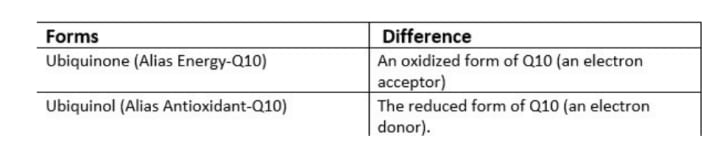
Ubiquinone- The compound is found in every cell of the body, primarily in mitochondria, and the organs with the highest energy requirements — such as the heart, liver, and kidney — have a lot of mitochondria. Energy Q10 triggers the combustion process (food + oxygen) in the mitochondria.
Mitochondria are minuscule factories found in all cells that provide the necessary means to make cellular energy (ATP). Many nutrients help in the process of producing ATP, including B vitamins, cofactors, magnesium, etc. But no other substance can be a substitute for CoQ10. In the absence of CoQ10, there will be no spark and consequently, no production of ATP.
Ubiquinol- (Antioxidant-Q10) donates its electrons to neutralize free radicals. This fact makes ubiquinol work as an antioxidant nutrient to protect against toxic oxidative reactions in the body.
One of the key functions of a molecule like CoQ10 is its oxidation-reduction cycle. The molecule always goes through a process where it accepts electrons and becomes "reduced" and then gives up electrons to become oxidized.
Ubiquinol can permeate through cell walls made of lipids. This helps protect cells and cells membranes from free radical damage. Besides, it protects the energy-producing mitochondria from free radical damage, thereby indirectly supporting energy production.
Ubiquinone vs Ubiquinol
The body requires both forms of CoQ10 to function properly. Some of it is converted to the "other" form so that equilibriums are maintained. It is amazingly easy for the body to convert energy-Q10 into antioxidant-Q10.
Ubiquinol is absorbed in water more easily than ubiquinone supplements, so ubiquinol supplements are considered to have superior bioavailability.
However, when it comes to choosing ubiquinol over ubiquinone, two important factors should be considered.
Expensive: Ubiquinol is a highly unstable compound, and it comes with a higher price tag.
The oldest form: Ubiquinone has been around for a long time as a dietary supplement. More statistics and research are widely available on it.
Ubiquinone is an older and cheaper form of CoQ10. It's just fine for many people.
As stated previously, ubiquinone-Q10 is a form of CoQ10 that is used in mitochondria to help make energy. However, when energy-CoQ10 is not used in cells to make energy, our body readily converts it into antioxidant-CoQ10 and stores it in the middle of the lipid bilayer of the cell membrane for future use.
Reasons for CoQ10 Deficiency and CoQ10 Supplements
- The amount of CoQ10 found in dietary sources isn’t enough for our bodies. CoQ10 supplements are available to maintain the required levels of it in the body.
- As we age, the body's ability to make CoQ10 also declines. CoQ10 levels are lower in people with certain conditions, such as heart disease.
- Excessive exercise and stress tend to trigger the higher consumption of CoQ10. This requires a higher amount of it in the body.
- Many prescription medications such as beta-blockers, statins, and metformin can deplete CoQ10 from your body.
Ramifications of CoQ10 Deficiency
- Less CoQ10 can contribute to free radicals. Since energy is vital to everything, a deficiency of CoQ10 contributes to the ageing process in all systems in the body, especially internal cellular health and those body systems that rely heavily on energy production (heart, liver, brain, and muscles).
- The body needs energy in order to function and stay healthy. With an adequate energy supply, the ageing process can be delayed and many chronic diseases can be prevented.
- If energy deficiency continues, free radical production may accelerate, which will further aggravate the shortage of CoQ10.
- The heart is one of the hardest-working organs in our body. It requires a steady supply of energy.
- When CoQ10 levels drop, the tissues start burning fuel inefficiently. This causes oxidative damage and eventually loses its function. When the heart muscle loses its fuel efficiency, heart failure may occur.
Cautions
- CoQ10 Supplements are generally considered safe when taken as directed.
- CoQ10 is coagulating (to help blood clot) in nature because it is like vitamin K.
You should seek a doctor’s advice if: ·
- You are pregnant. ·
- You are breastfeeding. ·
- You are taking blood-thinning drugs, such as warfarin.
Final Words
Energy and antioxidants are two vital elements in maintaining our body's health to enhance longevity. CoQ10 plays dual roles: it is part of the energy production team and is an antioxidant.
About the Creator
Rafi Muqaddar
I have a Master degree in Information Security and a second in Applied Informatics. I like to read a lot of blogs and books and then share what I learned with others to help make them feel more informed.
Keep reading
More stories from writers in Longevity and other communities.
Day 4 of Quitting
If this is how sobriety feels, maybe it’s better to go through life a little buzzed… this, along with other hits like, I want to kill myself, I wish I was dead, and I’m going to throw myself off a bridge have been the only thoughts on rotation these past few days. I promise myself that if, in a month, I still feel like this (‘this’ meaning despondent, full of rage, and simultaneously numb) I can go back to smoking. Until mid-February though? Nicotine is off the table.
By sleepy drafts15 days ago in Longevity
I Was Smiling Outside, Broken Inside
No one noticed. That’s the part that hurts the most. I smiled at work. I laughed in group chats. I replied, “I’m fine” so automatically that even I started believing it. From the outside, my life looked normal—stable, calm, even happy.
By Fazal Hadi5 days ago in Longevity
Center Stage with Paul Stewart
*** I'm keen to republish the interviews I did for my series with Vocal creators. It's been a few years and I thought it might be nice to revisit these wonderful conversations. I'll be releasing them one at a time for a few weeks/months.
By Heather Hubler7 days ago in Interview



Comments
There are no comments for this story
Be the first to respond and start the conversation.