

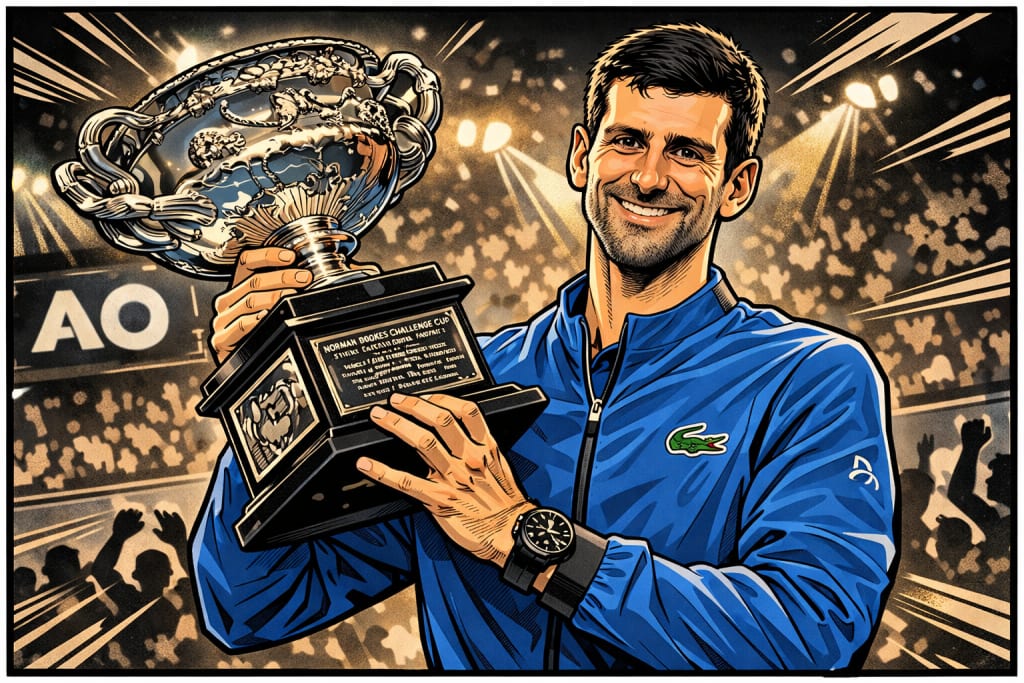
There is something in Novak Djokovic’s gaze that cannot be taught. It is not a pose, nor a media strategy. It is deeper — almost primal — a stillness charged with silent intensity, a focus that seeks neither approval nor aesthetic grace, but survival. This look is not performative. It is inherited. In Melbourne, when he returns to the Australian Open, his eyes arrive before he does. They announce intent. They say everything before the first serve is even struck. Djokovic does not step onto the court to join a celebration of tennis. He enters an inner arena — one where time, pain, and memory collide.
His story does not begin with trophies or statistics, no matter how dazzling they’ve become. It begins in a fractured world — in Serbia during the 1990s, a country torn by war, where childhood was shortened by sirens in the night, shortages at every corner, and a constant hum of uncertainty. Play was a luxury; resilience, a necessity. In that chaos, tennis was never just a game. It became an escape — not physical, but mental. A discipline that imposed order on disorder. Very early on, Djokovic learned that endurance wasn’t a choice. It was a condition of existence. That lesson, etched into him before adolescence, has never left him. And it explains much of what so many still struggle to understand: his uncanny ability to endure precisely where others collapse.
This point must be emphasized, because it is so often misunderstood. The dominant narrative would have us believe Djokovic became a champion through talent and hard work alone. That’s incomplete. He became who he is because he learned, as a child, that pain is not an accident — it is part of reality. While others encounter suffering only later in life — when their bodies begin to resist, when fatigue becomes a stranger — Djokovic met it early, as a familiar companion. That familiarity changes everything. It reshapes one’s relationship to effort, to frustration, even to failure. It turns constraint into fuel.
Over the years, Djokovic has not merely won. He has transformed. His evolution may be the most radical in modern tennis. His body has become a laboratory; his mind, a field of constant experimentation. Strict nutrition, meticulous recovery, conscious breathing, mental visualization — every detail is refined with near-ascetic discipline, as if a single lapse could unravel everything. A reasonable skeptic might argue that all elite athletes now follow similar protocols — that sports science has standardized excellence. But this objection, however logical, misses the essence of the man. For Djokovic, this discipline is not a luxury afforded by success. It is not marginal optimization. It is existential necessity. He isn’t trying to artificially extend his career. He is striving to remain faithful to an absolute inner demand: to be ready, always, no matter the cost.
That demand also explains why Djokovic divides opinion so deeply. He is not a consensus champion. He has never sought to be. While others fit neatly into comforting narratives, he chooses friction — with norms, with expectations, with his own era. His choices, his stances, his relationship to his body and to authority provoke questions. Some call it stubbornness; others, ego. A more careful reading reveals something else entirely: radical coherence. This is a man who refuses to outsource his sovereignty — even at the price of being misunderstood. Djokovic does not define himself by applause. He defines himself by fidelity — to his principles, to his path, to himself.
Nowhere is this fidelity clearer than in Melbourne. Under the crushing heat, in suffocating humidity, through endless rallies, Djokovic finds his truest expression. Where others see a tournament, he sees territory. The Australian Open is not just another stop on the calendar for him — it is symbolic ground. The Australian nights, the roaring crowds, the matches stretched to the edge of physical collapse — these are his native language. Every victory here feels less like triumph and more like confirmation: he can still converse with pain, still master it, still stay lucid when his body begs him to surrender.
This capacity to endure is not merely physical. It is profoundly mental. Djokovic plays tennis like a strategist in a war of attrition — not just against his opponent, but against himself. He accepts weak moments. He tolerates discomfort. He turns waiting into strategy. Where others chase brilliance, he cultivates patience. Where some want to finish quickly, he is willing to let the battle stretch, convinced that time favors those who know how to inhabit it.
Become a member
Yet the landscape has shifted. Before him now stand two figures of a new generation: Jannik Sinner and Carlos Alcaraz — young, explosive, hungry. Their tennis is direct, intense, spectacular. They strike hard, move fast, seek closure. They embody an era that prizes speed, immediacy, and instant impact. Djokovic plays differently. He plays with time. He bends to absorb, retreats to exhaust, endures to unsettle. Where the young wolves burn bright, he smolders slowly.
This contrast is not only athletic — it is almost philosophical. It stages two visions of the game, and beyond that, two ways of being in the world. On one side: immediate assertion, raw energy, the exuberance of youth. On the other: control, restraint, accumulated wisdom. A skeptic might insist this opposition is doomed — that youth always wins in the end. History seems to support that view. But history is not destiny. It is made of exceptions, of resistance, of figures who refuse to bow to the expected timeline.
One might assume age is weakening Djokovic. Numbers, biology, sporting chronology — all point that way. But Djokovic has never been a player of logic. He is a player of faith — in the existential sense. Faith in his body, in his method, in that early-learned capacity to remain standing when everything urges him to fall. His longevity is not a statistical anomaly. It is a philosophical response to decline. It asserts that self-mastery can delay — if not defeat — the erosion of time.
His record is staggering, almost overwhelming. Titles pile up, records fall, debates rage. Yet none of this captures the core. The essence lies elsewhere — in his relentless return, his willingness to test himself again, his refusal to exit gracefully as long as the inner fire burns. Djokovic doesn’t play to complete a legacy. He plays because playing remains, for him, an inner necessity. With every match, he adds another layer to his story — not as a monument carved in stone, but as a living current. And as long as that story remains open, it disturbs far more than any finished masterpiece ever could.
This perpetual openness is why each of his returns to Melbourne carries such unique tension. Nothing is guaranteed. Every tournament could be his last at this level. Every win could be followed by a fall. Djokovic accepts this fragility. He weaves it into his narrative. While others try to choreograph the image of their farewell, he embraces uncertainty. Perhaps that is his greatest strength: he has never tried to shield himself from reality.
In Melbourne, when he stares across the net, his eyes betray neither fear nor nostalgia. There is only that calm intensity — almost primitive — the look of a man who knows exactly where he comes from and why he is still here. His gaze does not promise victory. It promises battle. The eye of the storm is not one of anger, but of absolute patience. A patience forged in childhood, sharpened by years, polished by trials.
And as long as that gaze exists — as long as that silent focus precedes the swing — Novak Djokovic remains more than a champion. He stands as a challenge to time itself, a living contradiction to the inevitability of decay, a stark reminder that greatness is not only about youth or records, but about unwavering loyalty to an inner standard.
In Melbourne, under Australia’s harsh light, the eye of the storm is still watching.
And as long as it watches, the fight is not over.
JLP
About the Creator
Laurenceau Porte
Chroniqueur indépendant. J’écris sur l’actualité, la société, l’environnement et les angles oubliés. Des textes littéraires, engagés, sans dogme, pour comprendre plutôt que consommer l’information.
Keep reading
More stories from Laurenceau Porte and writers in Longevity and other communities.
We Live Longer, But We Live Sicker
We have gained years. Sometimes entire decades. Thanks to scientific advances, more precise treatments, and systematic screenings, life expectancy has steadily risen. The demographic curves show it clearly: we are pushing death further back, generation after generation. This is an undeniable victory for modern medicine.
By Laurenceau Porte3 months ago in Longevity
The Invisible Full-Time Job: Living With Chronic Pain While Trying to Keep Life Together
Most people think of a job as something you clock in and out of. A defined place where effort produces results. But when you live with chronic pain, you are working a second job every day—one that no one can see.
By Navigating the Worlda day ago in Longevity
Becca
"Everything is so... flat." Denille said stupidly as she looked around her new neighborhood. She looked around at the muted desert where even the smallest sign of life seemed to have given up. The plant life was shrubs that were half cooked by the heat and where there should have been a lawn, a mess of white rocks laid glistening in the sun. Even the sky looked stretched thin, like the sun had ironed it smooth. She’d moved from Riverside, where at least there were hills, but here in Barstow, everything felt baked and brittle.
By Sara Wilson7 days ago in Fiction


Comments
There are no comments for this story
Be the first to respond and start the conversation.