
Australia Cosmetics Market Size and Forecast 2025–2033
Clean Beauty, Digital Innovation, and Premium Personalization Redefine Australia’s Beauty Industry

Australia Cosmetics Market Overview
The cosmetics industry represents far more than appearance enhancement—it is a reflection of lifestyle, self-care, science, and cultural identity. Cosmetics include a wide range of products designed to cleanse, protect, nourish, and beautify the skin, hair, and body, while also enabling self-expression and confidence. From skincare and makeup to fragrances and haircare, the industry continuously evolves by blending innovation with changing consumer expectations.
In Australia, the cosmetics market has emerged as one of the most dynamic segments within the broader personal care industry. Growing consumer awareness, strong purchasing power, and the rapid adoption of digital technologies have accelerated market expansion. The country’s multicultural population has also played a significant role in shaping inclusive beauty standards, creating demand for diverse products that cater to different skin types, tones, and personal preferences.
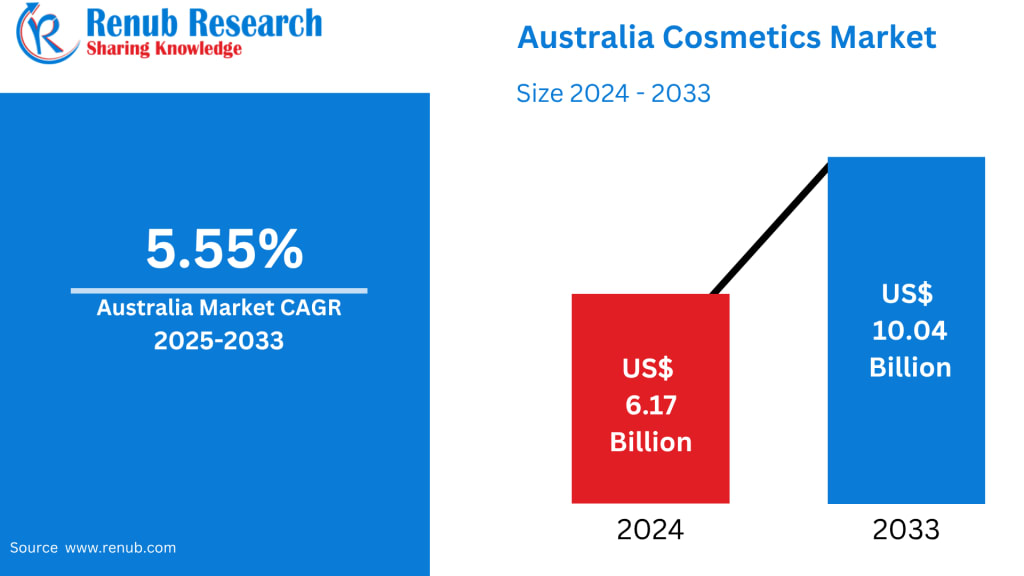
According to Renub Research, the Australia Cosmetics Market is expected to grow from US$ 6.17 billion in 2024 to US$ 10.04 billion by 2033, registering a strong CAGR of 5.55% during 2025–2033. Rising disposable incomes, increasing demand for clean and organic cosmetics, social media influence, and the rapid expansion of e-commerce platforms are the key forces fueling this growth.
Market Size and Growth Outlook (2025–2033)
Australia’s cosmetics industry is transitioning from a traditionally brand-driven market to a consumer-centric ecosystem defined by personalization, transparency, and ethical responsibility. Over the forecast period, premiumization will remain a key theme, with consumers willing to pay more for high-performance, environmentally responsible, and dermatologist-tested products.
Skincare remains the fastest-growing category, supported by sun protection awareness, anti-aging demand, and increased focus on skin health rather than just appearance. Haircare, fragrances, and color cosmetics are also evolving with new formulations, gender-neutral positioning, and hybrid products that combine beauty with wellness.
Digital retail channels will dominate growth, allowing brands to reach customers directly and collect valuable data for product innovation. The combination of lifestyle changes, urbanization, and a strong wellness culture positions Australia as one of the most attractive beauty markets in the Asia-Pacific region.
Key Growth Drivers for the Australia Cosmetics Market
1. Rising Demand for Clean Beauty and Sustainable Products
Sustainability has moved from being a niche concern to a mainstream purchasing criterion among Australian consumers. Shoppers now actively seek cosmetics that are organic, vegan, cruelty-free, and produced using eco-friendly processes. Ingredient transparency and ethical sourcing have become non-negotiable expectations, especially among younger consumers.
Local clean beauty brands such as Sukin, Go-To, and Biologi have set new standards for minimalistic formulations and sustainability-first packaging. These brands resonate strongly with consumers who value authenticity and environmental responsibility. Retailers are also responding by increasing shelf space for clean beauty products and adding online filters that allow customers to search by sustainability attributes.
This shift toward clean beauty is not a passing trend—it is reshaping product development, branding strategies, and supply chain practices across the entire cosmetics industry in Australia.
2. Innovation and Technological Advancements in Beauty Products
Technology is transforming the way cosmetics are developed and consumed in Australia. Brands are investing in biotechnology, skin microbiome research, AI-powered personalization tools, and advanced delivery systems to improve product efficacy and user experience.
Smart skincare solutions, including personalized serums and data-driven routines, are becoming increasingly popular. Ingredients such as peptides, ceramides, and post-biotics are being used to deliver targeted results, while sustainable lab-grown alternatives reduce environmental impact.
A notable example of innovation occurred in March 2024, when Medipledge entered the Australian market with clinically supported skincare products designed to repair the skin barrier after cosmetic procedures. The brand introduced advanced ingredients such as PDRN, GP4G, and Centella Asiatica, highlighting the market’s shift toward science-backed, outcome-driven skincare.
3. Rapid Expansion of E-Commerce and Digital Channels
The digital transformation of beauty retail is one of the most powerful growth drivers in Australia’s cosmetics market. Consumers increasingly prefer online shopping due to convenience, wider product variety, and access to global brands. Social media platforms, beauty influencers, and content creators are playing a pivotal role in shaping consumer preferences and driving purchase decisions.
Virtual try-ons, AI skin analysis tools, and personalized recommendations are enhancing online shopping experiences and building stronger customer relationships. Many brands are adopting omnichannel strategies, integrating physical stores with digital platforms to provide seamless customer journeys.
E-commerce has also enabled smaller and independent brands to compete effectively with multinational corporations by reaching consumers directly, reducing costs, and building loyal online communities.
Challenges in the Australia Cosmetics Market
1. Intense Market Competition
The Australian cosmetics industry is highly competitive, with a mix of global giants, regional brands, and local startups all competing for consumer attention. Product differentiation has become increasingly difficult as many brands offer similar formulations and claims.
To stay competitive, companies must invest heavily in innovation, branding, and digital marketing. This intense rivalry puts pressure on profit margins and requires continuous product launches, collaborations, and rebranding efforts. Maintaining customer loyalty in such a crowded environment remains a major challenge.
2. Growing Price Sensitivity Among Consumers
Although Australian consumers value quality, rising living costs are making them more price-conscious. Shoppers are carefully evaluating price-to-value ratios and often switching brands if similar quality is available at a lower price.
This trend forces companies to balance premium positioning with affordability. Brands must optimize supply chains, adopt cost-effective manufacturing methods, and introduce flexible pricing strategies without compromising quality or sustainability standards.
Recent Developments in the Australia Cosmetics Industry
March 2025: U.S.-based skincare brand Hydrinity announced its entry into the Australian market through a partnership with Device Consulting. The collaboration focuses on introducing advanced skincare solutions through medical aesthetics clinics and cosmetic professionals.
October 2024: Sephora Australia revealed plans to open three new stores in Adelaide, Melbourne, and Brisbane. These outlets feature immersive beauty experiences, live events, and digital beauty tools, further intensifying competition in the premium cosmetics segment and strengthening Australia’s retail beauty ecosystem.
Australia Cosmetics Market Segmentation
By Product Type
Skin and Sun Care Products
Hair Care Products
Deodorants and Fragrances
Makeup and Color Cosmetics
Others
By Gender
Men
Women
Unisex
By Distribution Channel
Supermarkets and Hypermarkets
Specialty Stores
Pharmacies
Online Sales
Others
Skincare dominates the market due to Australia’s climate, high UV exposure, and strong awareness of sun protection. Meanwhile, men’s grooming and unisex beauty products are witnessing rapid growth, reflecting changing social norms and greater acceptance of self-care among male consumers.
Key Players in the Australia Cosmetics Market
The competitive landscape is characterized by the presence of global corporations with strong brand portfolios and distribution networks. These companies invest heavily in R&D, digital marketing, and sustainability initiatives to strengthen their market position.
Leading companies include:
Coty Inc.
Procter & Gamble
Colgate-Palmolive Company
Johnson & Johnson Services Inc.
Revlon, Inc.
Beiersdorf Group
Kao Corporation
LVMH
Mary Kay Inc.
Each company is analyzed across four strategic dimensions:
Company Overview
Key Persons
Recent Developments and Strategies
Sales Analysis
Future Outlook: What Lies Ahead for the Australian Cosmetics Industry
The future of the Australian cosmetics market is set to be shaped by personalization, sustainability, and digital engagement. Consumers will continue to demand products that align with their ethical values while delivering visible results. Brands that combine scientific innovation with transparency and emotional storytelling will gain a competitive edge.
Artificial intelligence, augmented reality, and data analytics will play a larger role in product development and consumer engagement. At the same time, eco-conscious packaging, refillable systems, and carbon-neutral manufacturing will become industry standards rather than differentiators.
With steady economic growth, a digitally connected population, and a strong wellness culture, Australia will remain a high-potential cosmetics market throughout the forecast period.
Final Thoughts
The Australia Cosmetics Market is entering a transformative phase driven by clean beauty, technological innovation, and digital-first consumer behavior. With a projected market value of US$ 10.04 billion by 2033, the industry presents significant opportunities for both global brands and local innovators. Companies that embrace sustainability, personalization, and omnichannel strategies will be best positioned to succeed in this evolving beauty landscape.
As consumers redefine beauty through health, authenticity, and individuality, Australia’s cosmetics market is set to become a benchmark for modern, responsible, and innovation-driven growth.
About the Creator
jaiklin Fanandish
Jaiklin Fanandish, a passionate storyteller with 10 years of experience, crafts engaging narratives that blend creativity, emotion, and imagination to inspire and connect with readers worldwide.
Keep reading
More stories from jaiklin Fanandish and writers in Longevity and other communities.
United States Huntington’s Disease Treatment Market Size & Forecast 2025–2033
United States Huntington’s Disease Treatment Market Outlook The United States Huntington’s Disease (HD) Treatment Market is entering a transformative growth phase, fueled by rapid innovation in neurogenetics, expanding clinical trials, and rising awareness of rare neurological disorders. According to Renub Research, the market is projected to grow at a CAGR of 15.22% from 2025 to 2033, reaching US$ 552.5 million by 2033, up from US$ 154.38 million in 2024.
By jaiklin Fanandish4 days ago in Longevity
Day 4 of Quitting
If this is how sobriety feels, maybe it’s better to go through life a little buzzed… this, along with other hits like, I want to kill myself, I wish I was dead, and I’m going to throw myself off a bridge have been the only thoughts on rotation these past few days. I promise myself that if, in a month, I still feel like this (‘this’ meaning despondent, full of rage, and simultaneously numb) I can go back to smoking. Until mid-February though? Nicotine is off the table.
By sleepy drafts15 days ago in Longevity
I Was Smiling Outside, Broken Inside
No one noticed. That’s the part that hurts the most. I smiled at work. I laughed in group chats. I replied, “I’m fine” so automatically that even I started believing it. From the outside, my life looked normal—stable, calm, even happy.
By Fazal Hadi5 days ago in Longevity
Smart phones, Humans and Aliens.
WARNING. I will be tapping into one of your favorite creative tensions: The absurdity of humans worshipping their glowing rectangles as if they were tiny oracles. There’s something deliciously poetic about that contradiction, and it lends itself beautifully to an instructive proviso.
By Novel Allen6 days ago in Poets


Comments
There are no comments for this story
Be the first to respond and start the conversation.